PulihGo Leads STEI ITB Students to First Place in the Health Track at Garuda Hacks 7.0
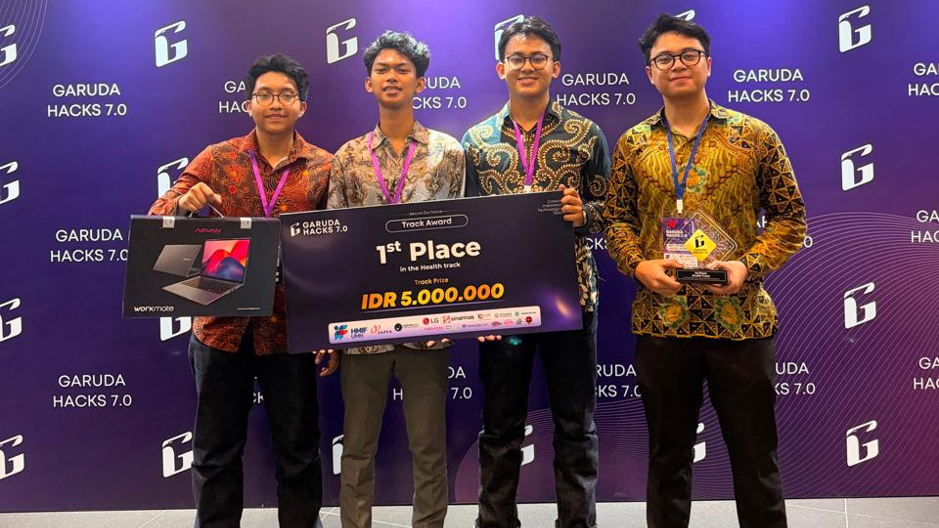
Bandung, stei.itb.ac.id – A team of students from the Informatics Study Program at STEI ITB won first place in the Health Track category at Garuda Hacks 7.0 through PulihGo, a home-based stroke rehabilitation application that utilizes a smartphone’s gyroscope sensor. The competition was held from 16 to 18 July 2026 at Universitas Multimedia Nusantara in Tangerang, Banten.
The PulihGo team consisted of four 2025 Informatics students: Raditya Wibian Sastaka as the tech lead and researcher, Rafi Pradipta Andira Sulistyo in charge of the technical architecture, Sulthan Dhiyazka Suwandi as the user interface designer and front-end developer, and Muhammad Adnan Kurniawan, who was responsible for preparing the pitch deck.
PulihGo was developed as a supporting application for stroke survivors undergoing independent rehabilitation exercises at home. To use the application, patients attach a smartphone to their forearm. The device’s gyroscope sensor then measures the angle and range of motion, counts exercise repetitions, and records the quality of each movement.
The exercise data are synchronized with a dashboard accessible to therapists. Through the dashboard, therapists can set exercise targets, monitor patients’ progress, and review rehabilitation outcomes remotely.
The idea behind PulihGo emerged from the team’s concern over the challenges faced by stroke survivors in regaining independence. Based on the research reviewed by the team, many patients experience weakness on one side of the body, making it difficult to perform daily activities such as getting dressed, eating, or turning a door handle.
Motor recovery requires consistent and repetitive exercise, particularly during the early stages following a stroke. However, independent rehabilitation at home is often hindered by limited supervision, a lack of feedback, and repetitive exercises that patients may find monotonous.
The situation is further complicated by the limited number of physiotherapists in Indonesia compared with the number of patients who require rehabilitation. According to data gathered by the team, Indonesia has approximately one physiotherapist for every 35,000 people. This shortage means that a significant portion of the recovery process must take place at home without regular direct supervision.
The team therefore identified an opportunity to transform a device that many people already own—a smartphone—into both a rehabilitation tool and a system for monitoring patient progress.
Rehabilitation exercises commonly involve rotational movements of the limbs. For this reason, the smartphone’s gyroscope sensor can be used to objectively measure changes in movement angles without requiring additional equipment.
In addition to helping therapists obtain exercise data, PulihGo allows patients to see the progress they have made. Visible progress is expected to motivate patients to continue exercising consistently.
Throughout the development process, the team emphasized that PulihGo was not designed to replace physiotherapists. Instead, the application serves as a supporting tool that enables a therapist to monitor more patients, particularly when exercises are performed independently at home.
Therapists remain responsible for setting exercise targets and evaluating patient progress. Meanwhile, the application functions as an additional “set of eyes,” recording patients’ activities on days when direct supervision is not possible.
Safety was also a key consideration from the earliest stages of the design process. The team recognized that exercises that are not suited to a patient’s condition could cause pain or potentially worsen certain conditions.
To minimize these risks, PulihGo is equipped with safe range-of-motion limits, a stop button that patients can use when they experience pain, and an assessment system that prioritizes controlled movement rather than simply rewarding the widest range of motion or the highest number of repetitions.
Given the limited development time, the team chose to test the most technically challenging component first: ensuring that the gyroscope sensor could measure arm rotation angles accurately, consistently, and reliably on an actual device.
Measurements of movement angles, repetition counts, range of motion, and movement smoothness are processed directly on the smartphone. The team then connected the patient application and the therapist dashboard through a shared database.
This integration allows exercise targets set by therapists to be received directly by the patient’s application. Conversely, the results of the patient’s exercises can be sent back to the therapist for review.
PulihGo was also developed using an offline-first approach. This allows patients to continue their exercises even when an internet connection is unavailable. The data can then be synchronized once the device reconnects to the network.
According to the team, one of the main challenges during the competition was integrating the patient application and the therapist dashboard into a single, seamless system. With limited time available, the team chose to focus on one type of movement that could be measured and demonstrated accurately.
The decision to limit the project’s scope ultimately became one of PulihGo’s strengths in the eyes of the judges. Rather than presenting numerous partially developed features, the team focused on refining a core solution that could be tested and demonstrated directly.
This achievement reflects the ability of STEI ITB students to combine an understanding of healthcare challenges with technological development and user-oriented solution design. Through PulihGo, the team has introduced not only a smartphone sensor-based innovation, but also an approach to supporting stroke rehabilitation that is more measurable, safe, and connected to healthcare professionals.