SafeTrip Innovation Leads STEI ITB Students to Victory in the Safety Track at Garuda Hacks 7.0
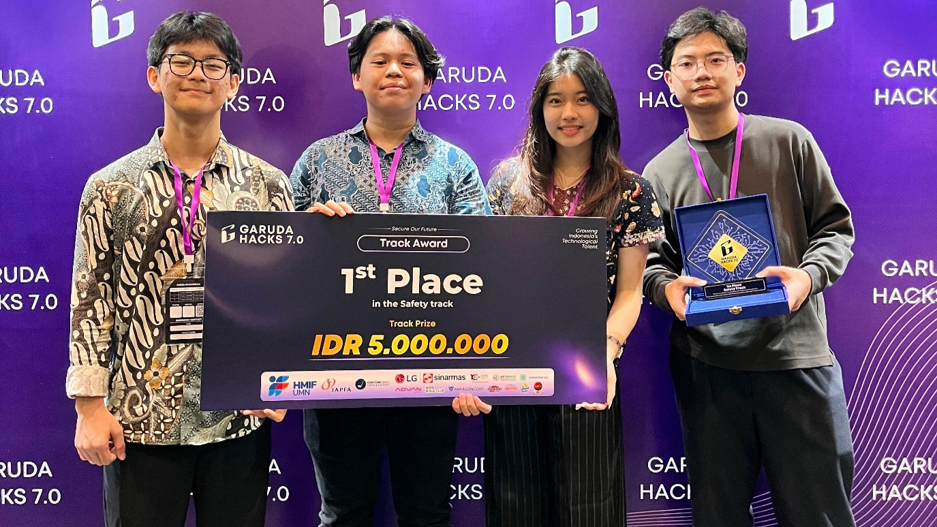
Bandung, stei.itb.ac.id – A team of students from the School of Electrical Engineering and Informatics at the Institut Teknologi Bandung (STEI ITB) won the Safety Track category at Garuda Hacks 7.0. The hackathon was held from July 16 to 18, 2026, at Universitas Multimedia Nusantara in Tangerang, Banten.
The achievement was secured through an innovation called SafeTrip, short for Safety for Transit Response and Investigation. The technology-driven solution was designed to help public transportation operators detect safety risks and trace incident-related evidence more efficiently during investigations.
The SafeTrip team consisted of Abel Gani, who was responsible for product development; Athilla Zaidan Zidna Fann, who served as the AI engineer; Jason Edward Salim, who worked as the full-stack engineer; and Tiffany Viriya C., who handled the financial and business aspects of the project.
SafeTrip was developed in response to persistent safety concerns within public transportation systems, particularly incidents of harassment and theft. Such incidents can significantly undermine passengers’ sense of security when using public transit services.
The team observed that the handling of safety incidents in public transportation continues to face several challenges. Operational procedures for processing reports may involve obstacles that delay response times, while incident reporting often relies heavily on the victims’ or witnesses’ recollections and personal descriptions of the perpetrators.
“We chose to develop SafeTrip because incidents of harassment and theft in public transportation have compromised people’s sense of safety in shared public spaces,” Athilla explained.
To address these challenges, SafeTrip employs two primary approaches. First, it helps reduce operational bottlenecks in the incident-response process. Second, it supports reporting and investigation by organizing information about the incident and the perpetrator’s explicitly identifiable characteristics.
Through these approaches, SafeTrip is expected to accelerate risk identification, incident response, and evidence tracing whenever a safety-related event occurs. In the long term, the solution is envisioned for implementation across various modes of transportation and throughout Indonesia’s broader public transit ecosystem.
“We hope this approach can eventually be implemented across Indonesia’s entire public transportation ecosystem to strengthen people’s sense of security when using public transit,” Athilla added.
SafeTrip was developed within approximately 30 hours during the hackathon. In the first few hours of the competition, the team conducted an intensive brainstorming session to identify the issue they wanted to address and determine the most suitable solution.
Several different ideas emerged during the discussion. Ultimately, however, the team agreed to focus on public transportation safety and develop SafeTrip for the Safety Track, as they considered the issue highly relevant and not yet fully resolved.
Once the central concept had been established, each team member carried out responsibilities aligned with their respective areas of expertise. A clear division of roles enabled the team to work simultaneously on product development, artificial intelligence implementation, system engineering, and the project’s business and financial components.
“Within the 30-hour timeframe, we were able to complement one another’s responsibilities and complete all the required deliverables effectively,” Athilla said.
The team’s previous experience in several hackathon competitions also helped them establish priorities and manage their limited time effectively. Technical challenges that arose during the development process were addressed through close coordination and a well-structured distribution of tasks.
According to the team, their success was closely tied to their ability to determine which features needed to be completed first. In a time-constrained competition, carefully managing the product scope became one of the key factors in ensuring that the solution could be developed and presented effectively.
Despite having prepared thoroughly and worked seriously on SafeTrip, the team said they did not place excessive expectations on winning the competition. Instead, they sought to enjoy every stage of the event and regarded the hackathon as an opportunity to learn, experiment, and test their abilities.
When SafeTrip was announced as the winner, surprise was the team members’ immediate reaction. They later viewed the achievement as the culmination of a long journey shaped by the experience and lessons gained from participating in previous competitions.
“When we were announced as the national champions, our first reaction was naturally one of disbelief and surprise. Nevertheless, we see this victory as the result of the sustained hard work and learning we have accumulated through previous competitions,” Athilla said.
SafeTrip’s success at Garuda Hacks 7.0 demonstrates the potential of STEI ITB students to develop technologies that are not only innovative but also grounded in real-world societal challenges. Through collaboration across multiple areas of expertise, technology can be transformed into a meaningful solution that contributes to a safer, more responsive, and more trustworthy public transportation system.