The ITB-Unpad Team Creates a Hippotherapy Simulation Tool for Children with Cerebral Palsy
Observing a child's growth from birth is crucial for parents. This is essential to quickly detect any health or developmental issues in the child. One such condition that can be detected in children from an early age is cerebral palsy. Cerebral palsy is a condition that affects movement and coordination.
This condition is caused by impaired brain development, usually occurring while the child is still in the womb. Children with cerebral palsy require regular therapy. One type of therapy that can be used is horseback riding.
To help children with cerebral palsy undergo therapy, a team of lecturers from the Bandung Institute of Technology (ITB) created an innovation in the form of a hippotherapy simulation tool.
Horse riding therapy for people with cerebral palsy
According to Wildan Trusaji (Faculty of Industrial Technology) from the ITB team, horseback riding therapy for children with cerebral palsy is a common and widely practiced therapy abroad. However, in Indonesia, this model of therapy is still rare. Therefore, the ITB team collaborated with researchers from the Faculty of Medicine, Padjadjaran University (Unpad)/RSHS to create a horseback riding simulator for children with cerebral palsy.
"Riding simulation training serves as a modality that can be used in equestrian training programs by directly imitating riding movements," Wildan Triaji told Kompas.com on Monday (November 8, 2021).
Apart from Wildan, the team involved in developing this hippotherapy simulation tool includes Ardianto Satriawan (Computer Engineering Research Groups), Muhammad Ogin Hasanuddin (Computer Engineering KK) and Syaiful Hammam from ITB.
Apart from ITB lecturers, there were also ITB students involved, namely Alfa Tazlia and David Azaria Rauf.
Meanwhile, the team from the Department/KSM of Physical Medicine and Rehabilitation, FK Unpad/RSHS, namely Ellyana Sungkar, Septia Susanti Rahadini and Mayang Cendekia.
Benefits of horse riding therapy: Wildan explained that horse riding training for children with cerebral palsy has benefits, namely improving coordination, gross motor skills, and improving static and dynamic balance.
According to Wildan, this exercise is used as an intervention to help improve motor skills in patients with central nervous system disorders such as cerebral palsy, stroke, spinal cord injury and Down's syndrome.
When a child with cerebral palsy rides this simulator, the horse's lower body acts as if the child is walking. "So, when riding this simulator, it stimulates the patient's brain to think of walking normally. This therapy also trains the muscles," Wildan explained.
Horse riding therapy is recommended for people with cerebral palsy because when a child rides a horse, the movement of the horse's hind legs is most similar to when a human walks.
Received a grant from LPIK ITB
With horseback riding therapy, the hope is to simulate hip, left and right leg, and spinal movements similar to those of a normal child when walking. However, live horseback riding therapy is expensive and difficult to maintain. So, a team from Bandung Institute of Technology (ITB) and Padjadjaran University (Unpad) came up with the idea of creating this hippotherapy simulation device.
This innovation, a collaboration between ITB and Unpad researchers, has successfully received a 2021 Innovation Strengthening Grant from the ITB Innovation and Entrepreneurship Development Institute (LPIK).
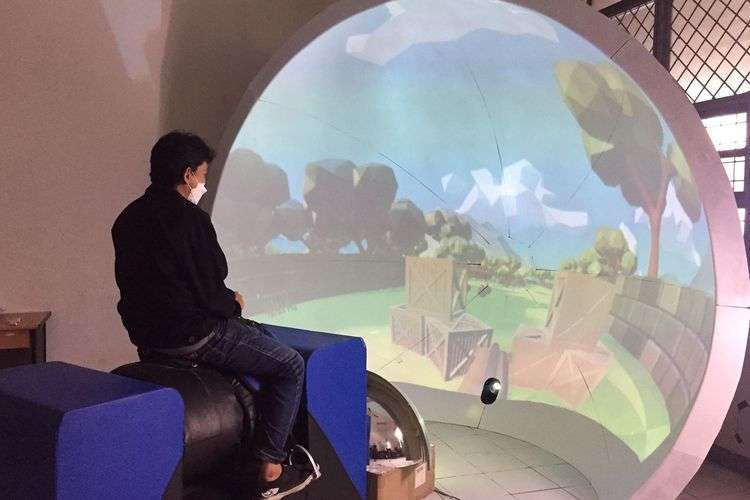
The simulator not only created a horse riding simulation device, but also included other features to ensure therapy sessions were not boring. The researchers added a dome screen so that patients could experience the sensation of riding a horse while enjoying the natural scenery.
Terapi sekaligus bermain game
Ardianto Satriawan, a lecturer from the Computer Engineering Study Program at STEI ITB, added that through this tool, he and his team wanted to combine physical and virtual therapy.
He explained that the horse frame on the simulator is equipped with a hydraulic motor designed to resemble the horse's four legs. While riding the simulator, children are given a vest that detects their movements, such as left, right, forward, and backward.
According to him, the dome screen has undergone extensive development. Meanwhile, the prototype itself is planned to be further refined for commercialization, as it will be offered in hospitals, clinics, and privately.
Furthermore, the dome screen offers a wider range of uses. Its concave shape creates a realistic impression of being outdoors. This allows for outdoor simulations such as cycling, train driver simulations, and driving simulations.
"This dome screen is used to keep children from getting bored during therapy sessions. It adds a visual aspect of the outdoors and games for children to play. The game on this screen is an apple circus. Children retrieve fallen apples by tilting their bodies so the horse simulator moves in the direction the apple falls," he concluded.
Although it hasn't been tested directly on children with cerebral palsy, the dosage of horse riding training and simulation training varies across studies. According to a 2014 study by Elshafey and colleagues, the simulation training intervention consisted of three 30-minute sessions over three months.
Before use, this tool will undergo safety and standardization tests by the Health Facility Safety Center (BPFK) of the Ministry of Health of the Republic of Indonesia before being applied for the first time to children with cerebral palsy.
"We hope the pandemic will end soon so this simulator can be tested on children with cerebral palsy," he concluded.
This article has been published on Kompas.com with the title "ITB-Unpad Team Creates Hippotherapy Simulation Tool for Children with Cerebral Palsy"
Penulis : Mahar Prastiwi
Editor : Dian Ihsan