
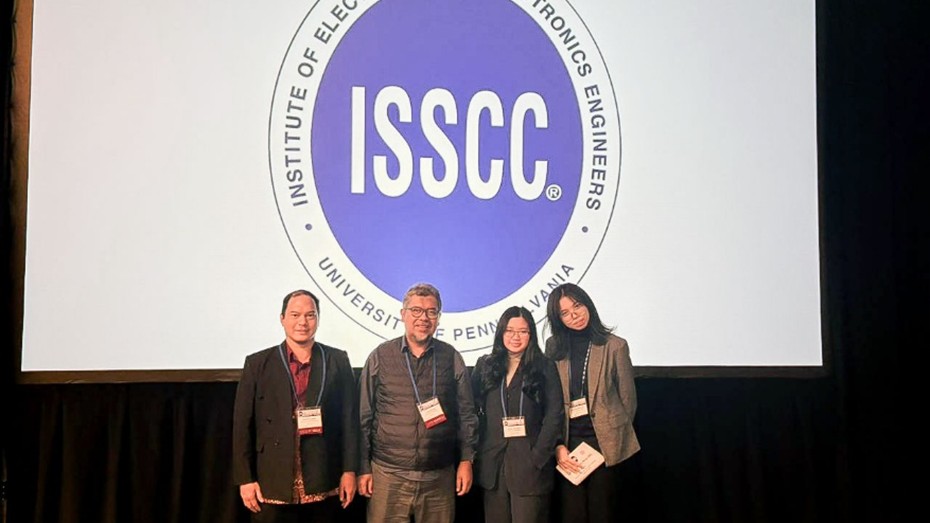
Award-Winning Healthcare-Oriented Analog Chip Innovation Reaches the Global Stage at ISSCC 2026
Bandung, stei.itb.ac.id — An international achievement has once again been earned by a student of the School of Electrical Engineering and Informatics, Institut Teknologi Bandung. Angelina Wahyuni Selva (EL’23), together with her team, received an award in the Code-a-Chip competition as part of the IEEE International Solid-State Circuits Conference (ISSCC) 2026, one of the most prestigious forums and competitions in the world in the field of integrated circuit (IC) design. Code-a-Chip in the IEEE series International Solid-State Circuits Conference (ISSCC) 2026, one of the world's most prestigious forums and competitions in the field of integrated circuit (IC) design.
Code-a-Chip is an IC or chip design competition, especially on the analog track, which is based on Open-Source Ecosystem Code-a-Chip is an IC or chip design competition, particularly focused on the analog track, built upon an open-source ecosystem with non-paid licenses. Unlike conventional approaches that rely on manual chip layout design, the competition requires participants to use Python Notebook and open-source Process Design Kits (PDKs). Through this approach, analog chip layouts can be programmatically generated using code, resulting in a design process that is more automated, efficient, and standardized. Python Notebook And Process Design Kit (PDK) Open-SourceThrough this approach, analog chip layouts can be generated programmatically using code, resulting in a more automated, efficient, and standardized design process.
In this project, Angelina Wahyuni Selva (EL’23) was responsible for designing the core amplifier, including sizing and floor planning through intensive team discussions, as well as the overall analog system integration and schematic development. She collaborated with Aleta Edna Jessalyn (EB’23), who contributed to the integration of the ESD section, chopper switches, and the low-pass filter (LPF) switched capacitor, including schematic design. core amplifier, termasuk proses sizing And floor planning through intensive discussions with the team, as well as the integration of the entire analog system and schematic development. He collaborated with Aleta Edna Jessalyn (EB'23) who contributed to the integration of the ESD section, chopper switches as well as low-pass filter (LPF) switched capacitor, including the schematic aspects.

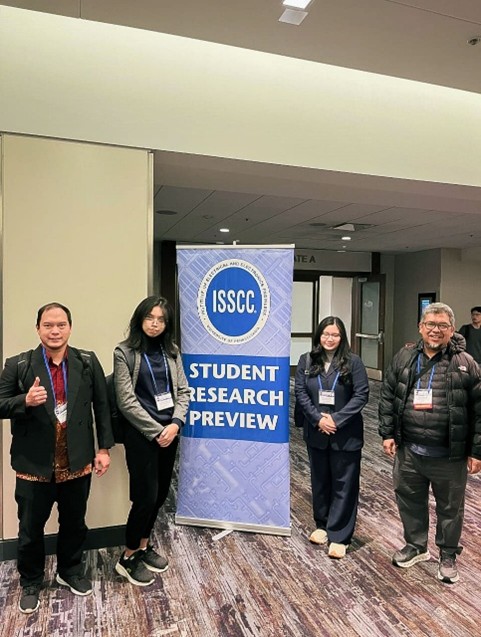
Abdillah Aziz from the PME Lab played a key role in developing the method. chopper switches, namely a technique for converting DC components into signals in the form of rectangular, and also support the process floor planning, sizing LPF and schematic preparation. Other contributions came from Keisya Andretta Basoeki (EB'23) who was involved in the development chopper switches, inverter and some schematic parts.
The team was supervised by Dr.Eng. Ir. Infall Syafalni, S.T., M.Sc., who oversaw the development of the digital clock divider component, fully implemented using the open-source digital design flow OpenLane.
The submission period took place in October 2025, although early submissions were permitted. The project development ran almost concurrently with Chipathon 2025 in July 2025. The entire competition was conducted online, requiring strong discipline and solid team coordination amid the technical complexity of analog IC design.
The decision to participate in Code-a-Chip at the IEEE International Solid-State Circuits Conference was driven by the recognition that ISSCC is one of the most prestigious competitions and forums in the global IC design community. For the team, participation was not merely about competing, but about testing their analog and IC design capabilities against international standards and receiving direct evaluation from global industry experts and academic leaders.
As a second-year Electrical Engineering student, Angelina acknowledged that the challenge was considerable. Many advanced topics in analog IC design had not yet been fully covered in her coursework, although the fundamental concepts had been introduced in several classes. To address this challenge, she and her team independently learned how to use the provided tools and deepened their understanding of analog IC design methodologies, including amplifier design and chopping techniques.
This achievement reflects not only the team’s perseverance and technical capability, but also demonstrates the readiness of STEI ITB students to contribute to the open-source semiconductor ecosystem and compete at the international level.