
STEI ITB Explains How Intelligent Transport Systems (ITS) Work in Indonesia
In connection with the 101st Anniversary of Higher Education in Indonesia, STEI ITB held a webinar on July 3, 2021. The webinar, held on July 3, 2021, was divided into two sessions. The first session presented how technology plays a role in the transportation system in Indonesia, presented by speakers Prof. Ir. Emir Mauludi Husni, M.Sc., Ph.D. and Dr. Ivan Kristianto Singgih, ST., MT. The topic presented in this webinar was Living Laboratory of Intelligent Transportation Systems in Indonesia: Research and Startup.
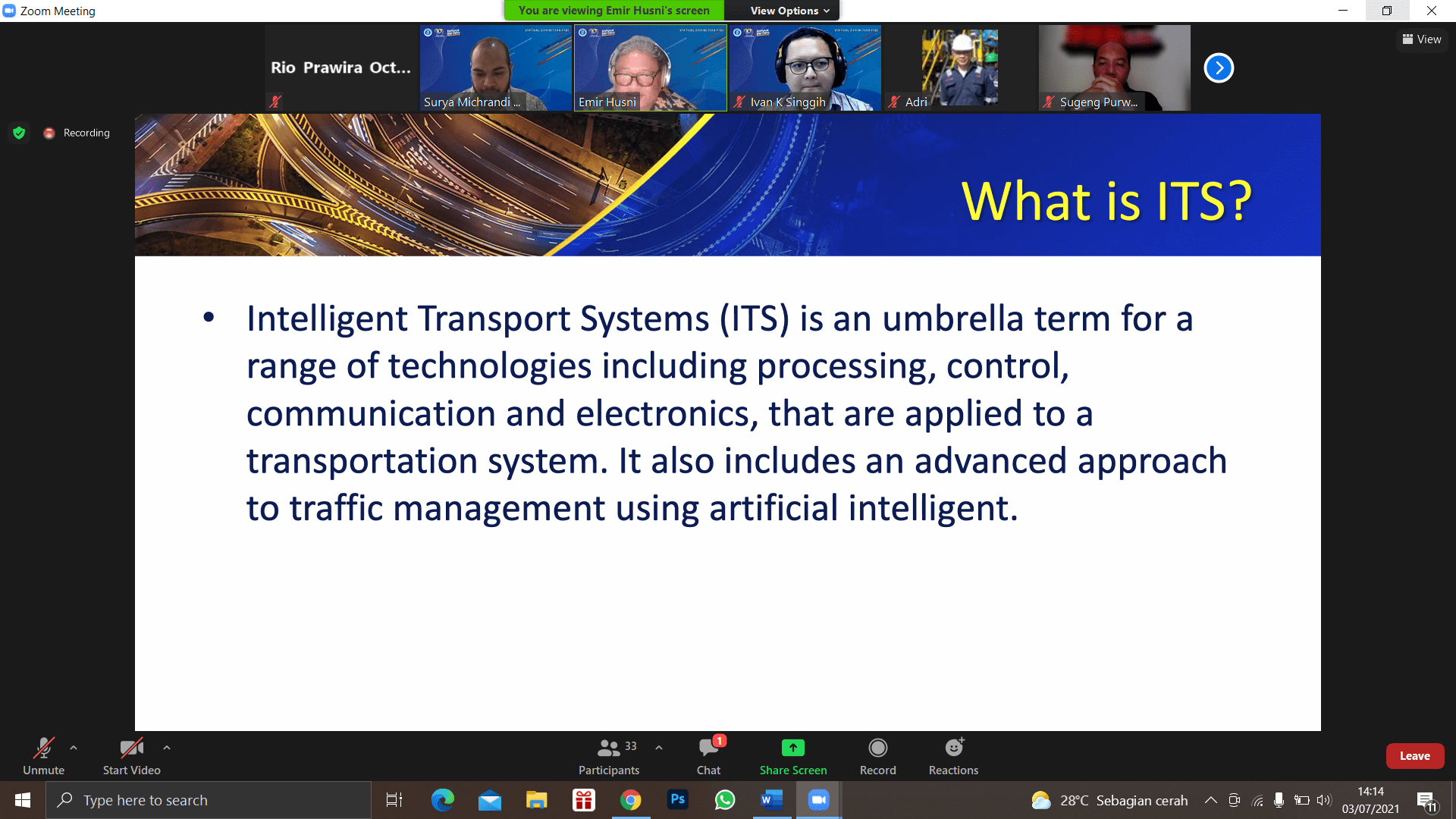
Intelligent Transport Systems (ITS) is a general term for a range of technologies, including processing, control, communications, and electronics, applied to transportation systems. ITS also includes advanced approaches to traffic management using artificial intelligence (AI).
ITS is needed to meet the needs of several sectors. First, government, which includes traffic management and guidance, road planning, early warning, and bus monitoring and management. Second, the corporate sector, which includes vehicle scheduling, real-time accident warnings, and commercial data analysis. Third, public service users, which includes detailed geographic information services, accurate real-time road conditions, accurate traffic information services, and real-time vehicle information services.
The sensors used to detect road conditions utilize CCTV. They generate data on traffic congestion by counting the number of cars and motorcycles passing on the road, as well as the average speed of road users. Undeniably, some roads lack CCTV, so sensors are replaced by applications like Google Maps or Waze, which of course require collaboration. In addition to vehicles, this system also functions for pedestrians, especially during the COVID-19 pandemic, supporting social distancing programs.
"The data sent from smart CCTV isn't images. Streaming video would require a significant amount of bandwidth. Therefore, a minicomputer is provided to calculate the data density and speed, reducing the bandwidth, similar to sending an SMS," explained Prof. Ir. Emir Mauludi Husni, answering questions from webinar participants.
Road traffic prediction using machine learning was also explained: heterogeneous traffic flow, which ultimately creates differences in the systems for motorcycles and cars. So, it's no surprise that motorcycles can be directed through small alleys.
With this system, route recommendations also arise that users can use to reach their destination with the shortest estimated time.
The problem that supports the creation of this system is the accumulation of vehicles, which causes congestion and decreases driving speed. According to Statistics Indonesia (BPS) data, there are 22 million cars and 113 million motorcycles in Indonesia. This has led to a 7.5% increase in traffic congestion. Furthermore, Indonesia was ranked the 7th worst country according to Numbeo in 2019, with an index value of 225.21.
This system uses a Bayes Classifier. This is because it contains statistical data and growth data, which are necessary for growing data.
Weather and time of day influence road congestion. The degree of saturation calculation is used to determine road conditions, as well as the NKJ calculation, which uses parameters such as road conditions, heterogeneity, weather, temperature, humidity, road length, and compatibility. The purpose of this NKJ calculation is to find the best route for users.
The Q&A session illustrated how weather can affect traffic congestion. For example, in Bandung, when the weather is hot, many motorcyclists stop in the shade at red traffic lights. Furthermore, rain also affects congestion levels.
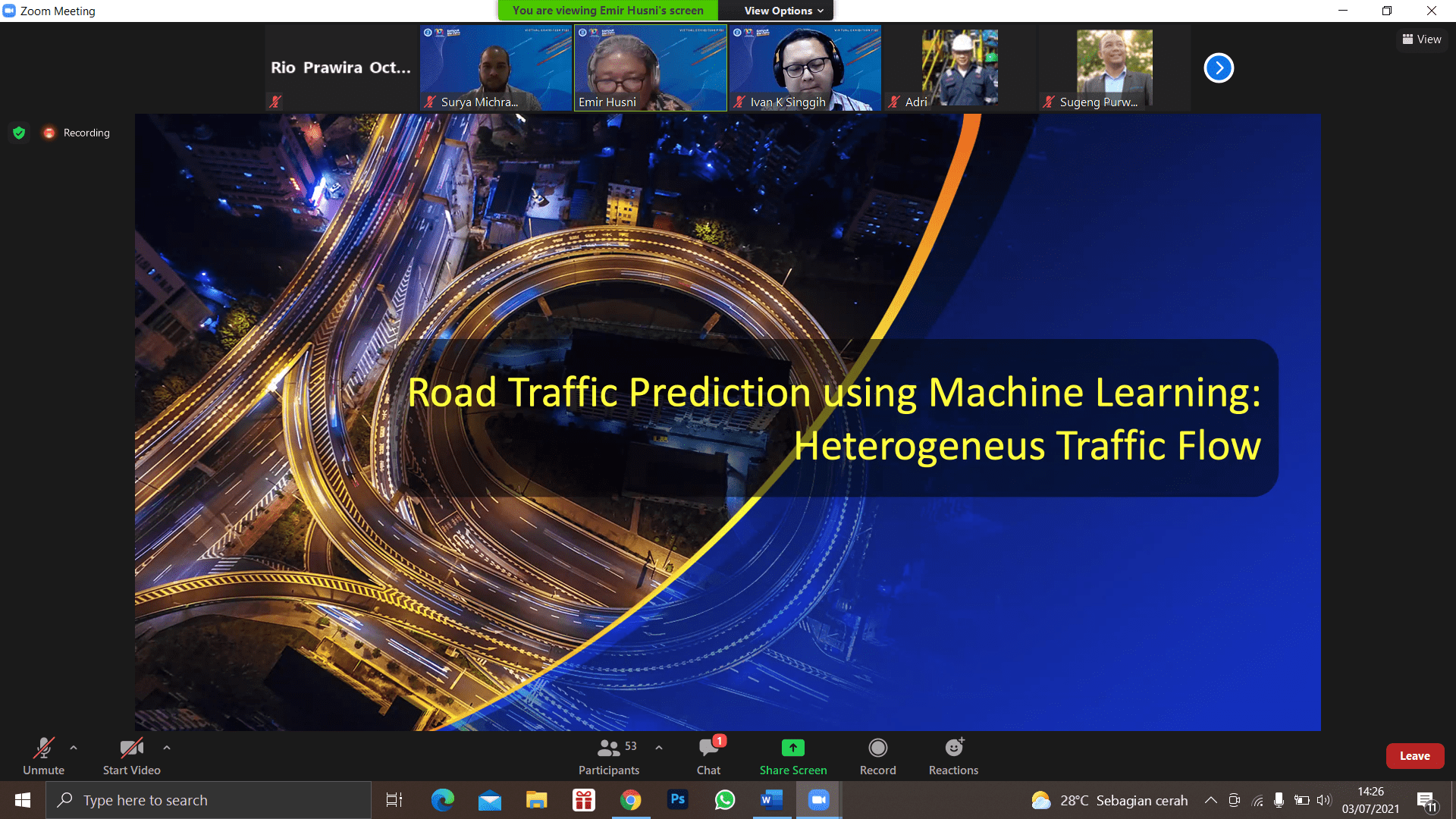
After Prof. Ir. Emir Mauludi Husni, M.Sc., Ph.D. presented his material, Dr. Ivan Kristianto Singgih, ST., MT., continued with a presentation on how traffic light management mechanisms can address existing congestion.
Smart control using sensors and big data will provide information related to traffic lights and driver movements. The goal is to monitor driver movement, regulate traffic flow to reduce congestion, and provide route recommendations to drivers through the app. This monitoring is expected to help drivers reach their destinations in a shorter time, reducing congestion.
"In Korea, they use the Related Studies with Traffic Control using RL method. They examine the effects of traffic light settings (times). They determine whether increasing them can reduce congestion. This is being continuously tested," said Dr. Ivan Kristianto Singgih.
During the Q&A session, the webinar participants were clearly enthusiastic about the topic. This was evident in the numerous questions they asked, making the webinar atmosphere more lively.
This event can also be watched on the STEI Youtube Channel: