Yudistira Dwi Wardhana Asnar, S.T, Ph.D: Open Data Plays an Active Role in Government
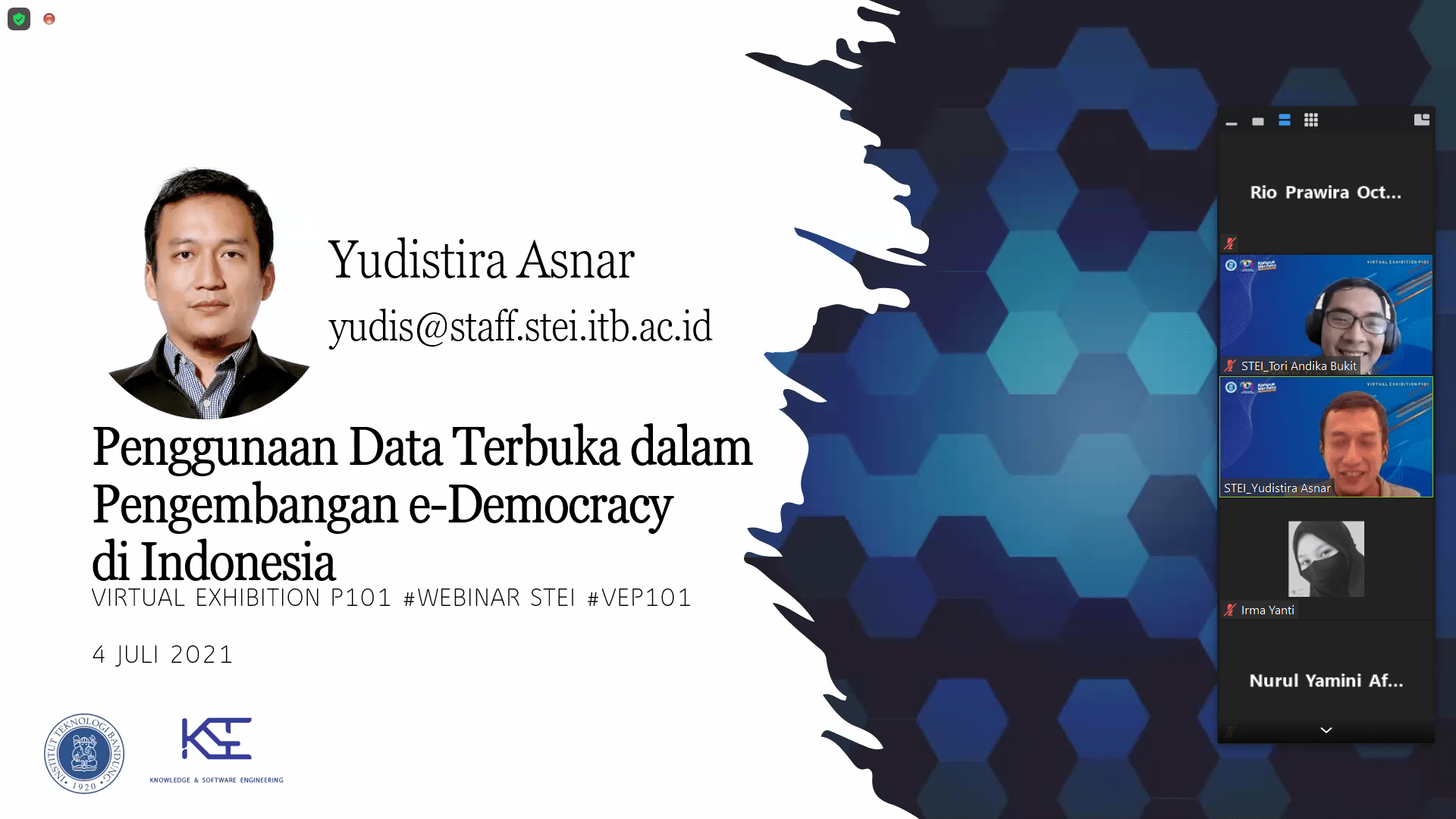
The PTTI 101 STEI webinar closed with a webinar entitled “The Use of Open Data in the Development of e-Democracy in Indonesia” by Yudistira Dwi Wardhana Asnar, S.T., Ph.D., a lecturer from KK Software Engineering and Knowledge ITB. In general, this webinar will explain how the democratic system in Indonesia is supported by electronics.
Open data is public data that can be accessed, enabling it to achieve several functions, such as enabling the public to create new businesses by analyzing data-based patterns and trends. Furthermore, open data can increase public trust in government. Open data is not limited to governments; businesses and organizations are also now implementing open data practices. The data used in this open data is legally valid.
“Open data "There should not be any additional data that is only for that data," he stressed, as the main speaker.
In open data, there are 5 levels as follows.
- 1-star : Data is available on the web in any format, open license
- 2-star : Structured data that machine-readable
- 3-star : Structured data that machine-readable in non-proprietary format
- 4-star : Menggunakan open standards from W3C
- 5-star : Connecting one data to another to provide various information
The origins of this open data stem from the regulation in Presidential Decree No. 96 of 2018 – SPBE concerning public information transparency. Furthermore, the desire to maintain a positive image and gain active citizen participation in development are other factors that contribute to the open data.
The 2014 election website is shown, the data of which is still incomplete. machine-readable Because it uses PDF format, the data could only be processed by machine in 2019. Since the 2019 election, it has moved to 3 or 4 stars.

"In 2020, data was not collected by scanning, but rather by taking photos directly from TPS by KPPS. This results in a higher level of accuracy and reliability," said Yudistira Dwi Wardhana Asnar.
The data displayed to the public is made as attractive as possible with the format data visualization. The data is formed into a form analytics with various graphics and colors that depict something.
The challenges that must be faced are outlined. First, data preparation still requires technical support and requires a lot of manual work. Second, some agencies have different coding systems for entities, such as for cities/districts. Third, the quality and relationships between data are crucial in gaining knowledge or insights.
At the end of the presentation session, it was announced what projects were currently being worked on, namely. Expands the data analytics beyond “election” And build series of prototype of voting systems such as electronics, internet, and blockchain-based)
In this way, elections are only one indicator of democratic practices. Furthermore, data disclosure is only the first step in fostering active public participation in development, and open data also opens up opportunities for research and business development.
This webinar can also be watched on the STEI ITB Youtube channel: