Menjaga Unicorn Indonesia

Jakarta Are you, me, and all of us increasingly convinced that significant changes in people's behavior have already occurred, transforming the socio-economic map of the country as 2018 has just begun?
Let's take a look at the research data from the Sharing Vision e-Commerce Survey, conducted in October-November 2017 with 808 respondents.
Average household spending on online shopping has surpassed offline spending. For example, online fashion is now Rp 594,000 compared to Rp 690,000 offline; cosmetics are Rp 237,000, surpassing the Rp 221,000 offline; and hobby books and collectibles are Rp 316,000 compared to Rp 239,000 offline.
Offline shopping that is still good is wholesale shopping at Rp. 687 thousand or more than online at Rp. 652 thousand, food and beverages at Rp. 323 thousand (Rp. 255 thousand), and mobile phones at Rp. 4.61 million (Rp. 3.86 million).
Our respondents, mostly in large cities, also stated that online methods have dominated their daily lives. For example, 90% of flight bookings, 87% of online transportation, and 60% of prepaid credit purchases are made through apps.
Furthermore, we estimate that the number of official stores on marketplaces has grown by 300%, with sales consistently increasing three-fourfold annually. In fact, one national marketplace has released annual sales figures reaching tens of trillions of rupiah!
So, at this starting point, the author draws the initial conclusion that Indonesia in general and big cities in particular are in a strong current of shifting from offline platforms to online platforms. A massive crossover.
This is also what has enabled Gojek, a unicorn less than 10 years old, to grow incredibly rapidly. It now has 2,900 employees in three countries, 65 million users, 1.2 million driver partners, 300,000 merchants, and a presence in 75 cities from Aceh to Manado.
This achievement is on par with and just as phenomenal as a number of other unicorns, including Tokopedia, Traveloka, and Bukalapak. Our focus as a nation, of course, is to ensure the interests of the nation are always safeguarded during this tremendous phenomenon.
Besides that, we have to ensure that small and medium enterprises and wong cilik we predict that at least 10 million people are involved in this phenomenon crossover This way, they can maintain their sustainability as micro-entrepreneurs. Self-reliance must be protected in this country!
War Between World
We all know that after cellular operators, the unicorn sector and its derivatives have also become a target for foreign investors. As a country with internet users exceeding 50% of its population (260 million), this market share is truly enticing. See the table below.
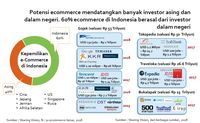 |
From the table above, we can see the tendency of foreign investors to be eager to enter the country. This is the embodiment of the concept of the current discourse of war (war between world) that we must face together, when the competition for interests in the information and communication technology (ICT) sector is getting tighter.
If we don't limit these external investors who don't have a lot of money and protect their business corridors, then they will always be ready to become the majority owners of the various unicorns above. That is also what is always possible which is their big motivation.
If these giant foreign investors simply have free rein to operate in the country without providing beneficial local added value, then we will once again be condemned to become a super-fat market that can only watch the success of foreign ICT players.
Let's ensure that this never happens. Their capital injection should be limited to a maximum of 49%, or they should never become a majority shareholder. If that happens, capital flight in mobile operators could repeat itself.
Therefore, relevant regulators should address this issue not only in terms of application penetration, but also actively regulate and strictly supervise to ensure that the majority of shares in Indonesia's proud unicorns never move abroad!
If this basic principle is not carried out, believe that this modern war will be extinguished by us (fire fighting) when the embers expand or even burn fellow citizens as we have experienced.
We certainly expect more than that, not regulators who are always gasping for breath to extinguish horizontal conflicts, but a government that provides a third way – to borrow the term of scientist Anthony Giddens– to war between world what is happening.
Third way This refers to a thorough and accurate understanding of the problem. Stakeholders' competing interests, resulting in conflicts being mapped out, impacts being predicted well in advance, and decision-making being at the top of the hierarchy because the substance of the problem is already comprehensive.
Sharing Vision also asks for the government's position (stance) Which ajeg From the start, not just deciding on an attitude after being pressed by circumstances. But always being visionary, to then determine stance Justice that balances national benefits and global roles. Hopefully.
*) Penulis, Dr. Dimitri Mahayana is a lecturer at STEI-ITB and Chief of the Sharing Vision Telematics Research Institute, Bandung. Taken from detikdotcom.