
The Story of an Electrical Engineering Alumni Becoming a Young Teacher in Indong Village (2) "Residents Still Care Less About Education"
This article tells about an Electrical Engineering alumni STEI – ITB therefore I added the title from the original article title. The article is divided into 4 parts, telling the story from the beginning of how to become one of the participants in Indonesia Mengajar to the experiences shared with the children in Indong Village. Of course, STEI is very proud that one of his alumni is able to dedicate himself to this nation. Hopefully, this article can inspire anyone who reads it. (source: Kompasiana)
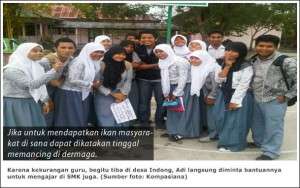 "I really felt at home. For the first three months, I felt like I was at home." Adi replied when I asked him what it was like to live in Indong village. The placement areas for Young Teachers (PM) are generally in remote areaThe village where Adi teaches is located on Mandioli Island, one of the most remote islands in South Halmahera, North Maluku Province. When he first departed from Jakarta, Adi spent a four-hour flight, then an eight-hour boat trip with an overnight stay, and then a six-hour motorboat journey.
Indong Village is located on the coast. However, the majority of residents earn a living by farming copra, corn, and other types of plants in the forests around the mountains. According to the man who was once active in the Indonesian youth organization AIESEC, Indong Village is inhabited by around 1,300 residents with around 300 heads of families (KK). Regarding educational facilities, there are only 2 PAUD, 1 SD, 1 SMP, and 1 SMK with a very limited number of teachers. Adi said that SD Indong only has 6 teachers including himself. Meanwhile, 3 teachers each work at SMP and SMK. Due to the limited number of teaching staff, Adi's initial "duty" as PM, namely teaching the children of SD, immediately increased as soon as he arrived in the field. "As soon as I arrived, I was immediately asked to help teach English and computers because they enggak "I have (a teacher). So now I also help teach at SD, SMP, and SMK," Adi said.
Adi is challenged to adapt to his current residence, which is vastly different from Jakarta. In Indong village, electricity is only available for four hours at night, and even then, it requires a generator. Adi's home also lacks a television. To watch broadcasts on the screen, he must visit a neighbor's house, the village head's, or wait for an opportunity. plesir Arriving in the city. Television broadcasts have become a rarity for Adi. "You can count the number of times I watch TV in a month," he said.
Signal isn't something that comes easily either. While in Jakarta he's "besieged" by various methods, media, and communication tools, or by seeking information, in Indong village, that's not the case. Adi gave the example of having to go to the fields to get a signal. The area around his house or school is nearly unreachable. Adi explained his daily life there, "Basically, from waking up to going back to sleep, it's completely different (from Jakarta)."
Despite living in a limited environment, Adi admits to falling in love with the food in Indong village. Due to its coastal location, fish is a nearly daily side dish. Often, it's served with a mouth-watering chili sauce. Yes, while locals can practically catch fish off the pier, chilies can also be obtained simply by picking them in their gardens. "So every day there's fish and chili sauce. It's delicious," Adi said.
Keramahan penduduk
Furthermore, the friendliness of the residents was another factor that made Adi feel at home in Indong village. When he first set foot there, many residents welcomed him and treated him to local specialties. Adi also learned many stories about the culture of the predominantly Muslim village. He was even told about the mystical stories prevalent there and invited to religious study groups.
Living in a region where the community has traditionally lacked awareness of higher education, Adi strives to bring about change through his own actions. The culture of "graduating or failing doesn't matter, as long as you can read, write, and count" remains deeply rooted. He realizes that untangling this tangle requires a more hands-on approach with students, teachers, parents, and the local education office.
The first thing he did was create a more communicative teaching method. "My class was the noisiest of all. Suddenly, someone would start shouting, singing, and cheering," Adi said. Recognizing this "potential," he created a learning method that made the children happy. Adi tried to ignore the habit of teachers who would just come in, write on the board, tell the children to take notes, and then "let them go" and make their own noise. One of the things he did was teach his students to greet each other while dancing and singing. This method was effective in getting the children in other classes interested. Several teachers began to try similar methods. Adi continued his story, "My class was only separated by a board, enggak "There's a door, so suddenly a lot of kids from the next class come into my class. 'Why are you so noisy? Why are you singing?'" Furthermore, Adi doesn't limit himself to teaching in the classroom. He often takes his SD Indong students to do hands-on practicals in the wild.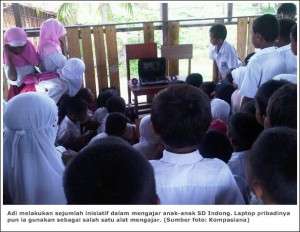
Adi also tries to approach parents directly. He once visited the home of one of the students' guardians. There, he found the parents tended to be "lax" in supervising their children. "I saw them think, 'It's okay, it's my child. If he's naughty, just hit him.' Once their children go to school, they think the important thing is that I've given them a home and a place to sleep. It's quite difficult to change that," Adi explained.
Not stopping at students, teachers, and parents, Adi also built credibility with the local education department. Through initiatives to create science olympiads and... . for children SMK, track record Positive results are starting to emerge. In the changes he's trying to implement, Adi believes the local Education Office is beginning to see that the Young Teachers in South Halmahera Regency are truly working. From there, Adi and his colleagues are starting to be trusted to help organize work meetings. "Relying on lower-level officials doesn't work. That's why we're trying to go directly to the district level. Thank God, after six months, input-input "We can get into their ears," Adi concluded.