
The story of an Electrical Alumni becoming a Young Teacher in Indong Village (1) "Don't Just Curse the Darkness"
This article tells about an alumnus of Electrical Engineering STEI & ITB, therefore I added the title from the original article title. The article is divided into 4 parts, telling the story from the beginning of how to become one of the participants in Indonesia Mengajar to the experiences shared with the children in Indong Village. STEI is certainly very proud to have one of its alumni who is able to provide service to this nation. Hopefully, this article can inspire anyone who reads it. (source: Kompasiana)
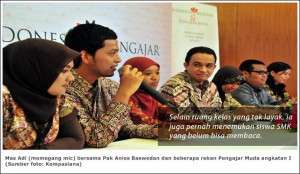 Rahman Adi Pradana He has everything he needs to live comfortably. Adi—as he is usually called—grew up in a big city and was able to earn two bachelor's degrees simultaneously in a timely manner. In 2009, he graduated from Electrical Engineering Study Program, STEI – ITB with a GPA of 3.28 and the Faculty of Economics, Padjadjaran University with a GPA of 3.66. Adi was climbing the career ladder at a prestigious multinational company in Jakarta before deciding to take part in the Indonesia Mengajar (IM) selection in 2010. It all started when he found a “calling” after reading an IM advertisement in a newspaper. The young man, born on April 10, 1986, then “turned” and set his mind to become a Young Teacher (PM). Adi passed the selection. Currently, he is halfway through fulfilling his noble task as PM in a remote area, specifically in Indong village, South Halmahera Regency, North Maluku. Adi admitted that he feels at home and enjoys his role as “Teacher” for children on a small island that only has electricity for 4 hours every day.
There is nothing wrong with Adi's work in the field marketing Before he quit and decided to join as a Young Teacher (PM), Adi said, "Actually, I think my job is cool, fun. challenging." At the company, various targets, almost all of which were measured numerically, often required Adi to work at 120 percent effort. This made him very challenged. However, after some time, Adi often felt something was missing from his routine. "From there, I started to feel anxious mode on"That's it," continued the young man born in Padang.
IM's advertisement in the Kompas daily newspaper then led Adi to find out more about the PM selection process. He "discovered" it through a mailing list. letter to young Indonesians written by Anies Baswedan. "I feel like Mr. Anies is like ngomong "Immediately. For 25 years of my life, it seems right, my life has been truly enjoyable. I've been able to study at two universities, I can work like this. The thought of living for others is nothing," Adi said. Anies Baswedan's letter made him even more determined. "Okay, I'll do this."
With a job at a prestigious company that was already quite stable and had bright prospects, Adi's parents initially doubted their son's decision. However, his desire to contribute to the nation won him over. They ultimately approved his wish. Adi's initial plan was to return to work in the financial sector. marketing after fulfilling his duties as PM. However, six months of teaching in a village on a remote island was an eye-opener. "Here I saw the reality of schools in Indonesia, and it made me want to do something immediately," said Adi. The children of Indong Elementary School ignited his dream of one day establishing a school. From there, Adi's hopes expanded. Not only did he return to work in his former field, but he also wanted to contribute more to education.
Provisions from the Indonesia Mengajar team
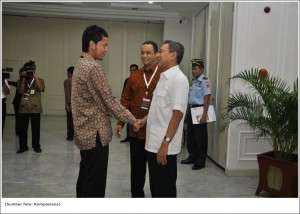 Before departing for their assigned areas, the Young Teachers received eight weeks of training from the Indonesia Mengajar Team. Two main topics were covered: pedagogy (teaching children) and leadership (leadership). Pedagogical materials are primarily provided so that PMs can teach in ways that are more motivating for students and not limited to writing on the board, taking notes, and then providing exercises. Furthermore, PMs are provided with guidance on how to mingle and interact with people in their assigned areas.
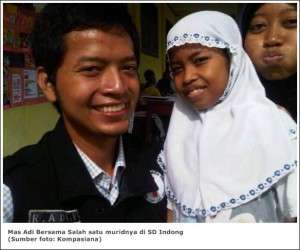
In the field, Adi found a culture that was very different from the one he grew up in. "In Java, they say they are gentle. Maluku children... enggak "You can soften it, sir, you have to hit it," said Adi, imitating the words of a local resident. Furthermore, what Adi also felt was that parents there tended to be more strict to his children. He had an interesting experience. When he first arrived at school, a rattan was already on his classroom desk. Apparently, there, punishing naughty children with rattan was considered commonplace. Even if the children were naughty, they would say, "Sir, hit me with a rattan." "And that's why, from the very beginning, I threw the rattan out the window. They were confused," Adi said. Gradually, Adi tried to make changes. He encouraged the children to learn by paying more attention. He also made learning methods more enjoyable. "For games "There are lots of quizzes, lessons outside the classroom, singing, dancing. That's what ultimately allows them to participate in their lessons," Adi continued.
Before departing for their assigned areas, the Young Teachers received eight weeks of training from the Indonesia Mengajar Team. Two main topics were covered: pedagogy (teaching children) and leadership (leadership). Pedagogical materials are primarily provided so that PMs can teach in ways that are more motivating for students and not limited to writing on the board, taking notes, and then providing exercises. Furthermore, PMs are provided with guidance on how to mingle and interact with people in their assigned areas.
 First time arriving at training centerThe PMs were given a presentation on the declining state of education in Indonesia from Sabang to Merauke, comparing it with other countries. Adi witnessed firsthand the reading, writing, and arithmetic skills of Indonesian children in Indong village, at least in terms of the shortage of teachers. He said, "In remote areas, out of 10 schools, only 6 can... enggak There are teachers. At my friend's place (fellow PM), one school only has 2 teachers, some have 1 teacher, some have 12 teachers, but enggak someone came instead.”
He also discovered that in his teaching environment, there were children in 5th and 6th grade who still couldn't read. There were also those in vocational school who still struggled to produce legible handwriting. Teaching in remote areas of Maluku often made Adi's heart tremble. Sometimes he saw the classrooms where he taught not much different from the school in the film Laskar Pelangi. "The school building where I teach is completely destroyed. When it rains, it floods, so we have to evacuate. And when it's holiday time, there are always goats in the classroom," Adi said.
However, despite these limitations, Adi refused to give up. Two messages stuck with him most during his time at the event: training become a wick of enthusiasm. Even though our educational situation is still in decline, thinking about how to try to contribute to overcoming it is far better than endless complaining. Adi said, "So don't just curse the darkness, but find a way to create light in that darkness. To light a candle. That's what Mr. Anies said." The second message he never forgot came from one of the pioneers of Wanadri (the Association of Jungle Trekkers and Mountain Climbers), Iwan Abdurrachman. "Abah Iwan had sharing "He told us not to treat this task as a sacrifice, but as an honor. (That) we're here to do something meaningful for others," Adi concluded.