STEI ITB Holds Technology Seminar Discussing Hybrid Broadband Strategy for Equitable Digital Access, Presents Academics and Practitioners
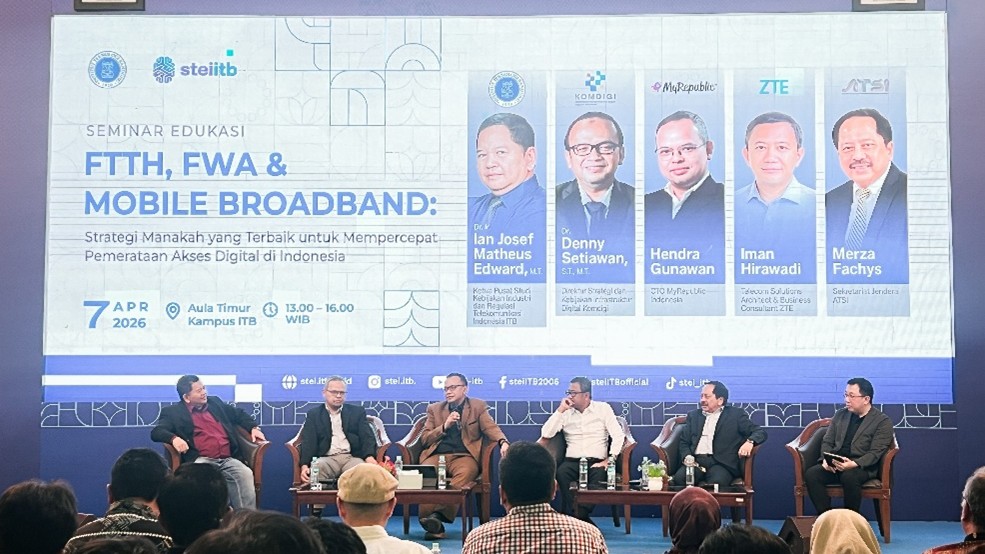
Institut Teknologi Bandung, through the School of Electrical Engineering and Informatics (STEI), reaffirmed its role in advancing technology and digital literacy by organizing a seminar titled “FTTH, FWA & Mobile Broadband: Which Strategy is Best for Accelerating Equitable and High-Performance Digital Access in Indonesia.” The event took place on Tuesday, April 7, 2026, at Aula Timur, ITB Ganesha Campus, and was attended by students, national media, and telecommunications industry players.
The seminar addressed the acceleration of broadband infrastructure development in Indonesia. Three key technologies—Fiber to the Home (FTTH), Fixed Wireless Access (FWA), and mobile broadband—were highlighted as having important roles in expanding reliable and equitable digital connectivity. However, each technology comes with its own characteristics and challenges.
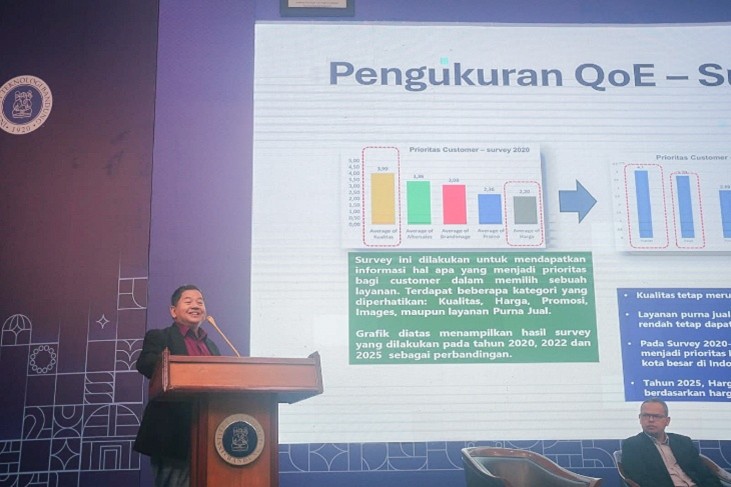
Head of the Center for Industrial Policy and Telecommunications Regulation Studies at ITB, Dr. Ir. Ian Josef Matheus Edward, M.T., stated that no single technology can serve as a universal solution for all national connectivity needs.
“FTTH offers the best capacity and stability, while FWA provides flexibility and speed in deployment"Both must be positioned as complementary solutions," he said.
From the government's perspective, the Director of Digital Infrastructure Strategy and Policy of the Ministry of Communication and Digital of the Republic of Indonesia, Dr. Denny Setiawan, ST, MT, emphasized the importance of equal access as a top priority.
“We encourage broadband development not only in densely populated areas but also in underserved regions. Rollout commitments will continue to be monitored to ensure equitable distribution,” he said.
“FTTH remains the main backbone, while FWA acts as an accelerator in areas not yet reached by fiber, particularly in regions 2 and 3,” he explained.
“FTTH remains the backbone "While FWA acts as an accelerator in areas that have not yet been reached by fiber, especially in regions 2 and 3," he explained.
From the technology provider side, Telecom Solutions Architect and Business Consultant ZTE Indonesia, Iman Hirawadi, said that the FWA ecosystem is currently increasingly mature with the support of 4G and 5G technology.
"The next challenge is achieving economies of scale to make devices more affordable for the wider community," he said.
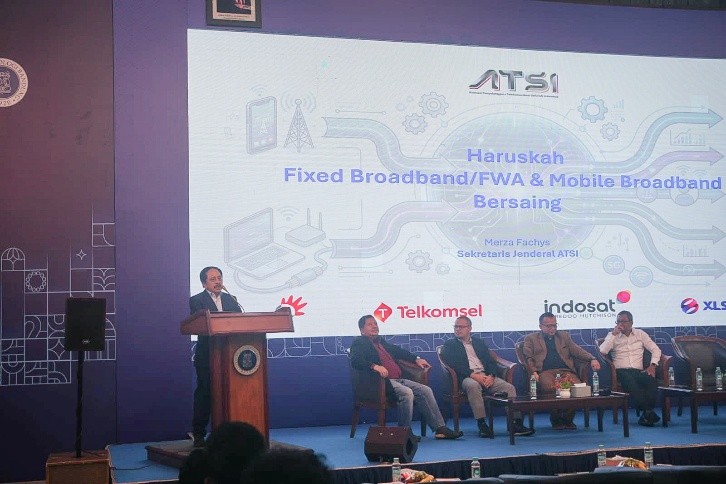
Meanwhile, Secretary General of the Indonesian Telecommunications Providers Association, Merza Fachys, emphasized that each technology plays a distinct role within the service ecosystem.
.Fixed broadband excels in stability, while . “Fixed broadband excels in stability, while mobile offers flexibility. What matters most is how policies can create a balanced and sustainable ecosystem,” he said.
Through this event, ITB provided a discussion platform that brought together academics, regulators, industry players, and technology providers to build a more comprehensive understanding of national broadband development strategies. broadband national.
In addition to serving as a forum for exchanging ideas, the seminar also functioned as an educational platform for students to better understand the dynamics and future challenges of the telecommunications industry.
Through this initiative, ITB hopes to continue contributing to the development of an inclusive and sustainable digital ecosystem, while fostering cross-sector collaboration to expand equitable digital access across Indonesia.