
Stories from the JAIST Internship Program


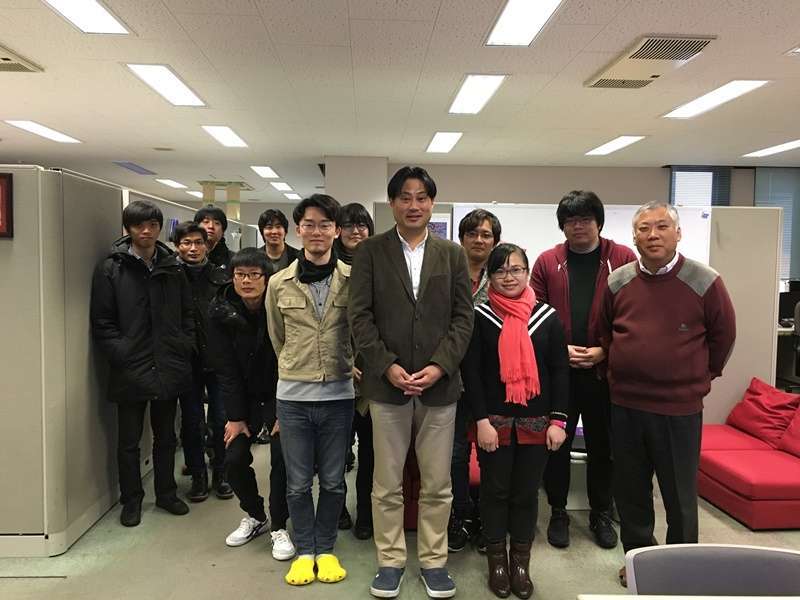
JAIST is one of the research-oriented educational institutions in Japan that operates in the fields of science and technology. Computer and information science is one of the developing technology fields at this university. In January – March 2017, JAIST in collaboration with JASSO (Japan Student Services Organization) invited two ITB Informatics Engineering students, namely Candy Olivia Mawalim (13513031) and Asanilta Fahda (13513079), to experience the learning and research atmosphere in Japan, especially at JAIST.
The topic that the first student worked on was inaudible audio watermarking by using the method phase coding and analysis Gammatone Filterbank. The purpose of this topic is to propose a scheme audio watermarking Which inaudible, robust, And blind berdasarkan persepsi pendengaran manusia. Implementasi skema audio watermarking created using MATLAB.
At the beginning internship, students are given books and several journals related to audio watermarking. In addition, students also take courses on the Human Perception System and its Models, particularly the human auditory system. They also learn basic speech signal processing techniques. After acquiring some basic knowledge, audio watermarking, students try to propose a scheme audio watermarking new one inaudible, robust, And blind. Students make modifications to the technique phase coding which uses transformation Fourier with analysis Gammatone Filter.
During the activity internship At JAIST, students successfully created a scheme audio watermarking with technical modifications phase coding using Gammatone Filter analysis. System audio watermarking which is made using MATLAB tools. In general audio watermarking is an activity to add a message related to an audio object to the object without being known by others. There are four requirements that must be considered in this. audio watermarking, among others inaudibility, blindness, robustness And high embedding capacity. Audio watermarking used to protect copyright, authenticate content, monitor distribution and copy arsip audio.
There are several basic techniques used in audio watermarking, namely modification least significant bit, phase coding, spread spectrum, cepstrum domain, wavelet domain, echo hiding, And histogram-based watermarkingEach of these techniques has advantages and disadvantages. Students focus on the techniques phase coding because this technique is related to the perception system in human hearing. However, this technique has a weakness in that the resulting sound quality is very poor. watermark The resulting product is also very vulnerable to attacks. Therefore, in this research, students proposed a technique audio watermarking by modifying the parts that may cause the weakness. Students modify the transform used to decompose the audio signal from the Fourier transform to the Wavelet transform (Gammatone Filterbank).
This research is able to produce a scheme audio watermarking Which inaudible. However, the technique for detecting watermark that exist in the audio archive still need to be developed because the Gammatone Filterbank transformation used results in the phases before and after resynthesis being significantly different which results in watermark The detected phases are significantly different. This phase difference can be seen in the following image.

Figure 1. Phase comparison between the original audio archive, watermark and detection results.
Research topics worked on by the second student during internship is a classification of Amazon review sentiment using techniques .. The goal of sentiment classification is to classify reviews into positif or negatif berdasarkan polaritas opini penulis ulasan. Eksperimen . this is done using library Hard for Python. Before working on the main research, there were several other tasks that were done to gain a better understanding of neural network, among others experimenting with implementation 2-layer neural network for the classification of written numbers from MNIST database, melatih academic writing by writing a report entitled "Comparison of Methods for Word Prediction", and do the practice questions neural network for Machine Learning classes. Sentiment classification research is divided into two main stages: experiments on text representations as input neural network, and experiments on various models deep neural network.
In this research, experiments on text representation use three different types of representation: word index sequence, one-hot vector. word embedding. In addition, the use of word embedding divided into five different types: word embedding layer from the untrained Hard, word embedding word2vec which has been trained from the Google News corpus, word embedding self-trained word2vec from the Amazon dataset corpus, word embedding GloVe which has been trained from the Twitter corpus, as well as word embedding GloVe trained itself from the Amazon dataset corpus. All four types word embedding last tried with two setting berbeda, statis (word embedding used as fixed weights which has not changed over time neural network training) and dynamic (word embedding used as initial weights which may change during neural network training). Hasil eksperimen menunjukkan bahwa word embedding gives much better results than the word index order and one-hot vector, as well as the use of word embedding dynamically for this matter tends to be better than statically. Although each type word embedding gives almost the same results, word embedding word2vec from Google News gives the best results.
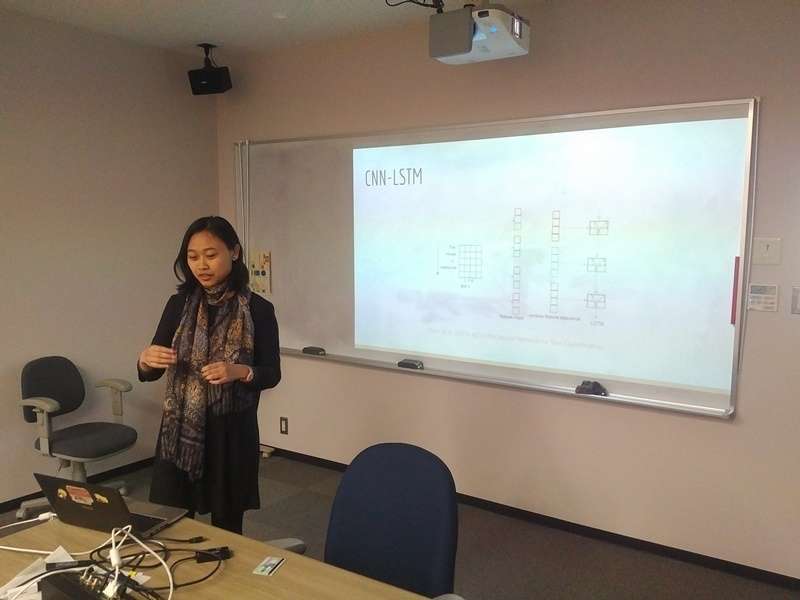
In the second stage, experiments were conducted by implementing several types of neural network, among others recurrent neural network (RNN) which is further divided into simple RNN, long short-term memory (LSTM), and gated recurrent unit (GRU); convolutional neural network (CNN); and a combination of CNN and LSTM (C-LSTM). In the C-LSTM model, CNN is used to extract N-gram features, while LSTM is used to process sequential data. This combination produces the best results. In the future, changes to the main architecture can be made, namely by creating a model that processes reviews per sentence first, with the results being sentiment score per sentence, which becomes the input for the next model. This next model provides the final sentiment results in the form of positif or negatif.
Written by Asanilta Fahda, Informatics Engineering ITB 2013.