
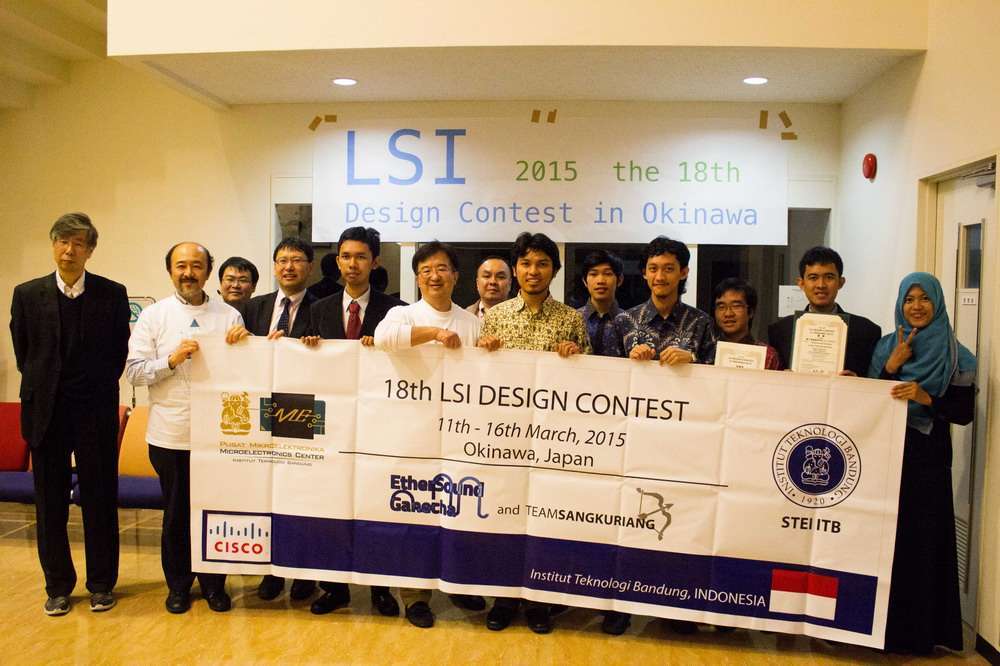
The STEI ITB Team Won First Place Again in the Chip Design Contest in Japan
The Ethersound Ganeca team from STEI ITB successfully won 1st place in the “Smart Info-media System (SIS) Award” on 18th LSI Design Contest, March 13, 2015, in Okinawa, Japan. In the final round held at 50th Anniversary Memorial Hall Department of Computer Science, University of the Ryukyus, Ethersound Ganeca Team successfully beat 11 other finalists.
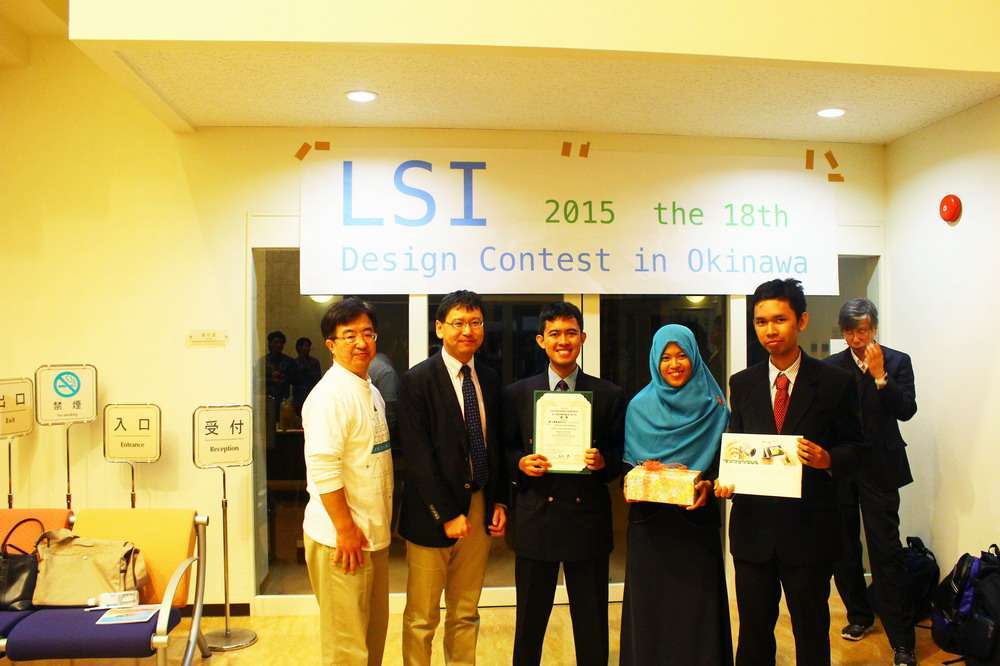
The team consisting of Bagus Hanindhito, Hafez Hogantara, and Annisa Istiqomah Arrahmah submitted a design entitled "Ultrasonic Sensor Based Contactless Theremin Using Pipeline CORDIC as Tone Generator in FPGA”. The theremin is an electronic musical instrument that can be played without having to touch it. This instrument basically uses two antennas to detect the relative position of the hands to control the frequency and amplitude. The Ethersound Ganeca team proposed the idea of replacing the antennas with ultrasonic sensors for hand position detection and CORDIC (Coordinate Rotation Digital Computer) as a tone generation method. The design was implemented on an FPGA board and worked well, successfully impressing the jury and other participants.
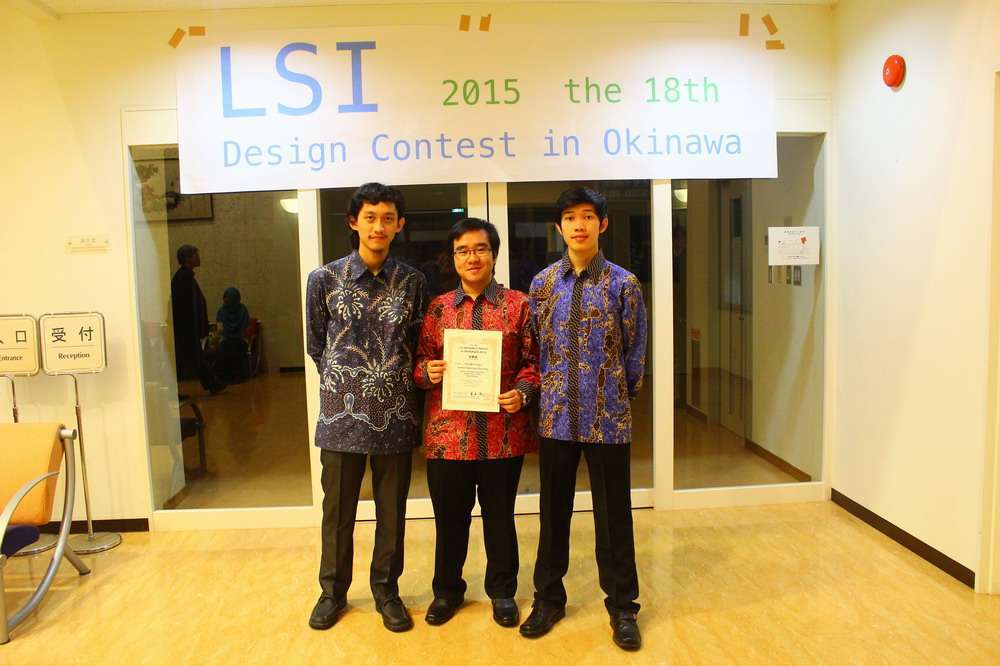
Another finalist from STEI ITB, the Sangkuring Team, also won the “Fighting Spirit Award” for its design entitled “Design and Implementation of CORDIC Algorithm in All-Digital FM Modulator-Demodulator". The team consists of Antonius Perdana Renardy, Ashbir Aviat Fadila, and Naufal Shidqi successfully created a CORDIC-based digital FM (Frequency Modulation) system. FM is the process of changing the frequency of a carrier wave so that it can carry information. FM is widely used in music or voice broadcasting, two-way radio systems, radar, and others. In their presentation, the Sangkuriang Team demonstrated their work by sending music and receiving the same music back through an FPGA board.
LSI Design Contest is an annual chip design contest organized by the University of the Ryukyus, Japan and attended by participants representing universities in Asia. This year's challenge was how to design hardware for calculating trigonometric functions and creating applications. From more than 80 designs submitted, 12 teams were selected to advance to the final round. Indonesia sent two representatives, as did Vietnam, while the rest came from Japan. The STEI ITB team were undergraduate students participating in the EL-4138 VLSI System Design course, supervised by Trio Adiono, Ph.D and Nur Ahmadi, M.Eng. The STEI ITB team, who were undergraduates, were able to compete and beat the Masters team from Chiba University in second place. The jury consisted of professors from the University of the Ryukyus, Tokyo University, Osaka University and representatives of companies such as Synopsys, Gigafirm, and Electronic Device Industry News. The first winner was selected based on the criteria of Academic Excellence, Industrial Applicability, and New Innovation, and was entitled to an award from Smart Info-media System (SIS), one of the largest societies of associations in the field of electronics and ICT in Japan. IEICE.