
Prof. Bambang Riyanto Menjelaskan Perkembangan Penelitian Teknologi untuk Deteksi COVID-19 Berdasarkan CT-SCAN dan X-RAY
BANDUNG, itb.ac.id – The Center for Artificial Intelligence of the Bandung Institute of Technology, through a Webinar Series held on Wednesday, May 13, 2020, explained its latest research on “AI for COVID-19 Detection Based on CT-SCAN and X-RAY.” Prof. Dr. Ir. Bambang Riyanto Trilaksono as a Professor at the School of Electrical Engineering and Informatics (STEI) ITB and Director of the ITB Advanced Robotics Research Laboratory explained the development of the research.
*Dok. Pribadi
"We also know that other testing tools, namely the Rapid Test and PCR (for COVID-19 testing), have been implemented in several countries, including Indonesia. However, these tests still produce false negatives and false positives," explained Prof. Bambang Riyanto regarding the background of this research. He explained that the results of this study will complement other existing types of tests.
Prof. Bambang, who serves as Chair of the Informatics and AI Sub-Taskforce for COVID-19 Detection at the Agency for the Assessment and Application of Technology (BPPT), stated that a study previously conducted in China indicated that CT scans and X-rays could be used to diagnose COVID-19. These techniques have the advantage of being relatively sensitive and can therefore be used to precede laboratory testing for the virus.
Prof. Bambang also stated that we are currently facing a shortage of medical personnel, including radiologists. Therefore, AI can play a role in the identification process of patients suspected of having COVID-19 using CT scan and X-ray results. In general, AI improves the work systems or procedures that radiologists must follow. According to Prof. Bambang, the manual process of detecting COVID-19 on CT scans and X-rays can take up to 15 minutes for a radiologist. However, with the help of a detection system built with AI, this can be done in 1-2 minutes.
AI in this research is applied through machine learning and deep learning. Simply put, Prof. Bambang explained that this was developed from a simple form of computation. This simple computational model is adapted from the workings of neurons in the human brain. Neurons are considered the simplest form of computation in humans.
"One of the objects examined is Ground Glass Opacity (GGO), a mucous membrane that forms in the lungs of COVID-19 patients. This GGO can then be visualized in the processed image to pinpoint the location of the affected lungs, which can then determine their extent. Furthermore, COVID-19 detection also takes into account other aspects such as the position and extent of consolidation," said Prof. Bambang.
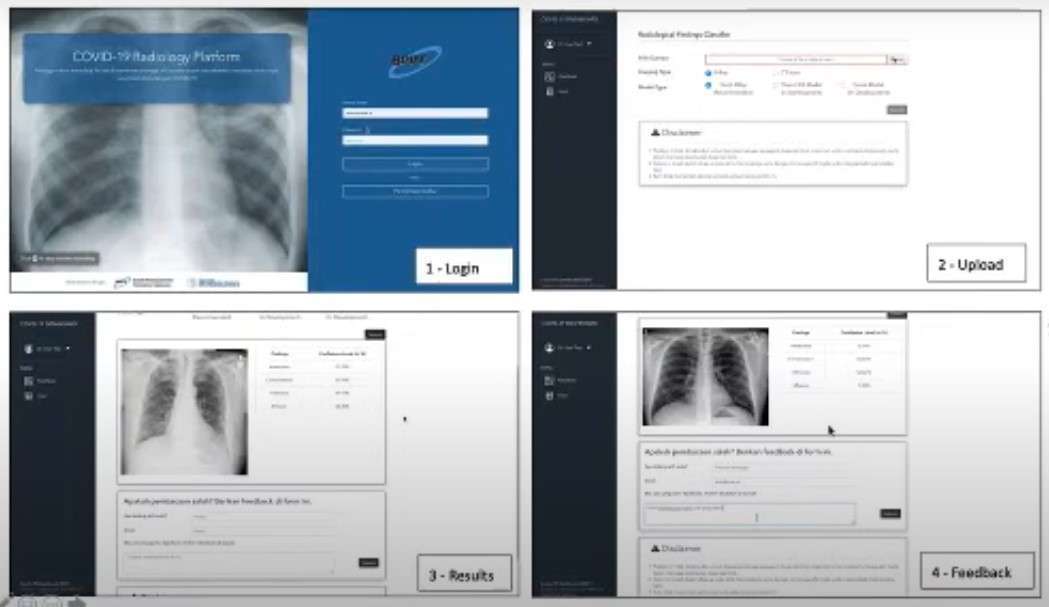
So far, the AI technology developed in this research has a user-friendly interface. However, accuracy in classifying CT scan and X-ray images is still under development. The models created have been trained with online datasets. The machine learning model was developed using a dataset of COVID-19 patients from Italy, which currently contains approximately 160 data sets. However, to improve the accuracy of image processing, CT scan and X-ray results from within the country are still needed.
"We are currently facing a challenge in collecting domestic data sets from hospitals in Indonesia," he said. He explained that the process requires compliance with several factors, such as codes of ethics and the signing of MoUs with relevant hospitals. However, Prof. Bambang has set a target of completing the research within the next month and a half.
Reporter: Irfan Ibrahim (Geodesy and Geomatics Engineering, 2016). This news was previously published on the ITB website.