About the Study Program
The Master of Information Systems and Technology Study Program (Prodi) has a vision of "To become a leading and superior Information Systems and Technology science development study program in Indonesia and recognized internationally and to play an active role in efforts to advance and improve the welfare of the nation." To support this vision, the mission of the Master of Information Systems and Technology Study Program is as follows:
- Organizing higher education and continuing education in the field of Information Systems and Technology.
- Keeping up to date (maintaining) the latest (Following (maintaining) the state of the art and developing Electrical Engineering knowledge through innovative research activities) and developing Information Systems and Technology science through innovative research activities.
- Disseminating knowledge, technology and views/insights on Information Systems and Technology to the community, either through graduates, partnerships with industry or other institutions or through community service activities in order to form a technologically wise society.
Program Objectives
- Graduates will have critical, innovative, and professional thinking aspects to compete globally in the field of Information Systems and Technology.
- Graduates will play a role in developing professionalism in a sustainable manner or successfully continuing their studies to the next level.
- Graduates will have the ability to learn continuously in managing research and innovation activities in the field of Information Systems and Technology, or business development driven by Information Systems and Technology.
Graduate Outcomes of the Study Program
- Students are able to evaluate Information Systems and Technology and provide recommendations for continuous improvement and innovation.
- Students are able to develop knowledge and technology through research and innovation activities in the field of Information Systems and Technology.
- Students are able to communicate effectively in professional and academic contexts at national and international levels.
Options or Preferred Paths
Research and Profession Caster
- Information System Cluster
- Trusted and Smart System Cluster
- Privacy and Digital Forensics Cluster
- Smart Education Technology Cluster
- Digital Services Transformation Cluster
- Digital Security Cluster
Curriculum Structure
The curriculum for the Master of Information Systems and Technology Study Program is designed to be completed within 4 (four) semesters with a minimum of 54 credits, with the following details:
- ITB Compulsory Courses (MKWI): 7 credits
- Compulsory Study Program Courses (MKWP): 18 credits
- Thesis Course: 10 credits
- Elective Courses (MKPB): 19 credits
The Master's Program in Information Systems and Technology does not have any electives. After completing all required courses, students can take elective courses tailored to their professional needs, interests, or thesis research plan or project.
Curriculum Structure of Courses in the Master of Information Systems and Technology Study Program:
| No | Code | Course name | sks |
|---|---|---|---|
| 1 | WI7001 | Digital Literacy, AI, and Academic Ethics | 2 |
| 2 | II5090 | Research Methodology | 3 |
| 3 | II5001 | Intelligent Infrastructure and Platform | 3 |
| 4 | II5002 | System Paradigm | 3 |
| 5 | II5003 | Aplikasi AI | 3 |
| 6 | Elective | 4 | |
| Total | 18 | ||
| No | Code | Course name | sks |
|---|---|---|---|
| 1 | II5004 | Digital Security and Privacy | 3 |
| 2 | II5005 | Data Science | 3 |
| 3 | II5006 | Digital Strategy and Transformation | 3 |
| 4 | II5091 | Thesis 1 | 4 |
| 5 | Elective | 4 | |
| Total | 17 | ||
| No | Code | Course name | sks |
|---|---|---|---|
| 1 | II6091 | Thesis 2 | 6 |
| 2 | Elective | 4 | |
| 3 | Elective | 4 | |
| 4 | Elective | 3 | |
| Total | 17 | ||
| No | Code | Course name | sks |
|---|---|---|---|
| 1 | II6099 | Master's Session | 2 |
| 2 | |||
| 3 | |||
| 4 | |||
| Total | 2 | ||
Registration and Selection of New Students
General Information
The registration schedule for prospective students of the Master Program in Informatics follows the Graduate Program Admission Schedule of ITB for Semester I of the 2025/2026 academic year, which can be accessed at: https://admission.itb.ac.id/info/program-magister/.
The Master of Informatics study program for the 2025/2026 academic year is only open for odd semester registration, and for the opening of the 2026/2027 academic year, registration information can be accessed around February or March 2026.
Specifically for the MBR program of the Master of Informatics Study Program, selection of prospective MBR students is carried out based on documents, written exams, and interviews, namely:
- Selection based on documents:
- TPA & TOEFL scores follow ITB regulations.
- Educational background in Science and Engineering (S1 diploma).
- Portfolio listing publications within 5 years, 5 years of research experience, graduation honors (minimum GPA 3.0), experience in research institutions, and curriculum vitae.
- Draft research proposal that has been discussed and approved by prospective supervisors from the Informatics Masters Study Program.
- Recommended by the prospective supervisor. The prospective supervisor's recommendation contains an assessment based on observations regarding the prospective student's quality (Article 12, paragraph 3 of the Rector's Regulation) and the prospective student's research track record. The supervisor may recommend the prospective student if they have published at least a paper in international conference proceedings, or at least have research content in their undergraduate final project, or have research experience deemed to be of a higher level.
- A written exam specifically assesses basic competency in Informatics. This is the same as the regular pathway. For MBR students, this exam can be used to confirm their undergraduate degree.
- Wawancara (mencakup presentasi draft proposal riset)
- Interview team (minimum 3 people): head of study program/representative + prospective supervisor + selection team members.
- The interview assesses students' readiness to conduct independent research, and determines students' eligibility to take courses independently, especially for compulsory study program courses.
Prospective students are declared to have passed the MBR selection process if they meet the requirements for passing the regular selection process (TPA, TOEFL, Science and Engineering educational background, written test), have a draft proposal signed by the prospective supervisor, and are recommended by the prospective supervisor. The supervisor's role in the selection process is very important, especially since recommendations can only be given after evaluating the prospective student's potential based on the portfolio and observations during the discussion of the draft research proposal.
Specifically for PISM students who will take part in the MBR program, there are the following requirements:
- At the end of semester 7, there is a recommendation from the undergraduate supervisor.
- Thesis research topic must be a continuation of the undergraduate research topic.
- At least one member of the Master's Thesis supervisory team is part of the Bachelor's TA supervisory team.
ITB Undergraduate – Masters Unification Program
New Student Admission Consultation Services
For prospective postgraduate and non-regular students who wish to consult about the administration of new student admissions at ITB, you can consult via Zoom according to the information in the following link: https://admission.itb.ac.id/home/kontak
Consultation schedule: Tuesday and Thursday at 13:30–14:30 WIB.
Other Information
Registration and Selection of New Students
- General requirements can be found at the following address: https://admission.itb.ac.id/home/
- Additional requirements: When registering online, all prospective students must have passed the ELPT score held by ITB.
- ITB ELPT score ≥ 77
- Bappenas TPA score ≥ 475.
Schedule and Materials for Semester II 2025/2026 Selection Wave 1 Registration
| No | information | Test Material |
|---|---|---|
| Written Test Selection | ||
| 1 | Written Test Material for Sub Study Programs: 1. Information Systems Research and Profession Cluster 2. Trusted and Smart System Research and Profession Cluster 3. Digital Privacy and Forensics Research and Profession Cluster 4. Smart Educational Technology Research and Profession Cluster 5. Digital Service Transformation Research and Profession Cluster 6. Digital Security Research and Profession Cluster |
|
| Test Date | December 5, 2025 | |
| Time | 08.30 – 09.30 WIB | |
| Implementation | Offline | |
| Place | Will be delivered via WAG | |
| Interview Test Selection | ||
| 2 | Test Date | December 5, 2025 |
| Time | Will be delivered via WAG | |
| Implementation | Offline | |
| Place | Will be delivered via WAG |
Notes:
WAG will be created after registration closes and WAG link will be sent
If you have any questions about this program, you can contact:
Sdr. Lili Sulaeman Yusup
E-Mail: lili@itb.ac.id
Telp: 0822-2999-6573
Participant Requirements
Requirements: Prospective students of the Master of Information Systems and Technology Program must come from the fields of Science and Engineering, including but not limited to Informatics, Computer Science, Information Systems, Information Technology, Information Systems and Technology, as well as other relevant fields, from accredited or equivalent domestic or foreign universities.
Details of the requirements can be accessed at the following link: https://admission.itb.ac.id/info/program-magister/
PPSM
The Bachelor's and Master's Integration Program (PPSM) aims to increase the number of ITB undergraduate students who continue their studies in the Master's Program, with a study period that meets the integration program's target. This is done to achieve one of the indicators targeted in the 2021–2025 ITB Strategic Plan, namely a 40% postgraduate student population by 2025.
Berdasarkan pemenuhan kompetensi dasar computingthere is a general scheme or unification of cognate and non-cognate Bachelor–Master degrees with the Informatics Masters Study Program, which is divided into three categories as follows:
- Linear, for undergraduate students who have met all basic competencies. Based on the curriculum, undergraduate programs that meet these requirements are those from STEI-K (Informatics Engineering and Information Systems & Technology).
- Semi-linear, for undergraduate students who have fulfilled some of the basic competencies. Based on the curriculum, the undergraduate programs that fulfill this requirement are those from STEI-R (Electrical Engineering, Telecommunication Engineering, Biomedical Engineering, Electrical Power Engineering).
- Non-linear, for undergraduate students who do not yet have basic competencies. Other study programs outside of STEI can generally be categorized as non-linear, except for those that have basic competencies. computing. Evaluation of study programs outside the STEI environment whether they fall into the semi-linear or non-linear category will be carried out on a case-by-case basis when the related undergraduate study program students register for this program.
Tabel Kompetensi Dasar Computing
| Basic competencies | Description |
|---|---|
| Programming |
|
| Database |
|
| Discrete Mathematics |
|
| Computer System |
|
The course structure for the PPSM Informatics Masters Study Program is as follows.
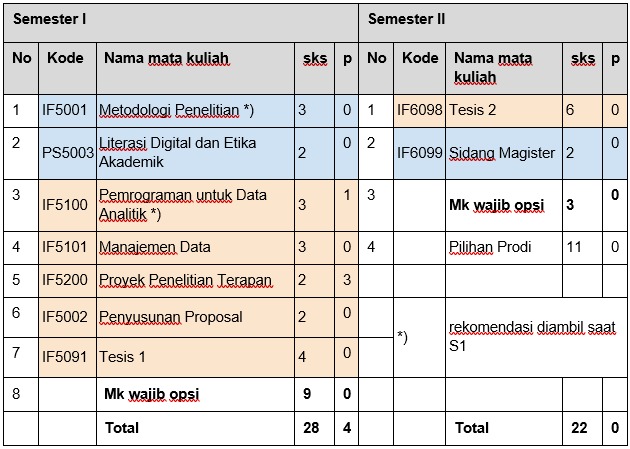
PPSM students are required to undertake a continuous TA–Thesis, which involves completing a TA in the undergraduate program and a Thesis in the master's program on a continuous topic, thus forming part of the work/research in the same area. Regarding the categories of PPSM program participants, the rules for implementing a continuous TA–Thesis are defined as follows:
- Linear: students are required to carry out continuous TA–Thesis with the same topic and supervisor.
- Semi-linearStudents are advised to undertake a continuous TA–Thesis with a topic that is possibly multidisciplinary in nature with the relevant undergraduate program field and with a supervisory team that can come from the relevant undergraduate program of the student and from the Informatics Masters Program. However, if not, then students are required to undertake a TA with a topic in the field of computing, even though it is not continuous with the thesis topic in the Informatics Masters Program and can be carried out with a different supervisor.
- Non-linearstudents are advised to carry out a continuous TA–Thesis with a topic that is possibly multidisciplinary with the field of the student's undergraduate program and with a supervisory team that can come from the student's undergraduate study program and from the Informatics Master's Study Program. However, if not, then students are advised to take a TA topic in the field of computing, although it is still possible to take another topic outside the field of computing according to the field of their study program, so that it can be carried out with a different supervisor than the thesis.
The general design for sustainable TA–Thesis management is as follows:
- Supervisor requirements: Continuous TA–Thesis is conducted with the same supervisor for both TA and Thesis. The maximum number of supervisors is 2 people, for both TA and Thesis. If there is only 1 supervisor, then the supervisor must be eligible as the main supervisor in the undergraduate and Masters Informatics study programs. If there are 2 supervisors, then one of the supervisors must be eligible as the main supervisor in the Master of Informatics Study Program and the rules for the order of main and assistant supervisors follow the rules in the undergraduate and Master of Informatics Study Programs. The list of supervisors for the Master of Informatics Study Program can be accessed at ITB Master of Informatics Thesis Supervisor.
- Topic requirements:
- TA–Thesis topics must be within the scope of the computing field.
- TA–Continuing Thesis topics must consider the appropriate level of knowledge and depth and must can be divided clearly targets for the TA process in undergraduate programs and thesis process targets in master's programs.
- The topic of the TA–Continuous Thesis must be in accordance with the student's chosen path in the Informatics Masters Study Program.
- TA–Continuing Thesis topics can come from prospective supervisors or from student suggestions. If the proposal comes from the student, it must be consulted with and approved by the supervisor.
- Student data collection: Before the 7th semester of the undergraduate student program begins, the PPSM implementation team held a meeting and socialization with all students participating in the PPSM program who were due to take their TA in the 7th semester. Students were asked to submit their TA-Thesis taking plans to obtain information about participants who would be taking ongoing TA-Thesis, especially for students from the semi-linear and non-linear categories.
- Topic and supervisor allocation procedures:
- For all students who will undertake a continuous TA–Thesis, the PPSM implementation team coordinates with all TA implementation teams in all related student study programs and the thesis implementation team of the Informatics Masters Study Program to coordinate the allocation of TA–Thesis topics and supervisors for the students concerned.
- The process of allocating TA–Thesis topics and supervisors can be a special case in the allocation of TA topics and supervisors in the student's undergraduate study program and the procedure can be adjusted to the procedures in each undergraduate study program provided that the topic requirements (see point 2) and supervisor (see point 1) are met.
- After students are allocated a topic and supervisor, students report the ongoing TA–Thesis planning proposal that has been signed by the student and supervisor to the PPSM implementation team.
- The topic and supervisor allocation process can begin before semester 7 begins and must be completed no later than the 7th week of semester 7 of the student's undergraduate program.
- Taking related courses:a. Taking TA courses in undergraduate study programs
- Assumption: there are TA-I courses in semester 7 and TA-II in semester 8 in each undergraduate study program.
- Students carry out the ongoing TA–Thesis portion for the undergraduate program by following the TA implementation procedures in their respective study programs with the following note: in submitting the TA proposal, the topic and planning for the implementation of the Thesis must also be included.
- Students take the TA-I course in semester 7. All or part of the topic and supervisor allocation process can be done in this semester.
- TA-II courses are taken in semester 8.
- Taking the Research Methodology and Thesis course This is implemented after the student changes status to a Master of Informatics student. The Research Methodology course is taken in semester 1 and the Thesis course is taken in semester 2 and is implemented according to the procedures and regulations applicable in the Master of Informatics study program.
Notes: In submitting a thesis proposal, the results of the TA must be submitted which will be continued in the thesis.
- During the ongoing TA–Thesis process, students are not permitted to change topics and supervisors, especially from TA to Thesis. Changing topics or supervisors may be done for certain emergency reasons and follow procedures established by the Informatics Master's Program and acknowledged by the PPSM implementation team.
To make it easier for students to choose elective courses that suit their needs, elective courses are grouped into 6 (six) Research and Professional Clusters as follows:
- Information System Cluster,
- Trusted and Smart System Cluster
- Privacy and Digital Forensics Cluster
- Smart Education Technology Cluster
- Digital Services Transformation Cluster
- Digital Security Cluster
List of Elective Courses for the Master's Program in Information Systems and Technology:
1. Information Systems Research and Profession Cluster
| No | Code | Course | Credits |
|---|---|---|---|
| 1 | II5011 | Information System Sustainability | 4 |
| 2 | II5012 | Data Governance | 4 |
| 3 | II5013 | AI Applications for Enterprise | 4 |
| 4 | II6014 | Digital Economy | 4 |
| 5 | II6015 | Special Topics in Information Systems | 3 |
2. Trusted and Smart System Research and Profession Cluster
| No | Code | Course | Credits |
|---|---|---|---|
| 1 | II5021 | Digital Twin | 4 |
| 2 | II5022 | Advanced Intelligence System | 4 |
| 3 | II5023 | Perception Systems and Technologies | 4 |
| 4 | II5024 | Digital Trust | 4 |
| 5 | II6025 | Human-Centered Smart System | 4 |
| 6 | II6026 | Smart System Special Topics | 3 |
3. Research and Professional Cluster of Digital Forensics and Provision
| No | Code | Course | Credits |
|---|---|---|---|
| 1 | II5031 | Data Protection and Privacy System | 4 |
| 2 | II5032 | Information Security Governance and Management | 4 |
| 3 | II5033 | Digital Forensic Science and Engineering | 4 |
| 4 | II6034 | Advanced Cryptography and Applications | 4 |
| 5 | II6035 | Cyber Criminology and Law | 4 |
| 6 | II6036 | Digital Security Penetration Testing | 4 |
4. Smart Educational Technology Research and Profession Cluster
| No | Code | Course | Credits |
|---|---|---|---|
| 1 | II5041 | Smart Education Technology | 4 |
| 2 | II5042 | Engineering Education | 4 |
| 3 | II5043 | Educational Game Development | 4 |
| 4 | II5044 | Multimedia Learning | 4 |
| 5 | II6045 | Educational Technology Management | 4 |
| 6 | II6046 | Philosophy of Science and Technology of Education | 4 |
5. Digital Service Transformation Research and Profession Cluster
| No | Code | Course | Credits |
|---|---|---|---|
| 1 | II5051 | Multimedia Internet of Things | 4 |
| 2 | II5052 | Digital Service Systems Engineering | 4 |
| 3 | II5053 | Science and Technology Services | 4 |
| 4 | II6054 | Information Technology Risk Management | 4 |
| 5 | II6055 | Enterprise Architecture and Business Processes | 4 |
| 6 | II6056 | Business Continuity Planning | 4 |
6. Digital Security Research and Profession Cluster
| No | Code | Course | Credits |
|---|---|---|---|
| 1 | II5061 | Detection and Anti-Malware | 4 |
| 2 | II5062 | Software Security | 4 |
| 3 | II5063 | Information Security Risk Management | 4 |
| 4 | II6064 | Malware Behavior and Analysis | 3 |
| 5 | II6065 | Security Operations and Incident Response | 3 |
| 6 | II6066 | Information Security Audit | 4 |
Dual Degree Program
The Master of Informatics Study Program of the ITB School of Electrical Engineering and Informatics carries out Double Degree Program (DDP), in collaboration with several partner universities abroad, allows DDP students to earn degrees from two universities simultaneously: an ITB degree and a degree from an ITB partner university abroad.
Students can start with the ITB Master of Informatics program and attend classes at ITB for the first year according to the ITB Master of Informatics curriculum, then continue their studies at a partner university abroad for the second year. The reverse applies for students from partner universities: they attend classes according to the curriculum at their home university for the first year, then continue their studies at ITB for the second year.

Perguruan Tinggi Mitra
Currently, the ITB Informatics Masters Study Program offers DDP with 4 partner universities as follows:
- Toyohashi University of Technology – Computer Science & Engineering (Japan) DDP TUT–ITB has been formally started with Agreement for Double Master's Degrees between Toyohashi University of Technology (TUT) and Bandung Institute of Technology (ITB) August 18, 2023, and Addendum Agreement for Double Master’s Degrees between Computer Science and Engineering TUT and Informatics ITB August 22, 2023.
- Singapore Management University – Master of IT in Business (Singapore) This program is registered for the LPDP Double Degree Program scholarship.
- Info LPDP: https://lpdp.kemenkeu.go.id/storage/beasiswa/kebijakan-umum/file/public_policy_file_1737168598.pdf
- Other scholarships: Soegiarto Adikosoemo Postgraduate Scholarship
- Website Link: https://masters.smu.edu.sg/programme/master_of_it_in_business/community-stories/bridging_borders_and_minds_smuitb_double
- Grand Valley State University – College of Computing
- La Trobe University
Information for Foreign Students
1. Study Permit & Visa Application
Necessary documents: https://partnership.itb.ac.id/pre-arrival/
Visa Fee: IDR 6,500,000.00 (subject to change)
Process flow:
| Party | Procedures |
|---|---|
| Applicant | Receive the Letter of Acceptance (LoA) from ITB. |
| Applicant | Send all required documents to IRO ITB.
Necessary documents: https://partnership.itb.ac.id/pre-arrival/ After IRO ITB receives all required documents, it takes 2–3 months for your study permit and visa. Visa fee is about 6.5–9 million IDR. |
| . | Process study permit online to Director of Institutional Affairs, DIKTI, Jakarta.
After obtaining a study permit from DIKTI, proceed with online application for E-Visa C-316 to the Directorate General of Immigration, Jakarta. |
| Applicant | Receive E-Visa C-316 approval from The International Relations Office Bandung Institute of Technology (IRO ITB). |
2. Guide for ITB Accommodation
ITB Student dormitory information: https://asrama.ditsp.itb.ac.id/asrama/1/
Necessary information & documents: photo, phone number, birthday, birthplace, current address (with postcode), guardian name, guardian phone number, and emergency contact.
Process flow:
| Party | Procedures |
|---|---|
| Applicant | Provide all required information to SEEI Office.
After SEEI Office receives all required information, it takes 1–2 weeks. Dormitory rent is about 1.5 million IDR per month. |
| . | The Directorate of Facilities and Infrastructure, through the Housing Service Section. |
| Applicant | Receive accommodation confirmation from STEI officer. |
Master's Program in Information Systems and Technology News
Administration Form
Administration Form
- Academic Planning Preparation Administration
- Re-registration and Study Plan Service
- Parallel Class Transfer Service
- Final Project/Thesis Defense Service
- Certificate/Statement Letter Service
- Legalization Service for Transcripts, Diplomas, and Diploma Translations
- Student Achievement Tracking
- Request for Support for Student and Student Association Activities
Rules and Guidelines
Contact
Contact Us
Master Program in Information Systems and Technology
Labtek VIII/Achmad Bakrie Building, Jl. II, Lebak Siliwangi, Coblong, Bandung City, West Java 40132
Admin Prodi: Itsna Hibatullah
Phone/WA: +62-822-2999-6573
Parking at ITB
Vehicles on the ITB campus are restricted to employees and special guests. There are three main parking facilities:
There are three main parking facilities, namely:
- Sasana Budaya Ganesha (Sabuga) is the largest parking area for four-wheeled and two-wheeled vehicles.
Access to this parking area can be reached from Jalan Taman Sari or Jalan Siliwangi. - Parkir Timur (SR) provides limited parking for four-wheeled and two-wheeled vehicles. This parking area is open 24/7, except on major holidays.
This parking is open 24/7, except on major holidays. - Parkir Barat (Civil) is specifically for two-wheeled vehicle users.