About the Study Program
The Master of Informatics study program aims to equip its graduates with critical, innovative, and professional thinking skills to compete globally in the field of Informatics, as well as to develop research-based knowledge and technology for the field of Informatics. The scientific fields of the Master of Informatics study program include the basic scientific fields of computing (Fundamentals of Computing) and scientific fields according to their options. There are eight options, namely Computer Science (CS), Software Engineering (SE), Media and Mobile Technology (MMT), Data Science (DS), Artificial Intelligence (AI), Cyber Security (CSec), Information Systems (IS), and Information Technology (IT). The types of programs in the Master of Informatics study program consist of: Regular, By Research/Project, Executive and Multidisciplinary
Program Objectives
The Master of Informatics Study Program aims to produce Master of Informatics graduates who have the following abilities in the early stages of their careers (3–5 years since graduation), namely:
- Our graduates will have critical thinking, innovative, and professional aspects to compete globally in the field of informatics.
- Our graduates will successfully pursue advanced study or engage in professional development.
- Our graduates will have managerial capabilities in research in the field of informatics.
Graduate Outcomes of the Study Program
The learning outcomes of the Master of Informatics Study Program when students are declared graduates are:
- Students will be able to analyze problems in the field of Informatics or other fields of science to identify computing-based solutions.
- Students will be able to design and build computing-based solutions through an interdisciplinary or multidisciplinary approach
- Students will be able to evaluate computing-based solutions that fulfill the requirements through an interdisciplinary or multidisciplinary approach.
- Students are able to develop research-based knowledge and technology for the field of Informatics, by engineering and developing specific scientific fields, including:
- algorithms or computational theories that are capable of solving current and actual problems (CS elective path), or
- development of large-scale, reliable, innovative, and maintainable software products (SEI elective track), or
- Information Systems governance at the enterprise level to maximize the system's potential and minimize its risks using Information Technology resources efficiently (IS preferred path), or
- analysis, modeling, design, construction, and development of information technology-based systems (IT elective path), or
- concepts, technologies, and applications of artificial intelligence, including appropriate tools for effective and efficient AI solutions (IntS elective path), or
- concepts, architecture, and technology of media and mobile devices, as well as the development of media and mobile device applications using human-computer interaction principles and good and appropriate software engineering methodologies (MMT elective path), or
- cloud computing concepts, architecture, technology, and applications in providing scalable and high-performance computing solutions for business and scientific needs (CC elective path), or
- management, processing, and interpretation of large and complex datasets for the extraction of important information and knowledge (DSAI elective track), or
- development, operation, and testing of cyber security systems (CSec elective track).
- Students will be able to communicate effectively in diverse professional and academic contexts.
- Students are able to function effectively in team activities that are appropriate to their field of study.
Options or Preferred Paths
There are 8 (eight) tracks, as follows Computer Science (CS), Software Engineering (SE), Media and Mobile Technology (MMT), Data Science (DS), Cyber Security (CSec), Artificial Intelligence (AI), Information System (IS), and Information Technology (IT).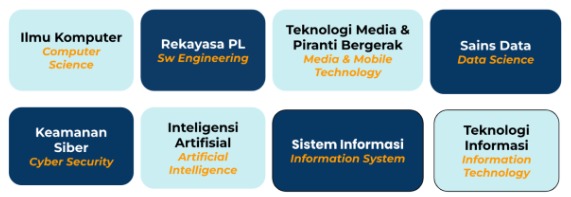
The curriculum of the Master Program in Informatics, comprising a total of 54 credits, is divided into 3 semesters with a maximum load of 18 credits per semester, following the composition below. For the multidisciplinary program scheme and the Double Degree program scheme, the curriculum is structured over 4 semesters.
- Ilmu Komputer (Computer Science)
- Rekayasa Perangkat Lunak (Software Engineering)
- Media and Mobile Device Technology
- Sains Data (Data Science)
- Keamanan Siber (Cybersecurity)
- Inteligensi Artifisial (Artificial Intelligence)
- Information Systems
- Information Technology
Curriculum Structure
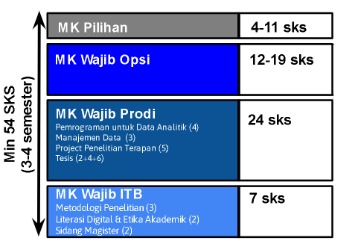
The Master of Informatics Study Program curriculum, with a total of 54 credits, is divided into three semesters with a maximum load of 18 credits per semester, with the composition below. For the multidisciplinary program scheme and the program scheme ., the curriculum is structured into 4 semesters.
- ITB Required: 7 credits
- Study Program Requirement: 12 credits of structured courses + 12 credits of Thesis
- Wajib opsi: 12–19 sks
- Pilihan: 4–11 sks
Struktur 3 Semester
The study period is scheduled for 3–4 semesters. The course structure for the Master of Informatics program is as follows: Students take 18 credits per semester.
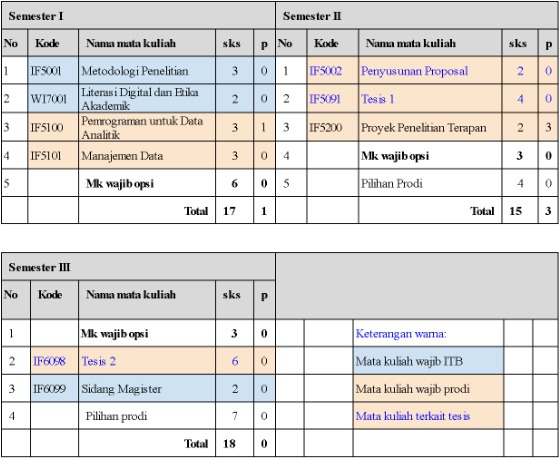
| No | Code | Course | Credits |
|---|---|---|---|
| 1 | IF5001 |
Research Methodology
|
3 |
| 2 | WI7001 |
Digital Literacy and Academic Ethics
|
2 |
| 3 | IF5100 |
Programming for Data Analytics
|
3 |
| 4 | IF5101 |
Data Management
|
3 |
| 5 | IF5002 |
Proposal Preparation
|
2 |
| 6 | IF5091 |
Thesis 1
|
4 |
| 7 | IF5200 |
Applied Research Project
|
2 |
| 8 | IF6098 |
Thesis 2
|
6 |
| 9 | IF6099 |
Master's Session
|
2 |
Structure 4 Semester
The Structure of the Master of Informatics Study Program in the following 4 semesters. Students take 11–16 credits per semester.

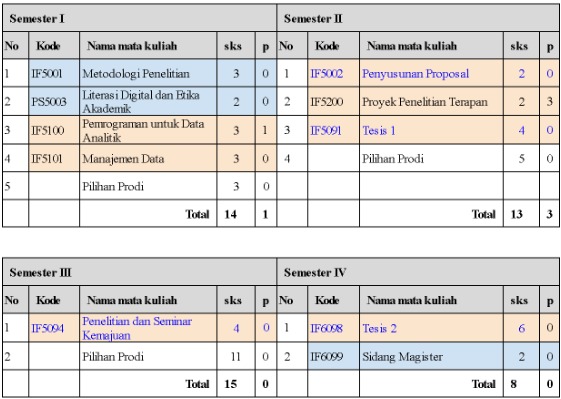
Research-Based Master's Path
Specifically for the Research-based Master's track, the course composition is arranged according to the following structure, and the curriculum is designed over 4 semesters.
- ITB Required: 7 credits
- Compulsory Study Program: 12 credits of structured courses + 16 credits of Thesis
- Optional: 19 credits
The Course Structure of the Master of Informatics Study Program for the Research-based Master's path is as follows.
Compulsory Courses
| No | Code | Course | Credits | P |
|---|---|---|---|---|
| 1 | IF5110 |
Algorithm Design
|
3 | 0 |
| 2 | IF5111 |
Mathematics for Computer Science
|
3 | 0 |
| 3 | IF5210 |
Compiler Design
|
3 | 0 |
| 4 | IF5112 |
Advanced Distributed Systems
|
3 | 0 |
| No | Code | Course | Credits | P |
|---|---|---|---|---|
| 1 | IF5120 |
Software Requirement Engineering
|
3 | 0 |
| 2 | IF5121 |
Software Design
|
3 | 0 |
| 3 | IF5220 |
Software Quality
|
3 | 0 |
| 4 | IF5221 |
Software Product Innovation
|
1 | 3 |
| 5 | IF6120 |
Software Evolution
|
3 | 0 |
| No | Code | Course | Credits | P |
|---|---|---|---|---|
| 1 | IF5130 |
Software Engineering for Game Domain
|
3 | 0 |
| 2 | IF5131 |
Multimedia Data Processing and Management
|
3 | 0 |
| 3 | IF5230 |
Mobile Technology and Application
|
3 | 0 |
| 4 | IF6130 |
Interactive Media Technology & Application
|
3 | 0 |
| No | Code | Course | Credits | P |
|---|---|---|---|---|
| 1 | IF5150 |
Advanced Artificial Intelligence
|
3 | 0 |
| 2 | IF5151 |
Mathematics for Artificial Intelligence
|
3 | 0 |
| 3 | IF5250 |
Deep Learning
|
3 | 1 |
| 4 | IF5251 |
Artificial Intelligence in Production
|
3 | 0 |
| 5 | IIF6150 |
Trustworthy Artificial Intelligence
|
3 | 0 |
| 6 | IF6151 |
Artificial Intelligence Individual Project
|
3 | 0 |
| No | Code | Course | Credits | P |
|---|---|---|---|---|
| 1 | IF5140 |
Machine Learning
|
2 | 0 |
| 2 | IF5141 |
Data Mining
|
3 | 1 |
| 3 | IF5240 |
Business Intelligence and Analytics
|
3 | 1 |
| 4 | IF5241 |
Big Data System
|
3 | 0 |
| 5 | IF6097 |
Industrial Internship
|
3 | 0 |
| No | Code | Course | Credits | P |
|---|---|---|---|---|
| 1 | IF5161 |
Data and Software Security
|
3 | 0 |
| 2 | IF6160 |
System Security & Privacy
|
3 | 0 |
| 3 | IF5260 |
Digital Forensics
|
3 | 0 |
| 4 | IF5160 |
Cybersecurity Operations
|
3 | 0 |
| 5 | IF6161 |
Cybersecurity Individual Project
|
3 | 0 |
| No | Code | Course | Credits | P |
|---|---|---|---|---|
| 1 | IF5170 |
Digital Strategy
|
3 | 0 |
| 2 | IF5171 |
System Thinking
|
3 | 0 |
| 3 | IF5270 |
Applied Artificial Intelligence for Enterprise
|
3 | 1 |
| 4 | IF5271 |
Information System Sustainability
|
3 | 0 |
| 5 | IF6170 |
Data Governance
|
3 | 0 |
| No | Code | Course | Credits | P |
|---|---|---|---|---|
| 1 | IF5180 |
Digital Twin Technology
|
3 | 0 |
| 2 | IF5181 |
Information Technology Platform
|
3 | 0 |
| 3 | IF5280 |
Digital Security, Privacy, and Forensics
|
3 | 0 |
| 4 | IF6180 |
Digital Transformation and Enterprise Architecture
|
3 | 0 |
Registration and Selection of New Students
General Information
The registration schedule for prospective students of the Master Program in Informatics follows the Graduate Program Admission Schedule of ITB for Semester I of the 2025/2026 academic year, which can be accessed at: https://admission.itb.ac.id/info/program-magister/.
The Master of Informatics study program for the 2025/2026 academic year is only open for odd semester registration, and for the opening of the 2026/2027 academic year, registration information can be accessed around February or March 2026.
Rules and Coverage of the Masters Informatics Selection Test Topics
Written exam participants must pay attention to the exam rules, implementation schedule, nature of the exam, and the scope of the ITB Informatics Masters Program selection test topics.
Tata Tertib Ujian
- Participants must know their respective examination rooms according to the invitation sent via email.
- Participants must wear appropriate clothing and shoes.
- Participants must bring original proof of identity, writing materials, and a calculator.
- Participants entered the examination room at exactly 12.45 WIB and sat according to their selection number.
- Items other than examination equipment must be placed in front of the examination room, communication devices must be turned off, and food is not permitted to be brought into the examination room.
- Participants are not allowed to read the exam script before the start signal for the exam is given.
- Participants are required to check the completeness of the examination script, fill in their identity, selection number, and sign the answer sheet.
- During the exam, participants are not allowed to leave the exam room, borrow each other's writing materials, talk, use unauthorized notes, or cheat.
- Violations of the rules may result in the participant's answer file not being assessed.
Cakupan Topik Tes
- Algorithms and Data Structures, including programming, control structures, function calls, and arrays.
- Computer Architecture and Operating Systems, covering computer organization and architecture, operating systems, and computer networks.
- Discrete Mathematics, Probability, and Statistics, covering propositional logic, combinatorial logic, graphs, algorithmic complexity, and discrete probability distributions.
- Database and Data Model, including entity-relationship, relational schema, normalization, and SQL.
Exam Schedule and Nature
| Jadwal | Mata Ujian | Test |
|---|---|---|
| 12.45-13.00 | Persiapan | – |
| 13.00-13.50 | Algorithms and Data Structures | Close the book. The programming language you can choose is Pascal, C/C++, Java, Fortran, or Python. |
| 14.00-14.50 | Database and Data Model | Open Note, 1 lembar A4, boleh ditulis bolak-balik. |
| 15.00-15.50 | Computer Systems and Architecture | Tutup buku. |
| 16.00-16.50 | Discrete Mathematics, Probability, and Statistics | Open Note, 1 A4 sheet, may write back and forth, and may use a physical calculator. |
The schedule for the selection exam for Semester I of the 2026/2027 Academic Year is planned for Selasa, 7 Juli 2026, pukul 12.45-17.00 WIB at Labtek V (Benny Subianto Building), 2nd Floor, Jalan Ganesha No. 10, Bandung. The room will be as per the information on the invitation.
Complete information regarding the rules, schedule, nature of the exam, topic coverage, and sample questions can be accessed through the following document: Tata Tertib Seleksi Ujian Masuk S2 IF 2026.
Research-Based Masters Program Selection (MBR)
Specifically for the MBR program of the Master of Informatics Study Program, selection of prospective MBR students is carried out based on documents, written exams, and interviews, namely:
- Selection based on documents:
- TPA & TOEFL scores follow ITB regulations.
- Educational background in Science and Engineering (S1 diploma).
- A portfolio listing publications within 5 years, 5 years of research experience, a minimum GPA of 3.0, experience at a research institution, and a curriculum vitae.
- Draft research proposal that has been discussed and approved by prospective supervisors from the Informatics Masters Study Program.
- Recommended by a prospective supervisor. A prospective supervisor's recommendation contains an assessment based on observations of the prospective student's quality and research track record. Supervisors can recommend students if they have published at least one paper in international conference proceedings, at least one research project in their undergraduate thesis, or have a higher level of research experience.
- A written exam specifically assesses basic competency in Informatics. This is the same as the regular pathway. For MBR students, the written exam can be used to confirm their undergraduate degree.
- Wawancara, mencakup presentasi draft proposal riset:
- The interview team consists of at least 3 people, namely the head of study program or representative, prospective supervisor, and members of the selection team.
- The interview assesses students' readiness to conduct independent research, and determines students' eligibility to take courses independently, especially for compulsory study program courses.
Prospective students are declared to have passed the MBR selection process if they meet the requirements for passing the regular selection process, namely TPA, TOEFL, Science and Engineering educational background, and a written test, have a draft proposal signed by the prospective supervisor, and are recommended by the prospective supervisor. The supervisor's role in the selection process is very important, especially since recommendations can only be given after evaluating the prospective student's potential based on the portfolio and observations during the discussion of the draft research proposal.
Specifically for PISM students who will take part in the MBR program, there are the following requirements:
- At the end of semester 7, there is a recommendation from the undergraduate supervisor.
- Thesis research topic must be a continuation of the undergraduate research topic.
- At least one member of the Master's Thesis supervisory team is part of the Bachelor's TA supervisory team.
ITB Undergraduate – Masters Unification Program
PPSM
The Bachelor's and Master's Integration Program (PPSM) aims to increase the number of ITB undergraduate students who continue their studies in the Master's Program, with a study period that meets the integration program's target. This is done to achieve one of the indicators targeted in the 2021–2025 ITB Strategic Plan, namely a 40% postgraduate student population by 2025.
Berdasarkan pemenuhan kompetensi dasar computingthere is a general scheme or unification of cognate and non-cognate Bachelor–Master degrees with the Informatics Masters Study Program, which is divided into three categories as follows:
- Linear, for undergraduate students who have met all basic competencies. Based on the curriculum, undergraduate programs that meet these requirements are those from STEI-K (Informatics Engineering and Information Systems & Technology).
- Semi-linear, for undergraduate students who have fulfilled some of the basic competencies. Based on the curriculum, the undergraduate programs that fulfill this requirement are those from STEI-R (Electrical Engineering, Telecommunication Engineering, Biomedical Engineering, Electrical Power Engineering).
- Non-linear, for undergraduate students who do not yet have basic competencies. Other study programs outside of STEI can generally be categorized as non-linear, except for those that have basic competencies. computing. Evaluation of study programs outside the STEI environment whether they fall into the semi-linear or non-linear category will be carried out on a case-by-case basis when the related undergraduate study program students register for this program.
Tabel Kompetensi Dasar Computing
| Basic competencies | Description |
|---|---|
| Programming |
|
| Database |
|
| Discrete Mathematics |
|
| Computer System |
|
The course structure for the PPSM Informatics Masters Study Program is as follows.
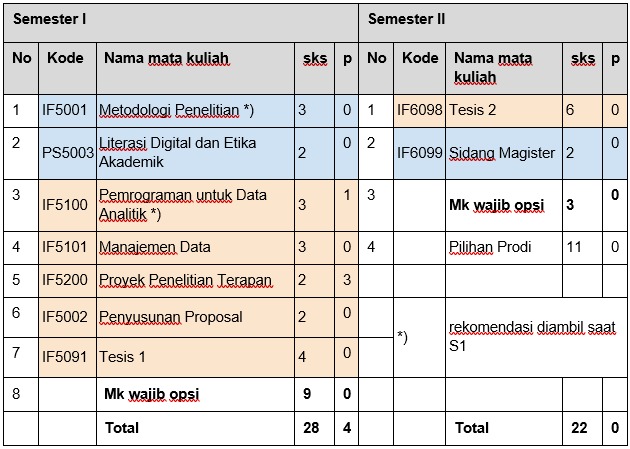
PPSM students are required to undertake a continuous TA–Thesis, which involves completing a TA in the undergraduate program and a Thesis in the master's program on a continuous topic, thus forming part of the work/research in the same area. Regarding the categories of PPSM program participants, the rules for implementing a continuous TA–Thesis are defined as follows:
- Linear: students are required to carry out continuous TA–Thesis with the same topic and supervisor.
- Semi-linearStudents are advised to undertake a continuous TA–Thesis with a topic that is possibly multidisciplinary in nature with the relevant undergraduate program field and with a supervisory team that can come from the relevant undergraduate program of the student and from the Informatics Masters Program. However, if not, then students are required to undertake a TA with a topic in the field of computing, even though it is not continuous with the thesis topic in the Informatics Masters Program and can be carried out with a different supervisor.
- Non-linearstudents are advised to carry out a continuous TA–Thesis with a topic that is possibly multidisciplinary with the field of the student's undergraduate program and with a supervisory team that can come from the student's undergraduate study program and from the Informatics Master's Study Program. However, if not, then students are advised to take a TA topic in the field of computing, although it is still possible to take another topic outside the field of computing according to the field of their study program, so that it can be carried out with a different supervisor than the thesis.
The general design for sustainable TA–Thesis management is as follows.
- Supervisor requirements: Continuous TA–Thesis is conducted with the same supervisor for both TA and Thesis. The maximum number of supervisors is 2 people, for both TA and Thesis. If there is only 1 supervisor, then the supervisor must be eligible as the main supervisor in the undergraduate and Masters Informatics study programs. If there are 2 supervisors, then one of the supervisors must be eligible as the main supervisor in the Master of Informatics Study Program and the rules for the order of main and assistant supervisors follow the rules in the undergraduate and Master of Informatics Study Programs. The list of supervisors for the Master of Informatics Study Program can be accessed at ITB Master of Informatics Thesis Supervisor.
- Topic requirements:
- TA–Thesis topics must be within the scope of the computing field.
- TA–Continuing Thesis topics must consider the appropriate level of knowledge and depth and must can be divided clearly targets for the TA process in undergraduate programs and thesis process targets in master's programs.
- The topic of the TA–Continuous Thesis must be in accordance with the student's chosen path in the Informatics Masters Study Program.
- TA–Continuing Thesis topics can come from prospective supervisors or from student suggestions. If the proposal comes from the student, it must be consulted with and approved by the supervisor.
- Student data collection: Before the 7th semester of the undergraduate student program begins, the PPSM implementation team held a meeting and socialization with all students participating in the PPSM program who were due to take their TA in the 7th semester. Students were asked to submit their TA-Thesis taking plans to obtain information about participants who would be taking ongoing TA-Thesis, especially for students from the semi-linear and non-linear categories.
- Topic and supervisor allocation procedures:
- For all students who will undertake a continuous TA–Thesis, the PPSM implementation team coordinates with all TA implementation teams in all related student study programs and the thesis implementation team of the Informatics Masters Study Program to coordinate the allocation of TA–Thesis topics and supervisors for the students concerned.
- The process of allocating TA–Thesis topics and supervisors can be a special case in the allocation of TA topics and supervisors in a student's undergraduate study program, and the procedure can be adjusted to the procedures in each undergraduate study program provided that the topic requirements (see point 2) and supervisor (see point 1) are met.
- After students are allocated a topic and supervisor, students report the ongoing TA–Thesis planning proposal that has been signed by the student and supervisor to the PPSM implementation team.
- The topic and supervisor allocation process can begin before semester 7 begins and must be completed no later than the 7th week of semester 7 of the student's undergraduate program.
- Taking related courses:a. Taking TA courses in undergraduate study programs
- Assumption: there are TA-I courses in semester 7 and TA-II in semester 8 in each undergraduate study program.
- Students carry out the ongoing TA–Thesis portion for the undergraduate program by following the TA implementation procedures in their respective study programs, with the following note: in submitting the TA proposal, the topic and planning for the implementation of the thesis must also be included.
- Students take the TA-I course in semester 7. All or part of the topic and supervisor allocation process can be done in this semester.
- TA-II courses are taken in semester 8.
- Taking the Research Methodology and Thesis course This is implemented after the student changes status to a Master of Informatics student. The Research Methodology course is taken in semester 1 and the Thesis course is taken in semester 2 and is implemented according to the procedures and regulations applicable in the Master of Informatics study program.
Note: in submitting a thesis proposal, the results of the TA must be submitted which will be continued in the thesis.
- During the ongoing TA–Thesis process, students are not permitted to change topics and supervisors, especially from TA to Thesis. Changing topics or supervisors may be done for certain emergency reasons and follow procedures established by the Informatics Master's Program and acknowledged by the PPSM implementation team.
Dual Degree Program
The Master of Informatics Study Program of the ITB School of Electrical Engineering and Informatics carries out Double Degree Program (DDP), in collaboration with several partner universities abroad, allows DDP students to earn degrees from two universities simultaneously: an ITB degree and a degree from an ITB partner university abroad.
Students can start with the ITB Master of Informatics program and attend classes at ITB for the first year according to the ITB Master of Informatics curriculum, then continue their studies at a partner university abroad for the second year. The reverse applies for students from partner universities: they attend classes according to the curriculum at their home university for the first year, then continue their studies at ITB for the second year.

Perguruan Tinggi Mitra
Currently, the ITB Informatics Masters Study Program offers DDP with 4 partner universities as follows:
- Toyohashi University of Technology – Computer Science & Engineering (Japan) DDP TUT–ITB has been formally started with Agreement for Double Master's Degrees between Toyohashi University of Technology (TUT) and Bandung Institute of Technology (ITB) August 18, 2023, and Addendum Agreement for Double Master’s Degrees between Computer Science and Engineering TUT and Informatics ITB August 22, 2023.
- Singapore Management University – Master of IT in Business (Singapore) This program is registered for the LPDP Double Degree Program scholarship.
- Info LPDP: https://lpdp.kemenkeu.go.id/storage/beasiswa/kebijakan-umum/file/public_policy_file_1737168598.pdf
- Other scholarships: Soegiarto Adikosoemo Postgraduate Scholarship
- Website Link: https://masters.smu.edu.sg/programme/master_of_it_in_business/community-stories/bridging_borders_and_minds_smuitb_double
- Grand Valley State University – College of Computing
- La Trobe University
Information for Foreign Students
1. Study Permit & Visa Application
Necessary documents: https://partnership.itb.ac.id/pre-arrival/
Visa Fee: IDR 6,500,000.00 (subject to change)
Process flow:
| Party | Procedures |
|---|---|
| Applicant | Receive the Letter of Acceptance (LoA) from ITB. |
| Applicant | Send all required documents to IRO ITB.
Necessary documents: https://partnership.itb.ac.id/pre-arrival/ After IRO ITB receives all required documents, it takes 2–3 months for the study permit and visa process. Visa fee is about 6.5–9 million IDR. |
| . | Process study permit online to Director of Institutional Affairs, DIKTI, Jakarta.
After obtaining a study permit from DIKTI, proceed with online application for E-Visa C-316 to the Directorate General of Immigration, Jakarta. |
| Applicant | Receive E-Visa C-316 approval from The International Relations Office Bandung Institute of Technology (IRO ITB). |
2. Guide for ITB Accommodation
ITB student dormitory information: https://asrama.ditsp.itb.ac.id/asrama/1/
Necessary information & documents: photo, phone number, birthday, birthplace, current address (with postcode), guardian name, guardian phone number, and emergency contact.
Process flow:
| Party | Procedures |
|---|---|
| Applicant | Provide all required information to STEI Office.
After STEI Office receives all required information, it takes 1–2 weeks. Dormitory rent is about 1.5 million IDR per month. |
| . | The Directorate of Facilities and Infrastructure, through the Housing Service Section. |
| Applicant | Receive accommodation confirmation from STEI officer. |
Graduate Profile
|
Daniel Tanta Christopher Sirait
|
|
Dionisius Pratama
|
|
Firdausi Aditya Darmawan
|
|
Gayuh Giliyuwana
|
|
Ginanjar Septian Adhitia
|
|
Hamdi Ahmad Zuhri
|
|
Haris Orizadi
|
|
Hilmi Aziz Bukhori
|
|
I Putu Eka Surya Aditya
|
|
Ihsan Fauzi
|
|
Irvan Ariyanto
|
|
Izuardo Zulkarnain
|
|
Josua Crishan Mintamanis
|
|
Mokhamad Arfan Wicaksono
|
|
Muhammad Adrinta Abdurrazzaq
|
|
Muhammad Husni Mubarak
|
|
Muhammad Isfan Rahadi
|
|
Muhammad Ulfi
|
|
Nabila Rahmi Maulida
|
|
Oktefvia Aruda Lisjana
|
|
Raden Alf Fajrus Shuluh
Implementation of Block Nested Loop Join Algorithm Using Server-Side Processing Method for MongoDB Database in Distributed Environment
|
|
Ratih Aflita Rahmawati
|
|
Suwardiman
|
|
Triana Dewi Salma
|
|
Adnan Setiawan AR
|
|
Ayu Komalasari
|
|
Fakhri Aunurrahim
Application of WOAmM to FLANN Training to Improve Accuracy in Software Effort Estimation
|
|
Hasna Karimah
|
|
Iswahyudi
|
|
Jatmiko Herjati
|
|
Kurniandha Sukma Yunastrian
|
|
Labib Izzatur Rahman
|
|
Mochammad Farrell
|
|
Muhammad Harun
|
|
Muhammad Ikhsan
|
|
Oky Rahmanto
|
|
Ranindya Paramitha
|
|
Sigit Widodo
|
|
Vincent Joel Sinatra
|
|
Walim Abdul Somad
|
|
Wawan Indrawan Madda
|
|
Adriel Gustino Parlinggoman Situmorang
|
|
Anindya Prameswari Ekaputri
|
|
Christovito Hidajat
|
|
Danendra Athallariq Harya Putra
|
|
Hollyana Puteri Haryono
|
|
Radhinansyah Hemsa Ghaida
Development of the DTLPLP Method for Link Prediction in Dynamic Heterogeneous Networks with the Heter-LP Approach
|
|
Jadequeline Marsha Pricila
|
|
Setyo Legowo
|
|
Ahmad Tarmizan Kusuma
|
|
Anggastya Diah Andita H.P
|
|
Anranur Uwaisy Marchiningrum
|
|
Arian Nurrifqhi
|
|
Byan Sakura Kireyna Aji
|
|
Faishol Muzaky Dwi Putra
|
|
Kukuh Muhammad
|
|
Michael Hans
|
|
Nima Rohmalia
|
|
Patrick Segara
|
|
Raden Haryo Pandu Prakoso
|
|
Safara Cathasa Riverinda Rijadi
|
|
Syfa Nur Lathifah
|
|
Vhydie Gilang Christianto The
|
|
Wisnu Arya Dipa
|
|
Yusuf Luthfi Ramdhani
|
|
Zalina Fatima Azzahra
|
|
Ilham Syahid Syamsudin
|
|
Moch. Nafkhan Alzamzami
|
|
Muhammad Farid Adilazuarda
Development of LanguageFusion Method to Overcome Language Identification Bottleneck in Modular Multilingual Language Models
|
|
Aaz Muhammad Hafidz Azis
|
|
Aditya Rachman Putra
|
|
Aisyah Nurul Izzah Adma
|
|
Amany Akhyar
|
|
Andreas Novian Dwi Triastanto
|
|
Annisa Muzdalifa
|
|
Arrival Dwi Sentosa
Predicting the Risk of White Spot Syndrome Virus in Vannamei Shrimp Using Machine Learning and Expert Knowledge Approaches
|
|
Dandy Arif Rahman
|
|
Dhiya Ulhaq Dewangga
|
|
Dimmas Mulya
|
|
Dinda Yora Islami
|
|
Fairuz Astra Pratama
|
|
Fajar Muslim
|
|
Fauzan Firdaus
|
|
Gabriel Jonathan
|
|
Giffari Alfarizy
|
|
Gisela Kurniawati
|
|
Hadi Permana
|
|
Hani’ah Wafa
|
|
Harits Abdurrohman
|
|
I Nyoman Switrayana
|
|
Irfan Ihsanul Amal
|
|
Isjhar Kautsar
|
|
Kadek Denaya Rahadika Diana
|
|
Keenan Adiwijaya Leman
|
|
Made Raharja Surya Mahadi
|
|
Marsa Thoriq Ahmada
|
|
Miftahul Mahfuzh
|
|
Moch Azhar Dhiaulhaq
|
|
Muhammad Anwari Leksono
|
|
Muhammad Fadhlan Putranto
|
|
Muhammad Faris Muzakki
|
|
Muhammad Haris Maulana
|
|
Muhammad Sidik Asyaky
|
|
Nadya Aditama
|
|
Paulus Setiawan Suryadjaja
|
|
Rayza Mahendra Guntara Harsono
|
|
Rifo Ahmad Genadi
|
|
Rizal Kusuma Putra
|
|
Rossevine Artha Nathasya
|
|
Widya Puteri Aulia
|
|
Zalid Qomalita Hijriana
|
|
Zilfikri Yulfiandi Rachmat
|
|
Eki Saputra
|
|
Goklas Henry Agus Panjaitan
|
|
Inkreswari Retno Hardini
|
|
Fais Zharfan Azif
|
|
Faisal Ridwan Siregar
|
|
Insan Ganang Putranda
|
|
Ricky Yuliawan
|
Administration Form
Administrative Form
- Supervisor Form from Outside ITB
- Topic/Supervisor/Add Supervisor Change Form
- Master's Informatics Thesis Seminar Proposal Form (offline)
- Master's Informatics Thesis Seminar Proposal Form (online)
- Thesis Defense Requirements Form
- Master's Informatics Thesis Defense Proposal Form (offline)
- Master's Informatics Thesis Defense Proposal Form (online)
- Link to the plagiarism check upload form for Master of Informatics students' papers
Guidelines and Rules
- Online Thesis Seminar Guide
- Online Thesis Defense Guide
- Guidelines for Implementing Postgraduate Seminars/Seminars
- Master's Thesis Proposal Template IF
- Systematics of Progress Report IF5091/IF5092 Research Implementation 1/ 2
- MBR Research Proposal Template
- MBR Interview Guide
- Master's Thesis Implementation Guide for IF (2022)
- Industrial KP Guidelines S2 IF & Administration
SK / IF Master's Accreditation Certificate
Server IF
Contact
Contact Us
Master of Informatics Engineering
Labtek VIII/Achmad Bakrie Building, Jl. II, Lebak Siliwangi, Coblong, Bandung City, West Java 40132
Admin Prodi: Sri Wahyuni, A.Md.
Phone/WA : +62-822-2999-6572
Parking at ITBVehicles on the ITB campus are restricted to employees and special guests. There are three main parking facilities:
There are three main parking facilities, namely:
- Sasana Budaya Ganesha (Sabuga) is the largest parking area for four-wheeled and two-wheeled vehicles. Access to this parking area is from Jalan Taman Sari or Jalan Siliwangi.
- Parkir Timur (SR) provides limited parking for four-wheeled and two-wheeled vehicles. This parking area is open 24/7, except on major holidays.
- Parkir Barat (Civil) is specifically for two-wheeled vehicle users.