
Prof. Trio Adiono Ungkap Peran IoT pada Revolusi Industri 4.0 di Indonesia serta Lahirnya Chip Ardunesia
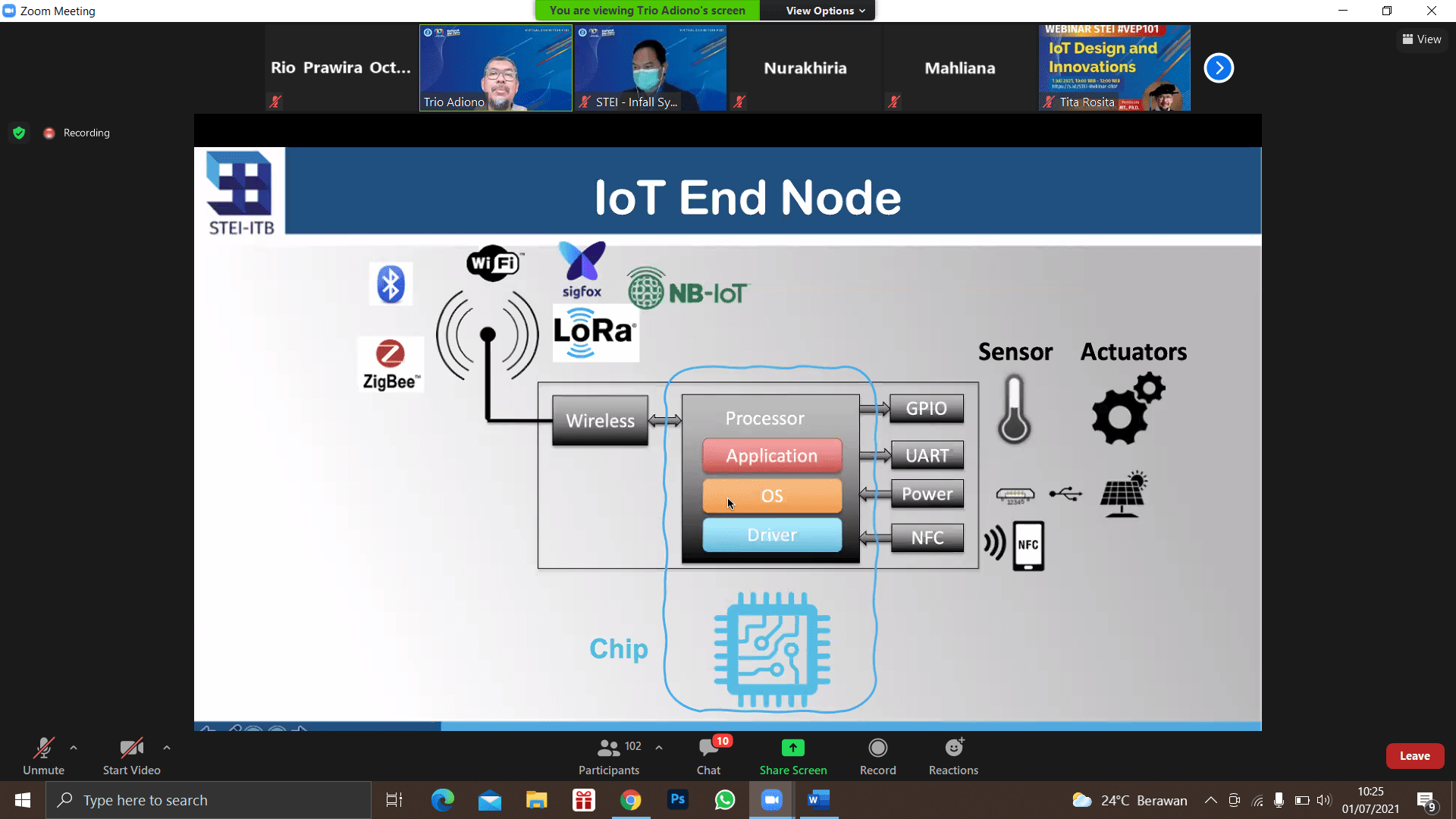
On July 1, 2021, STEI ITB held a webinar as part of the 101st Anniversary of Higher Engineering Education in Indonesia. The event focused on "IoT Design and Innovation," featuring Prof. Trio Adiono, ST., MT., Ph.D., Head of the ITB Electronics Research Group, as a keynote speaker. The two-hour event generated a lot of attention and lively discussion.
Prof. Trio Adiono explained that we are now entering the era of the Industrial Revolution 4.0, also known as the cyber-physical system. To illustrate this, he gave the example of a chair, which is no longer just a regular seat but can be adjusted for all its functions simply by pressing the available buttons. In this era, the main sectors are food & beverage, textiles & fashion, automotive, chemicals, and electronics.
Then, IoT (Internet of Things) was explained, a technology that combines the cyber world with physical and social objects. These three things can create devices that can see, hear, think, speak, and even behave through sensors. Examples of IoT applications include drones, eFishery, robots, toll gates, and so on. Even in smart cities, this technology is used to determine the location and schedule of buses, detect people passing by, and create smart campuses or smart schools.
With the internet, everything can be connected and accessed anytime, anywhere. Furthermore, cloud infrastructure, which is internet storage, is available 24/7. Furthermore, end-to-end integration allows machines to be controlled by machines, not humans. These three technologies are what give rise to the IoT.
The value provided by IoT is efficiency, making things easier at the touch of a button. Furthermore, convenience, ease, effectiveness, and increased productivity with fewer people, lower costs, and faster speeds are also valuable features of IoT. There are also economic implications.
This is because there is a new business model and it also provides new market segmentation.

The event also explained the parameters for success in IoT design. These include reliability, which means providing continuous service. Mobility, which means equipment must be accessible anywhere. Availability, which means it must be accessible at any time. Scalability, which means it can be expanded when there is a large amount of data or can accommodate large amounts of data. Performance, interoperability, management, and security and privacy are also part of these parameters.
The IoT industry comprises several components: those that provide IoT, and then there are ODMs to create modules. Furthermore, there are manufacturers responsible for mass production, and then there are system integrators who handle hardware and software. Prof. Trio Adiono also explained that those interested in entering the IoT industry don't have to be in all of them; this can happen through collaboration between various parties.
Prof. Tri Adiono also explained and showcased the Ardunesia product, a mid-range chip with a 32-bit processor and high speed. Ardunesia has been tested and can be used for keypads, RFID, LCDs, SPO2 sensors, temperature sensors, humidity sensors, and more.
It was also explained that a significant portion of IoT is in the healthcare sector. IoT in this area functions for monitoring, intelligence algorithms, media data, technology (telemedicine), rapid diagnosis, treatment, administration, and billing. Examples of healthcare devices utilizing IoT include the XVENT XMV200 Frontliner, High Flow Nasal Cannula, Respinos, and others.
At the end of the event, Prof. Trio Adiono explained the conclusion that Indonesia needs to complement its existing industrial value chain ecosystem with Industry 4.0 to increase the country's competitiveness. He also highlighted the emerging need for domestic IoT device manufacturers. IoT supports the growth of data center and cloud storage businesses in Indonesia, as well as the emergence of startups with innovative business models.
New digital technologies in the sharing economy era. Furthermore, fostering flexible manufacturing to increase efficiency and address ever-changing market needs.
"It is hoped that Indonesia can apply this technology (IoT) to implement the industrial revolution 4.0," said Prof. Trio Adiono.
(News written by: Rio Prawira Octavieri, Media Production Management, Padjajaran University)