
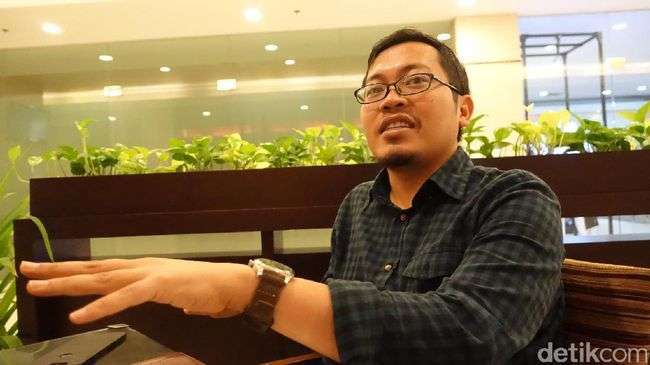
Speech by Achmad Zaky, STEI-ITB Alumni at OSKM Talks 2017
Jakarta The success achieved by Bukalapak founder and CEO Achmad Zaky didn't come overnight. At least three things changed his life.
Zaky explained all of this in a public lecture to thousands of new students at the Bandung Institute of Technology (ITB) some time ago. The full video can be watched on the ITB YouTube channel.
Here is the full transcript:
want to share a story about 3 things that I think are important for all of you.:
1. Soal Keberuntungan
I come from a village on the outskirts of Sragen Regency, Central Java. I wasn't the smartest kid in the village. My parents weren't the richest either; they both taught at a local junior high school. But I was fortunate that they thought of me, educated me, and saved money so I could attend a top university. This was my first stroke of good fortune in life. And I think the same luck applies to all of you who are now attending one of the best universities. We should be grateful for this. Let's make the most of this good fortune.
As a student from a remote area, studying at ITB wasn't easy. I was initially unsure because many of the students were so smart. But then, my next stroke of luck turned out to be: I became friends with people who were far smarter than me. One of my close friends was the smartest student at ITB; he never received a grade less than an A during his four years at ITB. He even got an A in his Religion class, while the head of the Islamic student family at the time got a B.
A week before the exam, I usually come to his boarding house to study. So, by the day itself, I'm fully prepared. On the day before, my friends ask me lots of questions about the exam, and I'm sure I can do it, because I've learned from their guru. By tutoring my friends, I've also become smarter. They don't know that I previously studied with Fajrin. His name is Fajrin Rasyid, and he's now one of the founders and CFO of Bukalapak.
So, to be lucky, make as many friends as possible who are smarter than you. It doesn't have to be in any field, not just academics.
As a student from the countryside, I faced a major obstacle: English. The elementary school I attended in my village didn't teach English at all, while all my junior high school friends did. In junior high and high school, I nearly failed because of English alone. Private tutoring didn't help, making me feel afraid and insecure, even though many of my friends were elementary school students.
On the TOEFL test at ITB, I ranked third from the bottom. This was my fear throughout my time at ITB. I had to abandon my dream of studying abroad, which all required a TOEFL. No matter how good my GPA was, it wouldn't help if my TOEFL was poor. But God had other plans. Another stroke of luck came: an exchange scholarship to America, specifically for students who couldn't speak English.
immediately looked for information about the scholarship. I approached several alumni who had received it to discuss how to get it. Apparently, the main criterion for the scholarship was "not being able to speak English." I was sure to get the best grades there, hehe.
The second criterion is good academic grades, and I'm not bad at this point either, thanks to the initial stroke of luck. Thank God, I received a scholarship to go to the United States. Upon arriving in America, I realized that "How are you? I'm fine. Thank you" is outdated. I began to realize that the essence of learning (in any field) is doing, not just in classes or textbooks, which are sometimes rigid and intimidating.
My friends in America also understood my mistakes. This is where I made many foreign friends, and my overseas connections later helped expand my investor network, which in turn helped Bukalapak grow.
The lesson from this first point is that luck comes when we're ready! Many opportunities lie before our eyes, waiting to be seized. We must prepare ourselves to seize the opportunities that come our way in the future.
2. Soal Kesenangan
I've always enjoyed new things. They offer new learning experiences and insights. At ITB, I also took advantage of my time exploring new things. I joined many organizations while at ITB. From KM ITB, I learned critical thinking (sometimes participating in demonstrations). From student associations, I learned solidarity. From Menwa, I learned discipline and resilience. From ARC, I learned how to tinker and solve problems.
also really enjoy participating in software competitions, which has led to a decent amount of savings, hehe. I truly cherished my time at ITB. I'm constantly searching for what will truly be my lasting passion. We never know what's in our hearts and souls until we try and explore it.
Because of my extensive network of friends on campus, I also created a unit called the Techno Entrepreneurship Club. We believe ITB students should be creating jobs, not pushing other students who previously failed to get into ITB into failing again because of ITB students.
In this club, we concretely set up a chicken noodle stall as an experiment. We all used our own personal funds. And it failed. This is where I first failed and lost a significant amount of money (for the time). It was heartbreaking at the time. But later, I'm grateful, as this failure allowed me to more thoroughly prepare for my next exploration.
Once, a television station contacted me to create election quickcount software. They got a recommendation from a friend of mine. Although I'd never created quickcount software before, I was confident it could be done, as everything was available online. Nothing is impossible; that's the tenet of my Informatics Engineering major, STEI.
Without further ado, I agreed to build the software, with a deadline of just seven days. They asked how much it would cost. I replied, "1.5 million." I calculated that the money would be enough to last me six months, and it would only take seven days to complete. It would definitely be profitable—since there were no costs—just like the Bukalapak ad.
I stayed up all night working on the software in my boarding house (Tubagus), and finally, on the day itself, it was broadcast smoothly on national television. It was my first commercial project, enjoyed by tens, if not hundreds of millions of people across Indonesia. It was an indescribable feeling: the joy of having my own work enjoyed by so many people.
However, I later learned the project was worth hundreds of millions. But I have no regrets because afterward, while I was still in my third year of college, I was trusted by a national TV station for another project. Of course, the value was now different from before, hehe. I increased it tenfold, and they still wanted it! This joy was a pivotal moment and the beginning of my love for the world of software.
We never know what the future holds for us. I think life is like water. Just go with the flow, trying new things as they come, and always following your heart. If you enjoy it and want to, try it! If not, don't try. We can be the best because we enjoy and want to be in that field. Find your passion.
3. Soal Tujuan/Purpose
After graduating, I returned to my hometown for a while. I observed many of my neighbors in the village who owned small businesses, yet their income remained the same as it had been for decades, despite inflation. This was the initial inspiration for creating this advanced software: how software could open up opportunities for small businesses like mine and millions of others to expand and grow even larger.
A new journey began, as I searched for a name and domain. Out of hundreds of names I'd applied for, I chose Bukalapak. Besides the low price of 90,000 Rupiah, this name embodies the software's mission: that anyone can easily set up a mat or stall with the software. Anyone can start a business and grow big online.
also decided to find a partner, because I couldn't build this massive mission alone. Not many people were interested when I pitched the Bukalapak concept, but I didn't give up. I eventually met a friend who had actually been in the same major and high school for a long time, Xinuc, currently the CTO at Bukalapak. He wasn't active in any organizations, but he enjoyed tinkering with computers in his boarding house.
When I told him about the Bukalapak idea, he was the most enthusiastic. Apparently, he'd been living in his boarding house, obsessed with machines. How to create a machine that could be used simultaneously by millions of people. "This is exciting," he said. We discussed day and night how to get our dreams off the ground.
We then started building Bukalapak for two months non-stop, working together in our boarding room. Yes, two men in one boarding house. But this isn't strange, you know. The two of us were building software. Our website went live in January 2010, and no one was visiting our website 🙁 There were 1-2, but when we checked the system, it was our own computer. It was sad and angry, but again, we never gave up, we remembered our Big Goal.
A new journey began. I started canvassing street stalls (offline) and online to find out who would join Bukalapak. Many weren't interested in our software. But a handful were. We repeated this activity every day until, after a year, we had 10,000 SMEs. We were happy because our goal was slowly coming to fruition.
But there was one major problem: the internet business was immature at the time, and the market was still small. We were spending all our personal money on running Bukalapak. We tried to find investors, but no one was interested. Meanwhile, my parents and perhaps my future in-laws were already asking, "Where do you work?" This sacred question haunted us, along with our zero cash flow. Xinuc even once thought about calling it quits. But once again, we didn't give up; I always reminded myself and Xinuc of the ultimate goal.
I told him, "Look at those 10,000 SMEs! They're making a living off us. If this is shut down, where will they make a living?" Remembering our goals keeps us motivated. Unexpectedly, our growth accelerated after that. In 2012, the internet became a lucrative business and continues to grow. As of today, we have 1.8 million SMEs and process 1 trillion transactions every month.
The lesson from this third point is to find your purpose in life. This purpose is what strengthens us in difficult times. We only live once, and this purpose is what gives our lives meaning.
sumber: detikNet