Development of an Autonomous Forklift for Industrial Use
Peneliti: Eric Sean Kesuma, Pranoto Hidaya Rusmin, Devira Anggi Maharani, Fabiola Maria
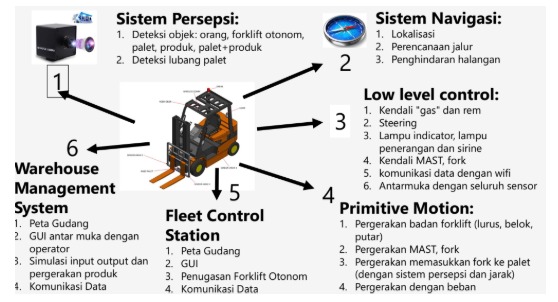
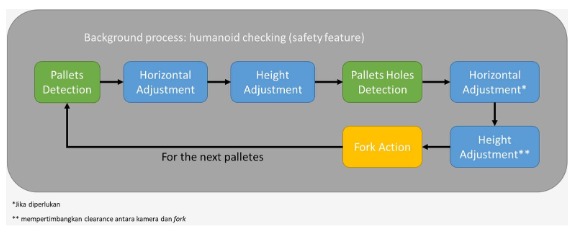
Recent developments in e-commerce have increased customer demand, expanding from small to large-scale operations in national and international trade. This undoubtedly provides several benefits to a country's economic well-being. One key aspect of e-commerce is the fulfillment of goods from manufacturers' warehouses, where goods are stored before being shipped. Large-scale goods mobility and transportation have traditionally been carried out using human-operated forklifts, which can be time-consuming, inefficient, and often raise ethical issues such as overwork and unsuitable working conditions in these warehouses. Technological advancements utilizing artificial intelligence and automation could be key for manufacturers to fulfill their role as customers, particularly in the storage and logistics of goods. Every industry requires forklifts to service and place goods. In warehouse 4.0, the use of autonomous forklifts can be proposed. The function of autonomous forklifts is to carry heavy goods placed on pallets. Autonomous forklift systems can be used for localization, navigation, pose estimation, obstacle tracking, and pallet detection. For navigation, autonomous forklifts can travel from point of origin to point of destination and must track targeted pallets and perform picking tasks.