Sensor Fusion and Machine Learning Approach for Tsunami Prediction in a Tsunami Early Warning System
Peneliti: Astri Novianty, Carmadi Machbub, Sri Widiyantoro, Irwan Meilano
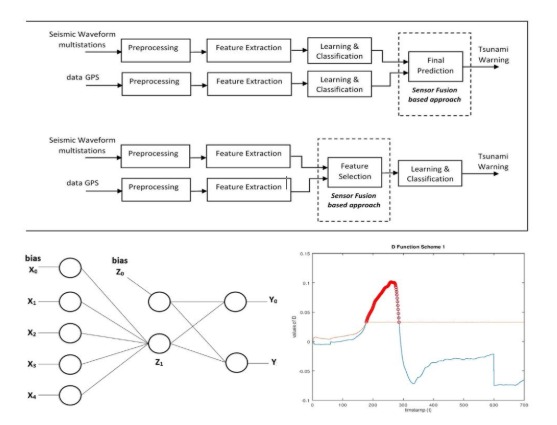
Two important issues related to the tsunami early warning system / tsunami early warning system (TEWS) is prediction accuracy and computational time optimization. These issues have driven research in several areas related to TEWS. This study attempts to find several alternative solutions to the first problem, namely prediction accuracy, using several approaches, namely the . / machine learning and sensor fusion approaches.
A machine learning approach was used to enhance the system's inference capability in determining tsunami predictions based on seismic parameters, while a sensor fusion method was applied to increase the presence of relevant features for prediction input. Using both approaches, it is hoped that the performance of the tsunami prediction system in TEWS can be significantly improved.
Several machine learning methods have been explored and applied in many experiments in this study, such as ANN, SVM, and Gaussian distribution. The results show that accuracy tends to increase but continues to improve with the research. GPS data has also provided additional seismic features beyond those provided by seismometer data. This research is ongoing and is expected to provide many beneficial contributions to technological advancements in the field of disaster management research.