
STEI Students Participate in the IZZIPACK Team, Winning Awards in South Korea
Two ITB students, Marchio Kevin Abdul Azis (Electrical Engineering 2015) and Intan Nur Amanah (Product Design 2015), achieved success with a team from Chonbuk National University Korea, at the Global Capstone Design Fair: Engineering Education Festival (E2Festa) 2019, at the end of last November. In the event, both of them won the Excellence Award Winner or equivalent to the Runner Up title. Other team members are Kim Ju Young Ko (Chonbuk National University, Mechanical Engineering), Jeong Gon Lee (Chonbuk National University, Mechanical Engineering), and Ga Young (Chonbuk National University, Industrial Design).
One of the team members, Marchio, revealed that his team was a delegation from the Hub of Innovation Chonbuk National University and his team was selected as one of the delegations because it had won the Grand Prize Award in the previous competition, namely the International Student Joint Capstone Design Project (i-CAPS) 2019 in Daejeon, South Korea, in August 2019.
"When we first started participating in this competition, you could say we had been preparing for this competition for a long time since January 2019 when we first participated in i-CAPS 2019, which is also a similar competition," said Marchio.
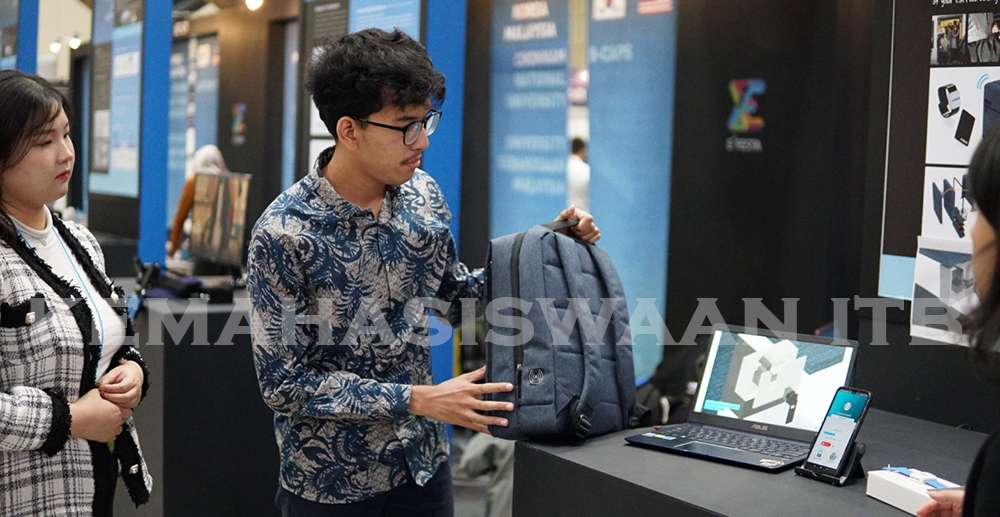
According to him, this competition is a technology-based innovation product design competition. The difference lies in the multi-disciplinary and multi-national aspects, where each team comes from a different study program, and the participants come from different countries as well. For example, his team consists of Indonesians and South Koreans. In the competition, Marchio's team created an anti-pickpocket backpack based on electromechanical technology, named IZZIPACK. This was motivated by the issue of the security of valuables when users use public transportation, such as buses/trains/MRT, especially during rush hour.

Based on the team's research, it was revealed that stealth pickpocketing is more likely and more frequent in crowded conditions than forced pickpocketing. Therefore, backpacks with zipper locking systems, so only the owner can open the backpack, are recommended. tap kartu/gelang RFID.
"We also raised the issue that many anti-pickpocket bags on the market generally prioritize security, resulting in very poor accessibility. Therefore, the zipper locking system we created is designed in such a way that IZZIPACK has excellent accessibility. IZZIPACK is also integrated with a smartphone app to monitor battery life, activate an alarm system, and track lost/stolen bags with a GPS tracker," he explained.
Despite winning the award, Marchio admitted that his team also faced significant technical challenges. He said the technology they created was indeed original, requiring significant effort. trial and error when implemented. In addition, the team also had quite a bit of difficulty integrating all the electrical and mechanical components into the bag. notabeneIt's made of soft fabric. So the technology must be sturdy, waterproof, and shockproof, but the bag must also remain elastic and lightweight.
"But the biggest challenge of this competition is its multidisciplinary and multinational nature. We have to adapt to long-term teamwork with team members from different majors and perspectives, especially with our three South Korean team members, who certainly face significant barriers in terms of perspective, language, and time," he concluded.
