Wireless Sensor Network and Multi-Agent System for Bridge Health Monitoring
Peneliti: Bambang Riyanto Trilaksono, Seno Adiputera, Muhammad Ryansyah, Dina Shona Laila
Bridges are one of the most important infrastructures supporting social and economic activities, especially in Indonesia, an archipelagic country with numerous rivers crossing the land. Indonesia is also located on an earthquake belt, making the land less stable due to frequent earthquakes and landslides. These natural challenges, coupled with a lack of adequate bridge monitoring and management, often result in fatal bridge collapses. Therefore, implementing bridge management and monitoring is crucial to ensure the sustainability of this infrastructure. This research project aims to explore embedded systems and wireless sensor networks technologies.wireless sensor network (WSN) and multi-agent systems to create an affordable and effective bridge health monitoring system.
The health of a bridge is highly dependent on its environment and usage. This study focuses on the effects of moving loads, such as large vehicles, as the parameter to be monitored. This is a crucial factor, especially for bridges on busy routes, whose availability has a significant impact on the economy and public welfare. An algorithm for translating bridge vibrations into bridge condition assessment ratings has been developed and implemented in a WSN embedded system platform.
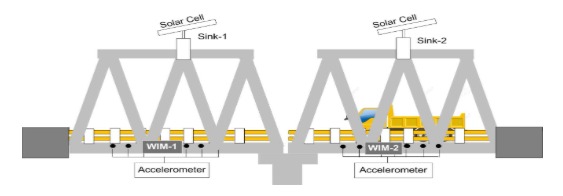
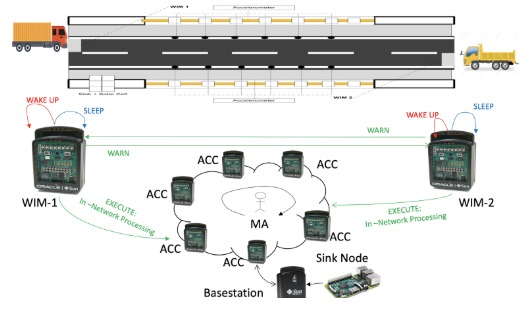
The use of WSN technology allows for local processing of measured data before the information is transmitted to a monitoring station. This autonomous and intelligent WSN with predictive capabilities is proposed for early damage detection and early warning to users. It also enables remote control and communication, which is particularly useful for applications on remote bridges. A simple yet efficient algorithm for detecting changes in bridge characteristics was developed using Agent Oriented Software, to build the intelligent capacity of this Wireless Sensor Network (WSN). Weight in Motion (WIM) is used to enable efficient operation of WSN nodes by predicting the type of vehicle crossing a bridge. The use of WSN and Artificial Intelligence algorithms is currently being developed for bridge damage (crack) isolation. This project is funded by the Newton Fund and is a collaboration between ITB, Telkom University, Coventry University (UK), and Pusjatan.