Hybrid Underwater Glider for Maritime Exploration and Surveillance
Peneliti: Bambang Riyanto Trilaksono, Egi Muhammad Idris Hidayat
Students: Simon Siregar, Natsir Habibullah
As the world's largest archipelagic nation, Indonesia has a vast marine territory of over two million square meters. According to the UNDP, millions of Indonesians depend on marine resources for food, livelihoods, and tourism. Indonesian waters are home to a diverse range of species with exceptional biodiversity. Indonesian waters are also thought to hold substantial reserves of oil and natural gas.
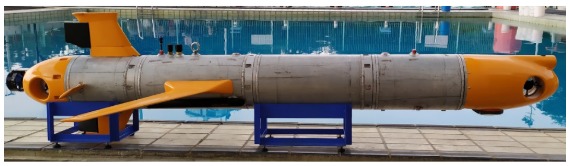
Autonomous underwater vehicle (AUV) is an alternative solution for maritime exploration and surveillance. This vehicle offers high flexibility with the possibility of being equipped with various sensor payloads. In our lab, we developed a hybrid autonomous underwater vehicle/glider prototype. This type of AUV allows the vehicle to switch between AUV and glider modes, thus extending operational duration without losing maneuverability. The main advantage of AUVs compared to other maritime technologies is the ability to perform long-duration voyages, allowing them to cover large areas with efficient operational costs. Potential uses of this technology include: sampling and monitoring ocean temperatures for climate studies, detecting the activity of specific species to determine fish stocks, and maritime border surveillance.