
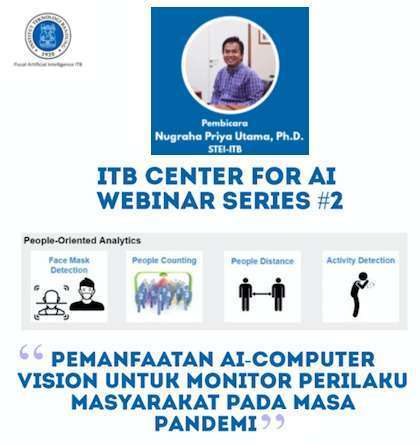
Nugraha Priya Utama in a webinar on the use of AI and computer vision to monitor public behavior during the pandemic.
BANDUNG, itb.ac.id – The Artificial Intelligence Center of the Bandung Institute of Technology held a webinar with the theme "Utilization of AI-Computer Vision to Monitor Community Behavior During the Pandemic", Wednesday, May 20, 2020. The webinar featured presentations from Nugraha Priya Utama, Ph.D., Lecturer at the School of Electrical Engineering and Informatics (STEI) ITB.
The purpose of the webinar was to explain what AI-Vision can do to help monitor the public regarding the new normal conditions that will occur, both in schools, places of worship, airports, offices, bus/train stops, libraries, and outdoors such as on the streets, tourist attractions, sports venues, parks, and other facilities.
He, often called Utama, explained that AI-Vision, or computer vision, is a branch of artificial intelligence that trains computers to interpret, interpret, or understand visual aspects of human vision. "This visual computer uses images obtained from digital cameras or videos, using deep learning-based models to identify and categorize objects. So, the main goal of AI-Vision is to automate human tasks visually," Utama said in his presentation.
The lecturer at the School of Electrical Engineering and Informatics (STEI) ITB added that there are three basic steps that are always present in computer vision. The first is acquiring the image (image collection), processing the image (image processing), and understanding the image (understanding/interpreting the image). "One thing that computer vision can be used for is monitoring public behavior both indoors and outdoors. Such as whether people are wearing masks or not, whether they are in crowds or not, or whether they are maintaining distance or not amidst the current pandemic conditions. Computer AI can also automatically measure temperature, health, or even monitor traffic density, estimate age, and so on," he said.
The ITB AI Research Center has been conducting community monitoring using AI-Vision in collaboration with Prosa AI. The first model is Vehicle Classification and Counting (VCC), combined with License Plate Recognition (LPR) and Illegal Parking (LP). It can be used both indoors and outdoors. For example, it can be used to monitor parking lots linked to the number of visitors at a shopping center. "Indoor use can be used, for example, to regulate the number of vehicles entering gas stations. We can see whether the vehicles are using fuel according to their intended use or not, using subsidized fuel or not?" he said.

*Several AI-Vision Models from the ITB AI Center for public welfare and security during the COVID19 pandemic
The model was built using Yolo V3-Tiny, trained and configured with a dataset of photos of various vehicle types, vehicle types, and license plate numbers. He explained that the inference flow for VCC is easier when input is obtained from CCTV, then vehicle detection and classification is performed for vehicle type and quantity. The same process is used to detect vehicle license plates. However, for the IP model, or illegal parking monitoring, the first step is to set the area. When a vehicle enters, the CCTV will calculate the time to determine whether it has exceeded the maximum parking time limit.
The second model involves monitoring people who aren't wearing masks. The goal is to anticipate if, when PSBB restrictions are relaxed, many people are still roaming around without wearing masks properly, allowing area management to take further action. This model was developed with the ability to recognize faces and distinguish between those wearing masks and those without.

*Several AI-Vision Models from the ITB AI Center for public welfare and security during the COVID19 pandemic
"Broadly speaking, we built this second model using a Single Shot Detector (SSD) and a deep CNN. Then, we input a dataset of hundreds of thousands of local Indonesian faces and their attributes. For inference, the camera first detects faces, then classifies whether they are wearing masks. If they are not wearing masks, we can then detect them based on the existing database," he explained.

*Several AI-Vision Models from the ITB AI Center for public welfare and security during the COVID19 pandemic
Furthermore, the ITB Artificial Intelligence Center has also developed a model to estimate the distance between people and count the number of people recorded indoors and outdoors. The goal is to determine whether people are practicing physical distancing.
Utama and his team have also created a model to monitor general human movement. "We hope that every human movement recorded on CCTV through the human movement model can be tracked and traced," he said.