
KURIKULUM
The Electrical Power Engineering program provides students with fundamental knowledge and principles in electrical power engineering, along with necessary knowledge in mathematics, science, computing, and the fundamentals of engineering. Students are given the opportunity to develop their abilities to formulate, analyze, and solve complex problems, as well as to design products or systems based on real-world problems, particularly in electrical power engineering.
This program provides sufficient breadth and depth of knowledge for successful graduate, master's, and doctoral studies. It also provides opportunities for lifelong learning, fundamental skills to contribute to the development of electrical power engineering and related industries, both in Indonesia and abroad. Furthermore, the Electrical Power Engineering Study Program provides an appreciation for issues arising in professional practice, including teamwork, leadership, safety, ethics, service, economics, environmental awareness, and professional organizations.
The courses that will be taken by students of the Electrical Power Engineering Undergraduate Study Program are as follows.
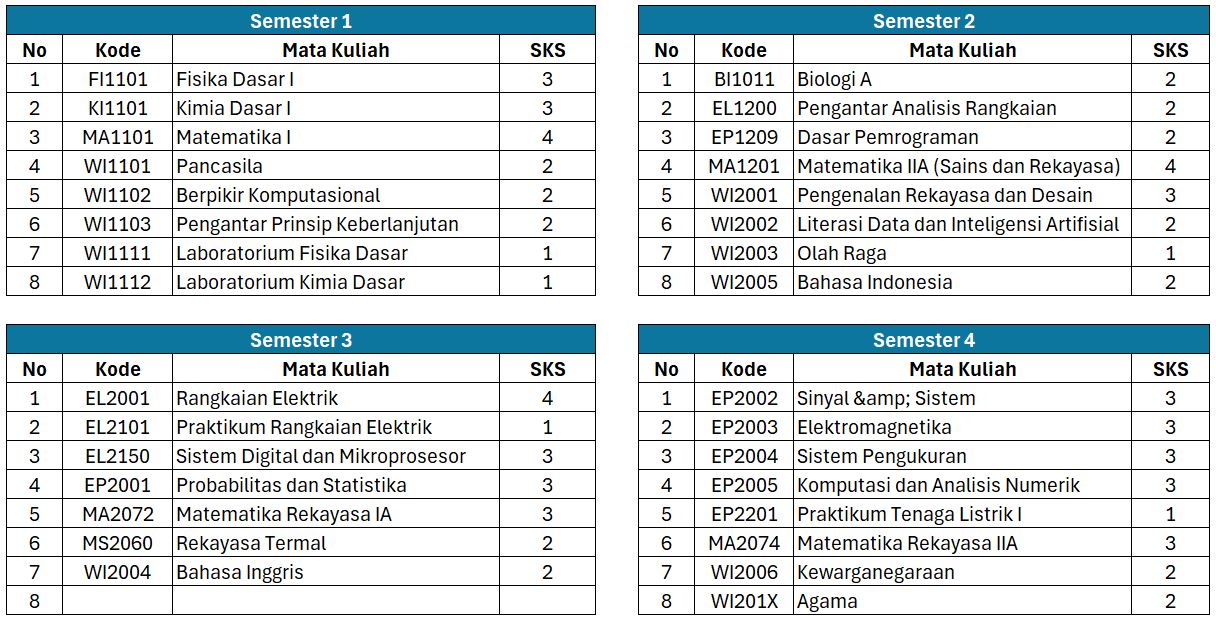
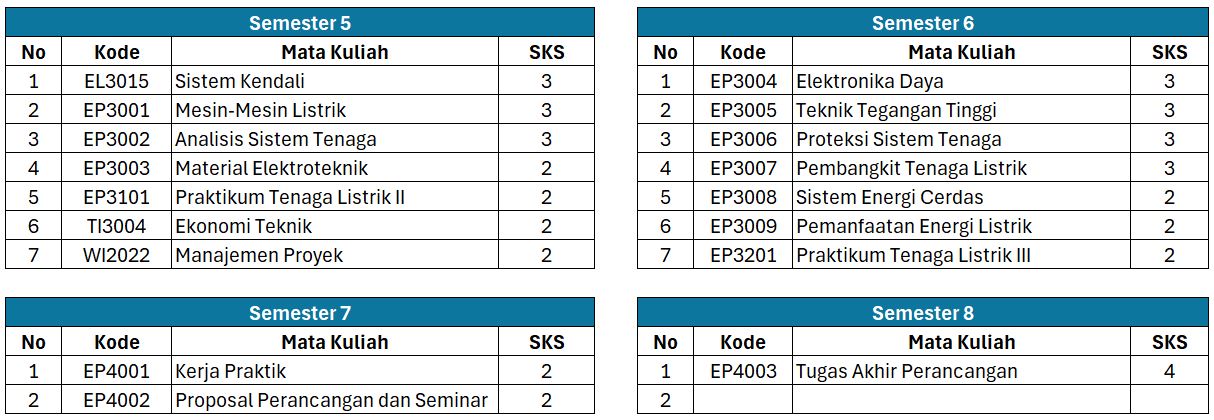
Detailed explanations for each course can be accessed through the following link.
Specializations are services provided to fourth-year students in the form of elective course packages that offer in-depth learning on specific topics. The Electrical Power Engineering Undergraduate Program offers four specialization tracks for students, as follows:
1. Electric Vehicles
Specialization package of the Electric Vehicle provides in-depth knowledge related to electric vehicle technologies. In this track, students are required to complete three courses focused on electric vehicle systems: Electric Vehicles, Energy Management Systems, and Electric Transportation Systems. After completing this specialization, students are expected to gain a deeper understanding of electric vehicle technology and the broader electric transportation landscape. Courses offered in the Electric Vehicles Specialization: Electric Vehicle Systems (3 credits), Energy Storage Systems (3 credits), and Electric Transportation Systems (3 credits).
2. High Voltage Equipment
Specialization package of the High Voltage Equipment provides in-depth knowledge of high voltage systems and equipment. Students must complete three out of the following four elective courses: High Voltage Equipment & Testing, High Voltage Equipment Insulation Techniques, Maintenance of High Voltage Equipment, and Diagnostic Techniques for High Voltage Equipment. This specialization aims to provide students with a more comprehensive understanding of high voltage equipment. Courses offered in the High Voltage Equipment Specialization: High Voltage Equipment & Testing (3 credits), Insulation Techniques for High Voltage Equipment (3 credits), Maintenance of High Voltage Equipment (3 credits), and Diagnostic Techniques for High Voltage Equipment (3 credits)
3. Renewable Energy
Specialization package of the Renewable Energy focuses on the utilization of renewable energy sources for electricity generation. Students are required to complete three courses: Energy Regulation and Policy, Renewable Energy Power Plants, and Sustainable and Economical Energy. Upon completion, students are expected to understand the technical and economic aspects of renewable energy utilization in electricity generation. Courses offered in the Renewable Energy Specialization: Energy Regulation and Policy (3 credits), Renewable Energy Power Plants (3 credits), and Sustainable and Economical Energy (3 credits)
4. Power Systems
Specialization package of the Power Systems provides deeper insight into the operation and technology of electrical power systems. Students are required to complete three out of five elective courses: Grounding and Overvoltage Protection, Relay Technology, Electric Power Distribution Systems, SCADA & Energy Management in Power Systems, and Power System Control & Stability. This specialization equips students with detailed knowledge of power system operations and associated technologies. Courses offered in the Power Systems Specialization: Grounding and Overvoltage Protection (3 credits), Relay Technology (3 credits), Electric Power Distribution Systems (3 credits), SCADA & Energy Management in Power Systems (3 credits), and Power System Control and Stability (3 credits)
Detailed information about each specialization can be accessed through the following page:
https://six.itb.ac.id/pub/kur2024/180