
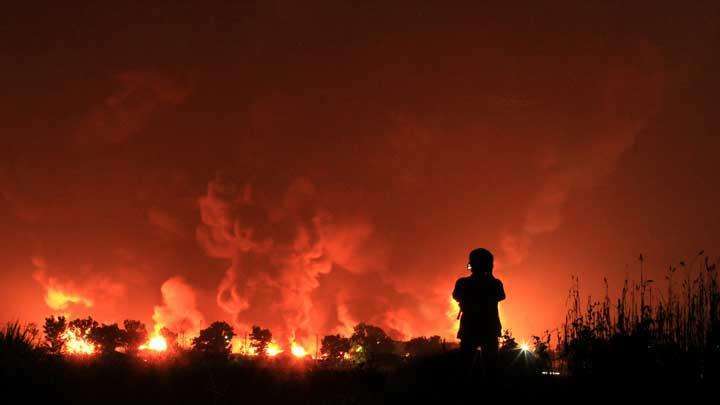
Prof. Reynaldo Zoro Ungkap Cara Petir Tropis Bisa Membakar Kilang Pertamina Balongan
STEI ITB lightning expert Reynaldo Zoro revealed how a lightning strike could burn down a Pertamina refinery, such as the one in Balongan, Indramayu, at the end of March.
According to him, a similar incident occurred at another refinery, in Cilacap. "When a lightning strikes a fuel component installation, there's oxygen. If there's a fire from lightning, it will ignite," said the retired professor at the ITB School of Electrical Engineering and Informatics.
Previously a lecturer and researcher in the Electrical Engineering research group, he believes the Balongan refinery caught fire and exploded after being struck by lightning. He went there to gather evidence outside the fire investigation team.
In addition to field findings, his assumptions are based on previous incidents. "Lightning has struck refineries in Indonesia more than once. Since 1995, the Cilacap lightning-caused fire has caused a tank fire almost every year," he said when contacted on Monday, April 5, 2021.
Furthermore, he said, the Dumai refinery has twice caught fire due to lightning, once in Balikpapan, and once in Sorong. So far, he said, there's no strong possibility other than lightning. "Was it a thrown cigarette butt? That's impossible," he said. Meanwhile, security in the oil region is very tight.
The indication of a tank leak before the fire and explosion is another factor to investigate. "They're all interconnected. Why the leak and why the fire happened? That's what we're investigating, trying to evaluate, and there must be a scientific reason," Reynaldo said.
According to him, Pertamina's refineries have been using standard lightning rods in accordance with international regulations. However, these devices are deemed insufficient to protect the 4.8 millimeter-thick tanks, as the standard refers to lightning in subtropical countries. Meanwhile, lightning conditions in Indonesia are unique.
"Almost throughout Indonesia, lightning strikes have large charges, high amplitudes, steep waves, and a high destructive capacity. This is called tropical lightning," he said.
Tropical lightning, he said, has been studied since 1992. Normally, the electric current from tropical lightning is 40 kiloamperes with a 50 percent probability, 100 kiloamperes with a 20 percent probability, and even more rarely, reaching 200 kiloamperes in 5 percent. The maximum current of tropical lightning is up to 900 kiloamperes. "It was recorded in 1995 in the Cinere area of Jakarta," Reynaldo said.
He believes that improved tank safety against lightning strikes is necessary, as standard lightning rods are insufficient. The simple goal is to prevent the refinery's tank structure from being hit by lightning currents.