Construction of the KOICA-ITB Cyber Security Center Building
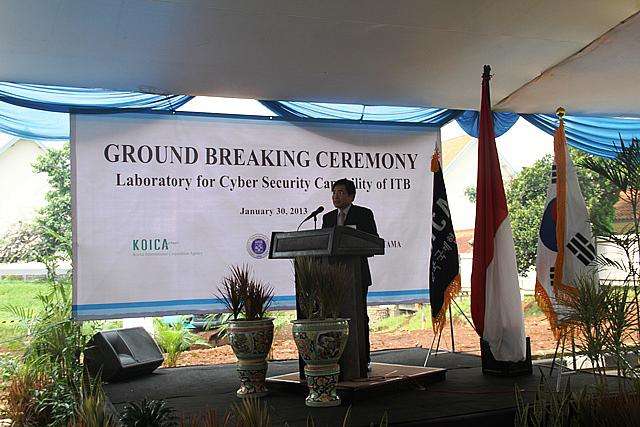
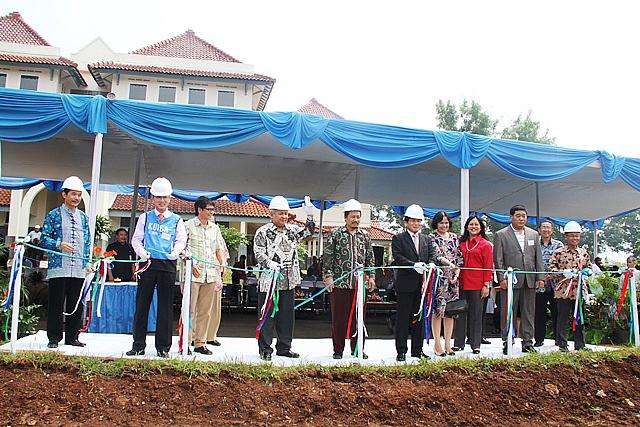
On January 30, 2013, the KOICA-ITB Cyber Security Center building, which will be fully managed by the School of Electrical Engineering and Informatics (STEI), was officially opened at the ITB Jatinangor Campus. The South Korean Ambassador to Indonesia gave a warm welcome. Mr. Young Sun Kimthen continued by Dr. Yusep Rosmansyah. The following is the content of Dr. Yusep Rosmansyah's press release: Every day more and more information is stored, entrusted, obtained, and exchanged electronically with digital computers that are connected to each other to form a network. In short, more and more information is processed in the cyber world, virtual world, or in practical terms: the Internet network. A simple example is money: we receive our salary via bank transfer and get notifications via SMS or email. Some of this money we spend on a book using a debit card online via the Internet. We receive money and spend it without needing paper money or coins, but only based on information on our cell phones or computers.
It turns out that information entrusted and exchanged in the form of digital electronic data using internet technology has encompassed almost every aspect of life. The more advanced a country becomes, the more information is entrusted to the internet, and the less it requires paper or manual forms. South Korea is one of the most advanced countries in terms of adopting internet technology in various aspects of life, from banking, government, education, defense, industry, and even agriculture. In fact, starting in 2013, a movement to school without textbooks, using only tablet computers, has begun in several elementary schools in Seoul.
With more and more information being entrusted to cyberspace, its security has become a necessity. In July 2012, President Obama wrote an article in the Wall Street Journal about the need for stricter cybersecurity legislation. He stated that a nation's defeated enemies on the battlefield could attack weaknesses in domestic computer networks. These vulnerable networks include banking systems, hospitals, water systems, and power grids. Furthermore, a few months later, Secretary of Defense Leon Panetta stated that internet attacks by terrorist groups could have a more devastating impact than the September 11 attacks.
What about the condition of our country? In 2012, a national newspaper reported that there were more than one million attacks on our internet network. These attacks consisted of various types, including data theft, data falsification, data alteration (e.g., website homepages), phishing, data leaks, industrial espionage, data misuse by insiders, and other crimes. Yet, in that same year, all adults had entrusted crucial personal data (such as address, year of birth, fingerprints, and corneas) to cyber networks for the production of electronic ID cards (e-KTP). Is the security of these hundreds of millions of citizens' important data guaranteed? No one knows for sure, because information theft in cyberspace does not erase the original information.
Frankly, our country is still lagging behind in the field of cybersecurity. One proof of this is the lack of a robust Computer Emergency Response Team (CERT), staffed by hundreds or even thousands of competent full-time employees, as is the case in our neighboring countries. Our country still lacks competent experts capable of handling cyberattacks, especially large-scale ones. We are also far from self-sufficient in the procurement and development of information security tools and technology. In other words, almost all information security tools and products still have to be imported.
It is for these two main reasons that the KOICA-ITB Cyber Security Center was built with a grant from the Korean Government through KOICA (Korean International Cooperation Agency). Once construction is complete, at least two programs will be implemented: an educational program and a research and development program. The educational program is aimed at producing competent human resources in the field of cybersecurity, both in the form of regular master's programs and executive master's programs (for experienced employees), or professional training and certification programs. The research and development program has even begun through research by undergraduate, master's, and doctoral students, and product development. In the next few years, we aim to continuously improve the quality and quantity of competent human resources in the field of cybersecurity and implement research and development products in various government and private institutions, even exporting them abroad. Parallel to these two main programs, collaborative programs will continue to be developed, both with domestic and international partners.
The KOICA-ITB Cyber Security Center building, which began construction today, will have 3 floors, consisting of an auditorium and exhibition plaza on the 1st floor, a cyber security laboratory and research room on the 2nd floor, and a teaching and learning activity room on the 3rd floor.
We hope that the commencement of construction on this building will also raise awareness among all of us of the importance of cybersecurity, both for ourselves and for our beloved country. We must not allow ourselves to assume that everything is under control simply because we don't know, when in fact, all our important information, whether we know it or not, is already in the hands of the enemy. We will begin construction on this building, then develop our human resources, and through the collaboration and support of various parties, we will strengthen our research and the independence of our domestic products. Ultimately, we can strengthen our nation's cyber defense and resilience.
The following is photo documentation of the inauguration event: http://stei.itb.ac.id/gallery/index.php/20130130-Ground-Breaking-Ceremony-Laboratory-for-Cyber-Security-Capability-of-ITB-ITB-Jatinangor?page=5