First Offline Lecture After 1.5 Years of the Pandemic
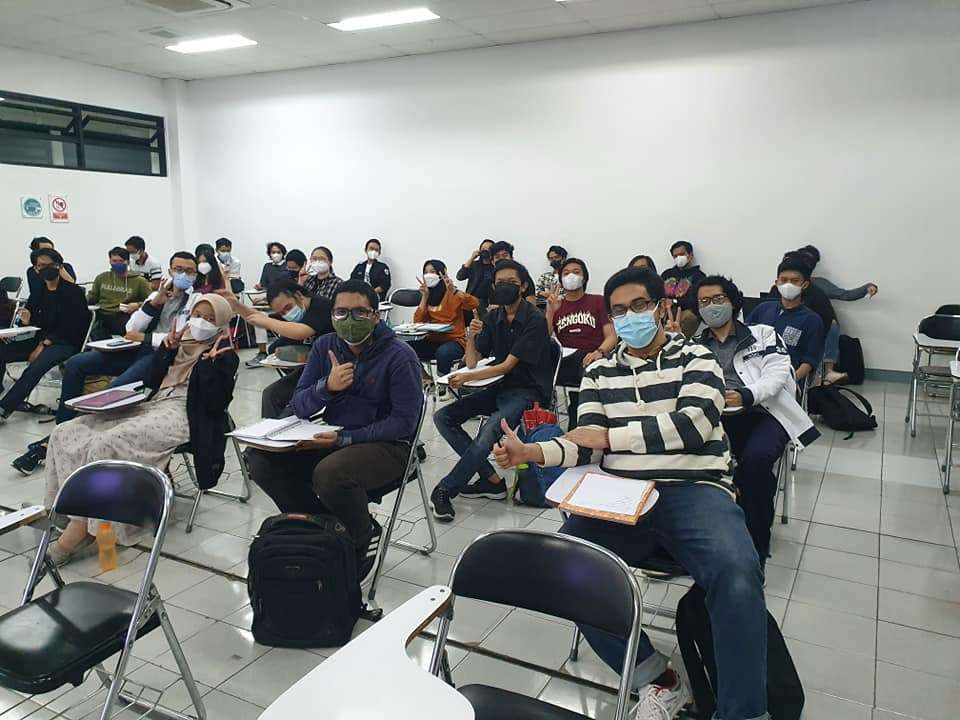
Tuesday, November 2, 2021, was a "historic" day for some Informatics Engineering students of STEI-ITB class of 2020. Because, on that day, their first face-to-face lecture was held after more than a year since their TPB had been studying online.
Thank God, the coronavirus pandemic in Indonesia has begun to subside. The number of positive cases has decreased significantly over the past two months, falling to less than 1,000 per day. The number of recoveries exceeds the number of positive cases, and the death toll has also dropped dramatically. Vaccinations are being increasingly carried out everywhere. It's possible that a new wave of cases has already been formed. herd immunity in society so that positive cases continue to decline. God knows best.
The government has begun easing restrictions on previously closed or restricted activities, including education. Schools have begun to reopen gradually, and universities are also reopening limited lecture activities such as labs, studios, field trips, and face-to-face lectures.
When there was a questionnaire circulated from the Head of Informatics Study Program regarding the willingness of lecturers to teach lectures offline (offline) After the midterm exam, I expressed my willingness to teach on campus again. There were several reasons why I agreed to teach. First, I shared the sadness of the 2020 class. Since being accepted as ITB students, they had never experienced a single face-to-face class on the Ganesha campus. Forget about attending a lecture, most of them had never even set foot on the Ganesha campus.
The second reason is that for almost two years, the ITB campus has lost its distinctive academic atmosphere. Before the pandemic, we could see how lively the academic atmosphere on the ITB campus looked. Despite its small campus area, we could see students engrossed in studying and working on assignments on park benches, in the cafeteria, at open study tables, on the floors of buildings, in the library, in the unit and association secretaries. In the lab, we could see students working on practicums. In other rooms, seminars, discussions, and scientific meetings took place. Not only from morning to afternoon, but even into the night, the campus remained alive with students who seemed reluctant to return to their dorms. The ITB campus is indeed a conducive place to study. However, all of that scenery disappeared when the fire nation attacked, eh—when the coronavirus struck. The coronavirus pandemic forced the campus to close, students returned to their hometowns, and lectures and other activities were conducted online. By starting offline classes, it is hoped that the lost academic atmosphere on campus can be revived.
The third reason is more personal. I'm a lecturer who loves teaching. Education has long been my passion. For me, teaching face-to-face in the classroom is irreplaceable by online lectures. There's a special joy in finishing a lesson, the joy of seeing them understand, comprehend, and be enlightened. There's a dialogue and narrative built during a face-to-face lecture. In online lectures, we don't get to see the students' faces nodding as they see formulas deduced, or quips like "...oooo… begitu caranya” when we answer a difficult question on the board.
Long story short, I started surveying students in the courses I teach, asking who wanted to study offline on campus this semester. Previously, the Head of the Informatics Study Program had also surveyed IF students about offline classes, and it turned out that 63 percent of IF students were ready to participate in offline classes. Of the 2020 IF students, there were 70 people who tentatively wanted to study offline. Because class capacity was limited during the adaptation to new habits, the number was limited to a maximum of 34 people. The 34 people were the capacity for room 7602, the largest lecture room in LabTek 5. Interest in offline classes was not only from class K1 that I teach, but also from other parallel classes, K2 and K3, after coordination with the lecturers in charge of each class. In total, there were around 30 students who wanted to study offline at LabTek 5.
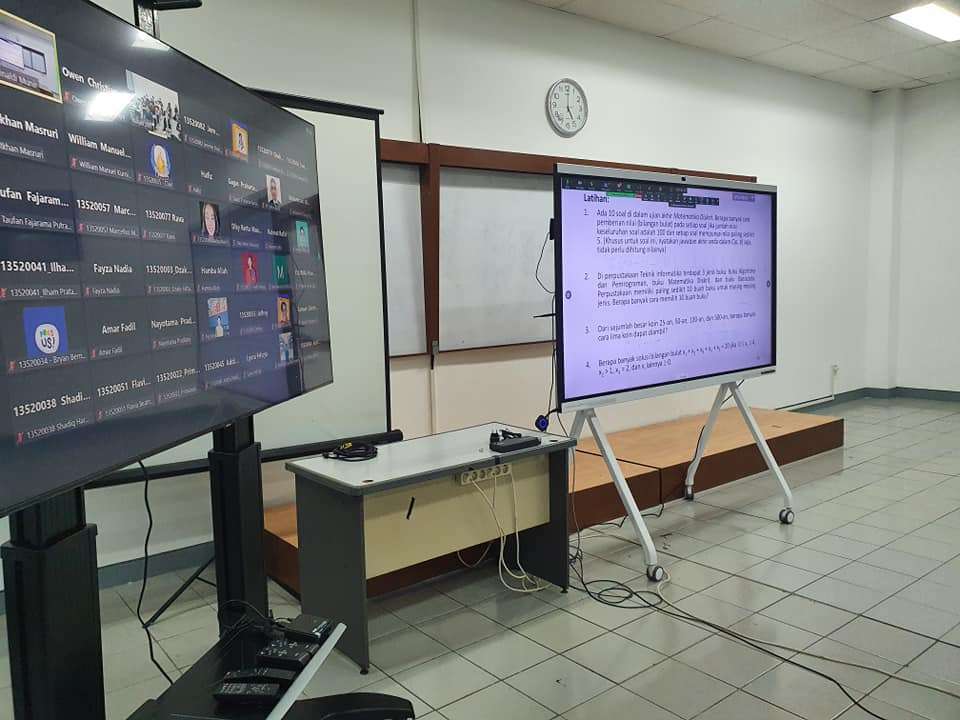
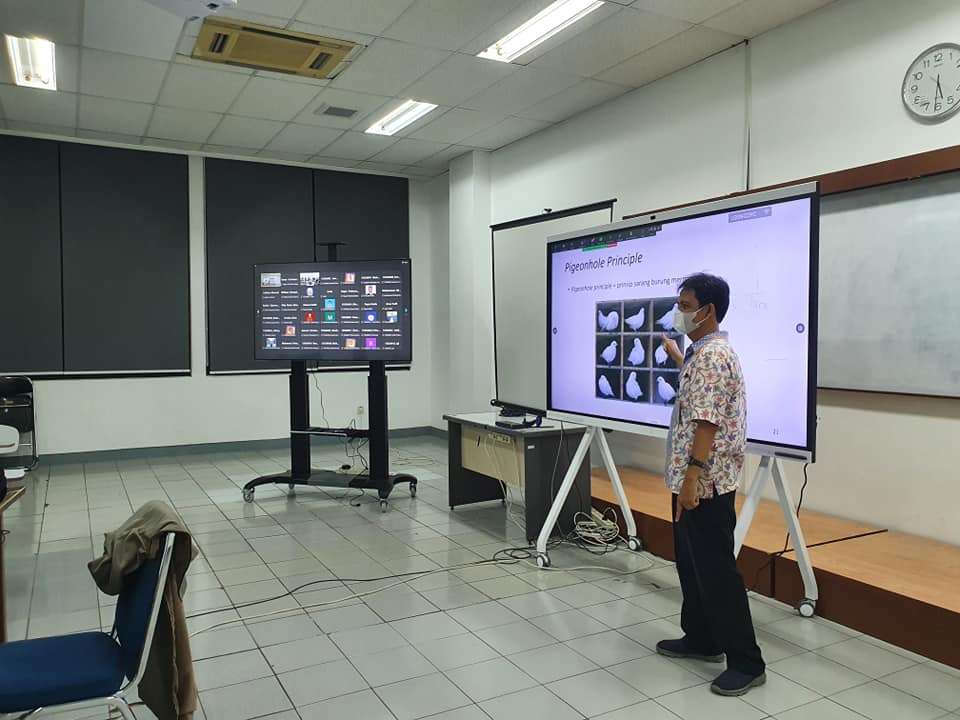
The offline courses I teach are IF2120 Discrete Mathematics (Matdis) and IF2123 Linear Algebra and Geometry (Algeo). The Matdis lectures are on Tuesday afternoons and the Algeo lectures are on Wednesday afternoons. Lectures will be held in a blended format (hybrid), so that students studying online at home can join their classmates studying offline on campus. To achieve this, equipment is used that can facilitate both learning methods.
arrived on campus two hours before class began. I had to learn how to use the equipment, which consisted of a camera and two large monitors connected to a computer and internet access. It took me an hour to learn how to use it. The Duktek staff, Mr. Sudiarto, Mr. Syamsudin, and Mr. Cece, assisted me in using this sophisticated equipment. They were also learning how to use it, as this blended learning equipment had just been purchased and installed. According to information, this blended learning equipment is very expensive.
One large monitor from Huawei in front of the class is used to display PPT slides that areshare with the platform Zoom, while another large monitor is used to display students studying online at home. A camera that can rotate automatically is installed in front to display the lecturer's image in real time. live who teaches in front of the monitor HuaweiWherever I walked in the classroom, the camera rotated toward me so that the lecturer's images moving around the classroom could also be seen by the students online at home.
At just before 4:00 PM, the students had already entered room 7602. They had received campus entry permits, had been vaccinated, had filled out their AMARI forms, and were wearing masks. I assumed they were all students from Greater Bandung, but it turned out many also came from Jakarta, Central Java, Padang, and elsewhere. It turned out these students from outside Bandung had been boarding in Bandung for several months. So, they weren't suddenly in Bandung because they wanted to attend in-person classes.