
EU Panel Seminar on Smart Cities: The Importance of Human Resources for Smart Cities
 The development of technology means that the smart concept is not only applied to various devices, but also to various systems, one of which is the concept smart cityThis concept proposes a smart city system that can manage its resources, both human and natural resources, efficiently and effectively to achieve... high livabilitycomfort, and sustainable development. By implementing this concept, the quality of life for people living in a city will improve, including in Indonesia.
Panel Seminar on Smart Cities which was held on Friday (12/02/16) at the West Hall of ITB from 12.30-15.00 was the result of collaboration between the Institute for Innovation and Entrepreneurship Development (LPIK) ITB and the European Union delegation to Indonesia. This seminar presented Patrick Herman (Belgian Ambassador), Michal Slivović (Slovak Ambassador), Johanna Brismar Skoog (Swedish Ambassador), Andreas Karabaczek (Austrian Ambassador), Valerica Epure (Romanian Ambassador), and Prof. Dr. Suhono Harso Supangkat, M.Eng (Initiator) Smart City ITB) as a speaker. More than 500 participants from various educational institutions attended this seminar.
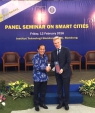 The event began with an opening speech from the Ambassador of the European Union to Indonesia and Brunei Darussalam Vincent Guérend, followed by remarks from the Rector of ITB Prof. Dr. Ir. Kadarsah Suryadi, DEA. Simply put, a smart city is a city that uses technology, especially information technology, to improve the quality of life of the people within it. ITB is one of the universities in Indonesia that is actively involved in the development of smart cities in Indonesia. ITB contributes through LPIK which encourages the development of the smart city concept that is starting to be implemented in Indonesian cities. The transformation of a city into smart city "It requires participation from the community, the private sector, and the government," said Prof. Kadarsah.
Smart Cities in European Union Countries
The five ambassadors who were present took turns explaining the concept. smart city that have been implemented in each country, followed by a question and answer session moderated by Santi Novani, Ph.D. "A smart city must be a creative city, as well as a city that supports human rights. These three things cannot exist without each other," said Belgian Ambassador Patrick Herman. Slovak Ambassador Michal Slivović explained the types of smart buildings and housing being built in Bratislava. The building design emphasizes energy efficiency and aims to improve the quality of life of its residents.
 Swedia menggunakan pendekatan quadruple helix in the application of the concept smart city which shows the importance of the relationship between the community, educational institutions, the private sector, and the government. Without integration between these four parties, the concept of smart citywill not be able to be executed properly. Some examples of the technologies applied are ecological sustainability, smart heating and cooling system, waste to energy, as well as transporting household waste using vacuum suctionSweden managed to reduce carbon emissions by 22% and increase GDP by 58% between 1995 and 2013.
Smart City Challenges in Indonesia
"According to UN data, more than 60% of the population lives in cities, and the need for energy and waste management continues to increase. Therefore, ways will be needed to ensure that people feel safe, comfortable, and sustainable," said Prof. Suhono. "Some of the challenges faced by Indonesia include how to (1) Improve mobility, (2) Water supply and waste management, (3) Energy conversion, (4) Make a country safe, healthy, andsecure, and (5) Building social and economic infrastructure,” he continued.