
Cybersecurity Threats as a Classic Challenge in the Internet World
BANDUNG, itb.ac.id — Technological skills must also be supported by the ability to manage and maintain the technology systems developed. This was the topic of discussion at the Academic, Community Service, and Research Discussion (BINAAR) held by the School of Electrical Engineering and Informatics (STEI ITB).
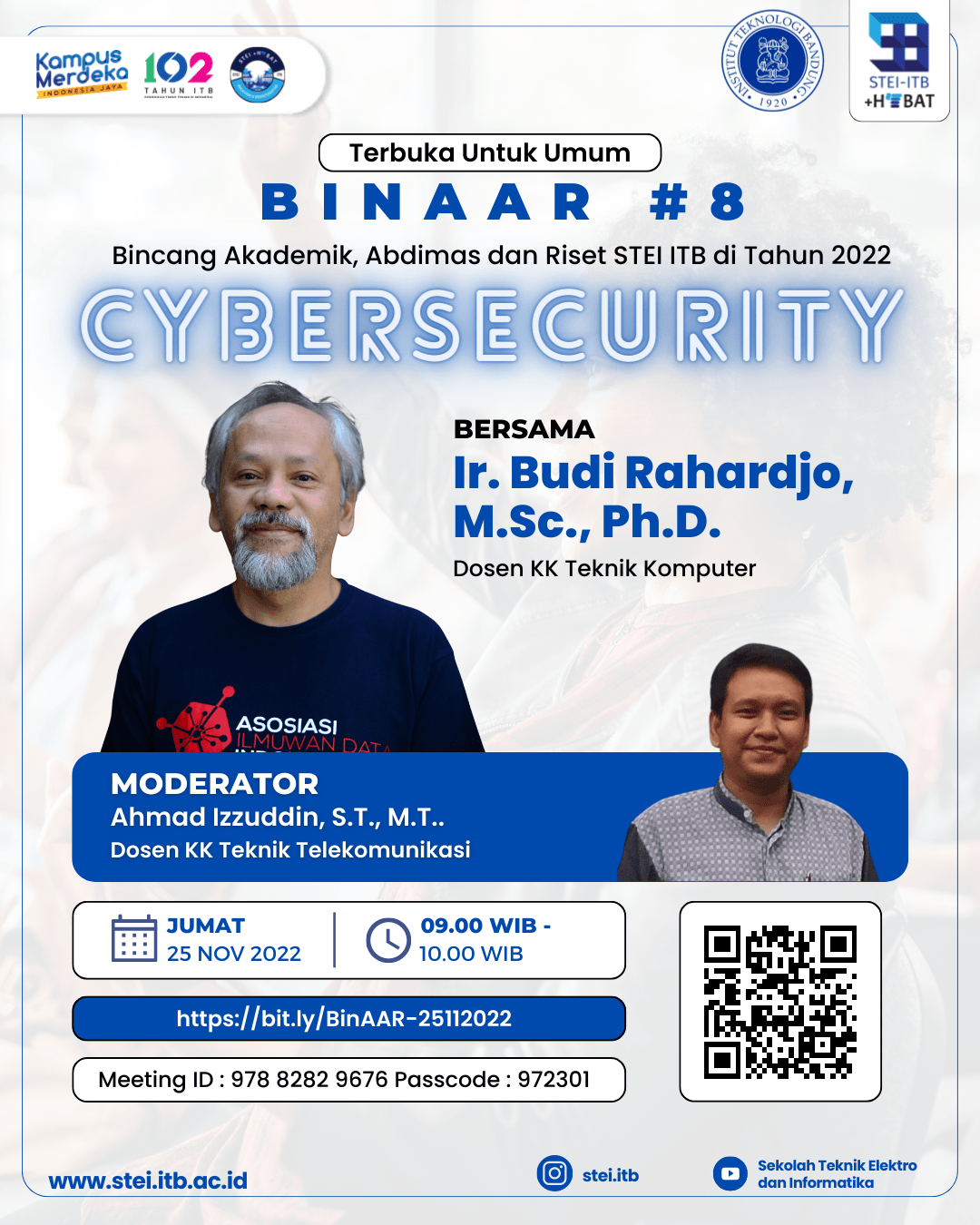
With the theme of cybersecurity, the event was presented directly by Ir. Budi Rahardjo, M.Sc., Ph.D., who is a lecturer Computer Engineering Research Groups, The 8th BINAAR STEI which was held online on Friday (25/11/2022).
According to data as of February 2022, Indonesia has approximately 204.7 million internet users. This population presents a significant market opportunity for internet and digital technology. Without proper attention and management to address this size, Indonesia's internet and technology market share will be overtaken by other countries.
"This 200 million is a market. If we don't capture it, Google, Facebook, and so on will. The problem is that we're not ready. We're not technologically ready, human resources ready, and financially ready," he said. Budi explained. The adoption of internet-based technology and social media is currently undergoing rapid growth. A wide variety of applications and platforms for transportation, e-commerce, travel, and financial services are all easily accessible.
However, behind this potential lies the inherent risks of everyday internet use. The most common internet threat is data breaches. Leaked databases can be caused by user negligence or weak system security. The threat of data breaches affects not only individual users but also large corporations equipped with sophisticated data security technology. While data breaches are highly vulnerable and can occur at any time, prevention efforts must be consistently implemented through multi-layered protection and the development of improved security systems.
Another equally risky threat is ransomware. Ransomware is a type of malware used by hackers to encrypt data, making it unreadable by a user's device. To retrieve the data, users must use the encryption code, which is usually obtained after paying the hacker a ransom. Besides ransomware affecting user data, hacking and data manipulation threats can also occur in blockchain systems. Hackers typically alter or scramble data in unvalidated transaction lists, causing problems with those transactions. All of these internet threats are carried out by actors known as cyber threat intelligence.
Furthermore Budi He explained, "All systems have vulnerabilities. We typically use protection measures like firewalls to protect systems from external threats. But the problem still exists because it stems from the system itself. If the protection used is sufficiently secure, it's fine. But if it isn't, external threats can compromise security, and security incidents occur."
According to Budi, cyber security problems are caused by four main factors, namely weak passwords, outdated software, fraud that exploits human weaknesses (social engineering), and the transition from network security to application security.
To address existing security threats, developers are expected to create better security applications and systems. Meanwhile, users in general must also improve their cyber literacy and understanding to better safeguard their data and device security.
Reporter: Hanifa Juliana (Urban and Regional Planning, 2020)