Perception and Path Planning System for Autonomous Vehicles
Peneliti: Bambang Riyanto Trilaksono, Arief Syaichu Rohman, Egi Muhammad Idris Hidayat
Students: Muhammad Aria Rajasa Pohan, Satrio Wicaksono, Dhimas Bintang Kusumawardhana
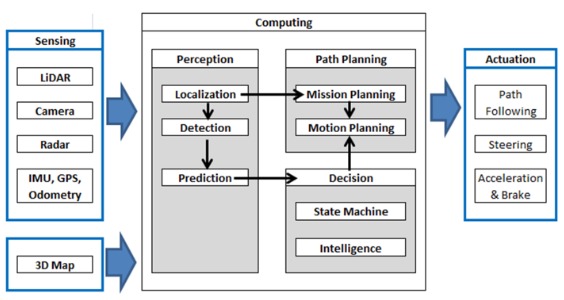
Increased safety, reduced congestion, lower emissions and greater mobility are some of the benefits of vehicles capable of self-driving compared to conventional cars which require humans. Artificial Intelligence, khususnya . And ., plays an important role in automotive technology self-driving. This technology includes environmental perception, mapping, accurate location determination, path planning, and decision making. All of these technologies are needed to enable autonomous driving on the road. To achieve such autonomous perception, cars self-driving Generally equipped with various sensors such as cameras, Lidar, GPS, inertial sensors, radar, and other sensors, which are used to measure attitude, position, determine the state of the environment, and perform the “inference” necessary for steering and acceleration/braking.
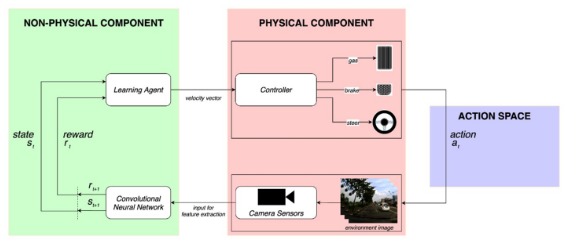
Research on . For self-driving has developed rapidly today. Basically, there are two main approaches in the use of . for cars self-driving, especially those based on visual sensors: 1) Implementing . (seperti convolutional neural networks (CNN)) to automate each sub-section in autonomous driving, for example, using CNN to detect lanes, see traffic lights, detect pedestrians through visual sensors, and use deep reinforcement learning for path planning; 2) The second approach is called as behavior reflexThis approach applies the algorithm . For end-to-end autonomous driving, by mapping input information directly into the model . to drive the vehicle.
Although significant progress has been made on . for cars self-driving, there are still important issues that need to be addressed, namely when using a car self-driving in bad weather conditions, such as rain and fog, which often occur in countries like Indonesia. . is known to provide excellent performance when the input data is undisturbed, but this performance deteriorates significantly when the input data is disturbed by interference signals/noise. Noise virtually contained in the car's sensory data self-driving during bad weather conditions or when driving with incomplete road and lane markings.
Another challenge that is not easy in implementation . The challenge for autonomous driving in Indonesia is mixed traffic conditions involving cars, buses, motorcycles, bicycles, and pedicabs, which adds complexity to autonomous driving development. Driver behavior and various vehicle characteristics contribute to the complexity of autonomous vehicle decision-making.
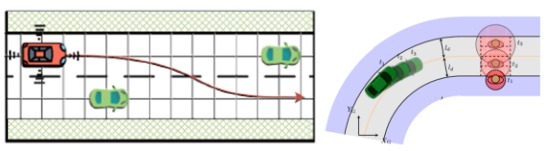
In this study, two approaches to autonomous driving were considered. The first approach is with the method pipelining through optimal path planning based on a combination of algorithms Rapid Random Tree And Ant Colony SystemMeanwhile, in the second approach, the perception system is based on the method deep reinforcement learning which was trained and evaluated using urban road conditions in Indonesia was developed.