
ITB Holds Socialization of the 2014 Joint Selection for University Entrance (SBMPTN) for the Academic Community
In 2014, the Directorate General of Higher Education (DIKTI) established three pathways to enter state universities in Indonesia, one of which is the Joint Selection for Entrance to Higher Education (SBMPTN). SBMPTN is a selection pattern implemented jointly by various State Universities in an integrated system and held simultaneously through written exams. In addition to the written exam, art and sports study programs also require a skills test. One of the requirements to be able to participate in SBMPTN is graduating from an educational unit, passing the National Examination or equivalent to graduates in 2012, 2013 and 2014. In connection with the holding of SBMPTN, ITB also held a socialization of SBMPTN in the West Hall of ITB, Tuesday (13/05/14).
In the 2014 SBMPTN, there are 3 categories of test groups that prospective students can choose from. The first test group is the Science and Technology (Saintek) test group, the Social and Humanities (Soshum) test group, and the mixed test group. For the Saintek group, the field of study tested is the Academic Potential Ability Test (TKPA) consisting of the Academic Potential Test (TPA), Basic Mathematics, English, and Indonesian, followed by the Basic Science Ability Test (Mathematics, Physics, Chemistry, and Biology). For the Social Sciences Group, the field of study tested is the TKPA and the Basic Science Ability Test (Soshum) consisting of Sociology, History, Geography, and Economics. For the mixed test group, the field of study tested is both the Science and Technology and Social Sciences groups.
Exclusive Secretary 1 of SBMPTN, Asep Gana Suganda said that the implementation of SBMPTN 2014 this time was only held for 1 day on Tuesday, (17/06/14) and continued with the skills test on (18-19/06/14) for those who chose the skills study program. "There is a difference in the implementation of the exam between 2013 and 2014, for last year it was held for 2 days, this year it is only 1 day" said Asep.
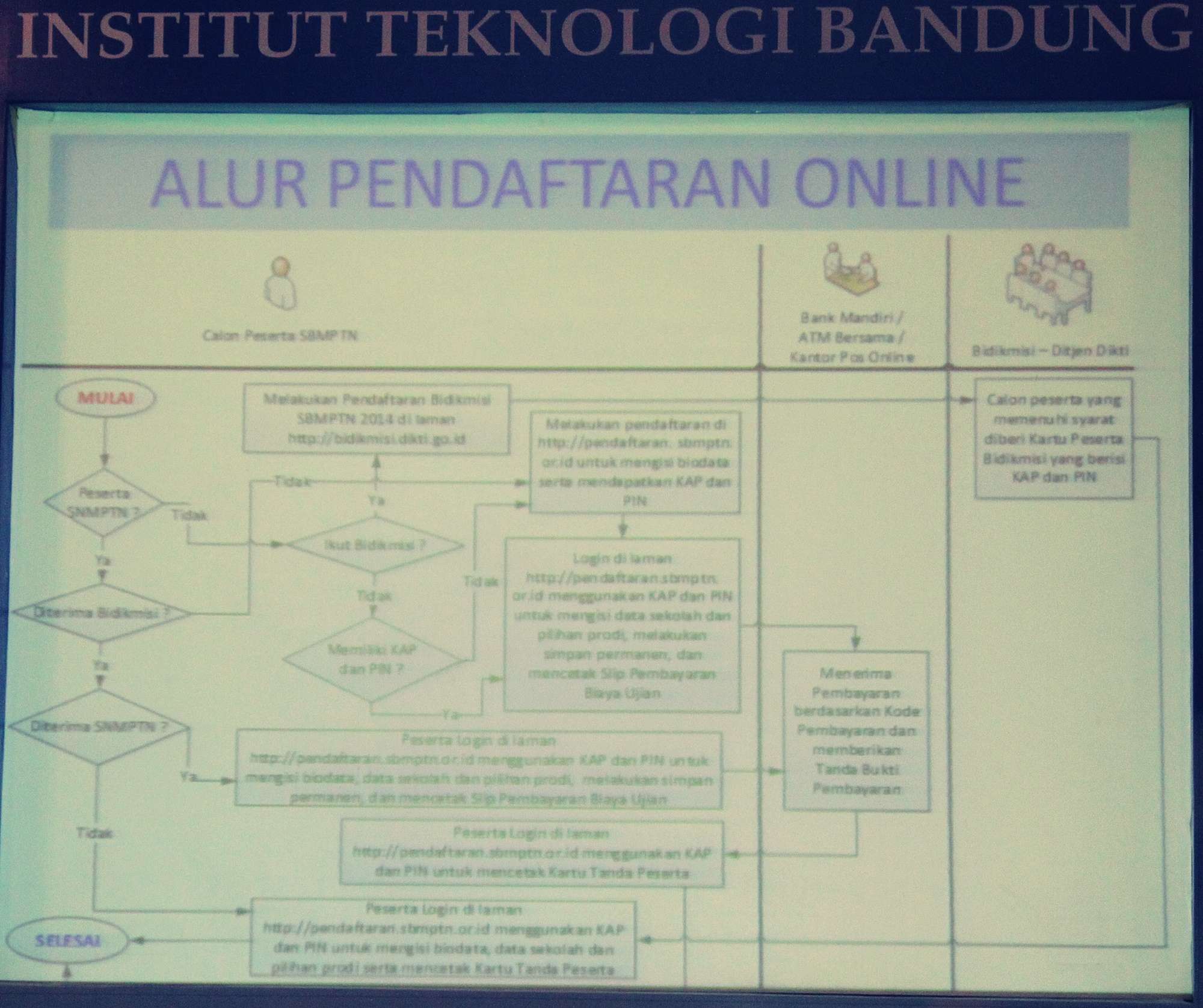
Some of the differences between SBMPTN 2014 compared to the previous year, apart from the written exam implementation, are that the start time of the written exam has been moved forward, and there are also differences in the registration process, where previously you had to pay at the bank first and then register, but now you have to register first and then pay at the bank.
"The registration fee is also lower. Last year, it was 175,000 rupiah for Science and Technology or Social Sciences, 200,000 rupiah for Mixed Sciences, and 150,000 rupiah for the Skills exam. So this year, it's only 100,000 rupiah for all exam categories," Asep said.
The registration process is still the same, done online on the official SBMPTN website which was opened on Monday (12/05/14) at 08.00 WIB and ends on Friday (06/06/14) at 22.00 WIB. This online registration can also be done at Plasa Telkom and PT. POS throughout Indonesia. For study program choices, prospective students are allowed to choose a maximum of 3 study programs where if choosing only 1 study program then they can choose any State University in Indonesia, but if choosing 2 or 3 study programs, then one of the PTN must be located in the region where the exam is held. For Region I starting from PTN located in Sumatra, West Kalimantan, Jakarta, Banten, and West Java. For Region II starting from PTN located in Central Java to DI Yogyakarta. Region III consists of PTN located in Kalimantan (except West Kalimantan), East Java, Bali, NTT, and NTB. Region IV consists of PTN located in Sulawesi, Maluku, and Papua.
This year, the Bandung Local Committee has provided 14,800 seats for the Science and Technology group, 15,800 for the Social Sciences group, and 7,600 for the Mixed group. The total for the three exam groups is 38,200 seats for the SBMPTN, spread across 75 points and 15 sectors. Up to now, two days into the SBMPTN registration, approximately 300 participants have registered with the Bandung Local Committee. "If the number of participants reaches 40,000, we are ready. If there are not enough participants, we also have experience," said Asep enthusiastically.