
Aksantara Team ITB Wins Second Place in Indonesian Flying Robot Contest
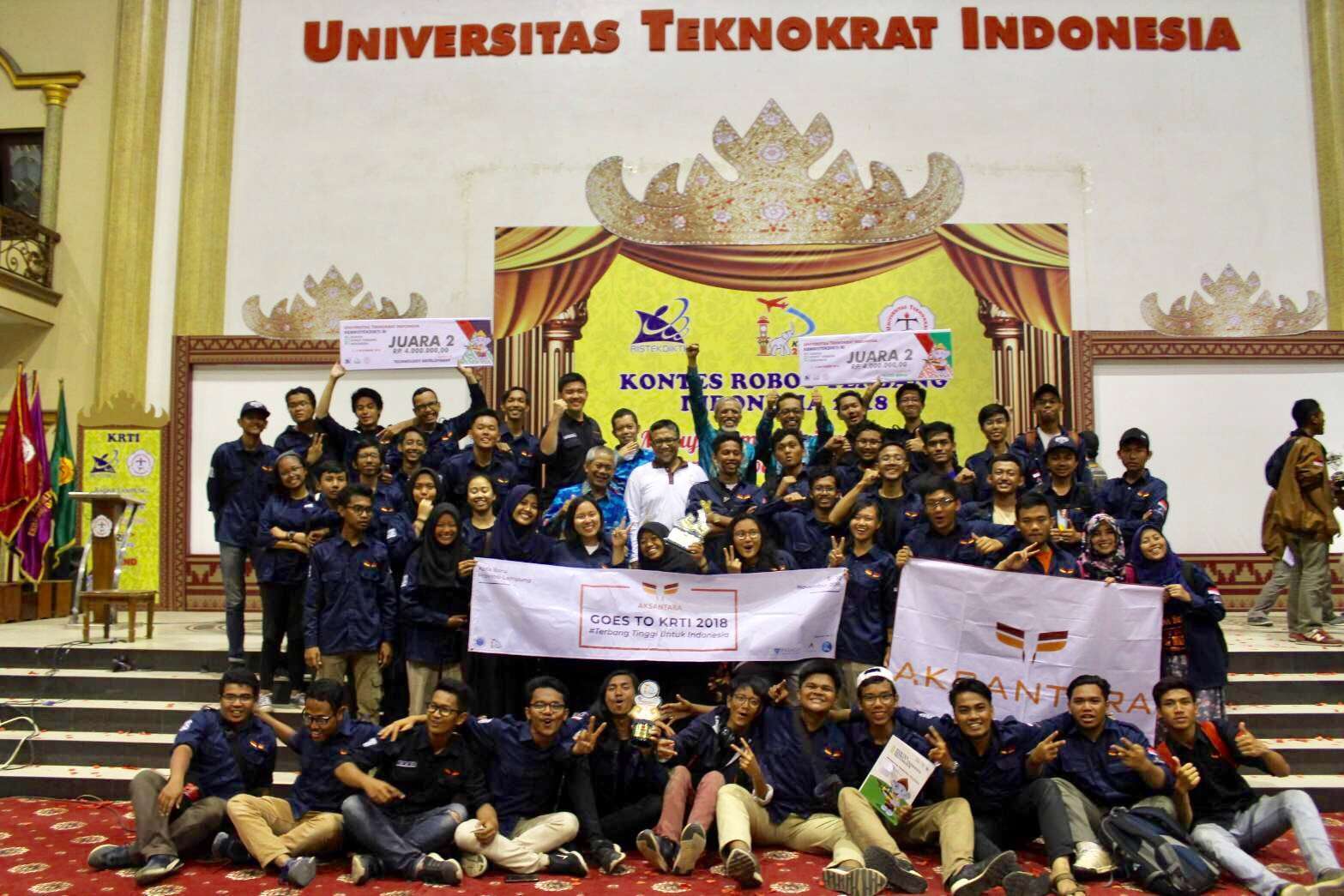
BANDUNG, itb.ac.id – After successfully winning the championship at the international level, it did not make the Aksantara ITB team stop the struggle there. This time, Aksantara again made ITB proud at the national level by winning 2nd place in the fixed wing and technology development category at the 2018 Indonesian Flying Robot Contest (KRTI) held at the University of Teknokrat Indonesia, Lampung, November 5-9, 2018. Aksantara was able to compete and outperform 83 other teams from 38 universities in Indonesia.
KRTI is an annual competition held by Ristekdikti since 2013. Every year, the Aksantara ITB Team regularly sends representatives to participate in KRTI. This year, Aksantara sent teams for each category: Racing Plane (RP), Fixed Wing (FW), Vertical Take-off and Landing (VTOL), and Technology Development (TD).
When met by ITB News Agency reporters, Nathan (Aerospace Engineering 2015) as the head of Aksantara along with Pramadithya Herdian (Telecommunication Engineering 2016) and Naufal Alifyari (Mechanical Engineering 2016) as the heads of the Technology Development and Fixed Wing divisions of Aksantara ITB explained the competition system for their respective divisions. For the fixed wing team, this time they had to carry out two missions: monitoring and mapping.
"To support this mission, we brought quite a lot of equipment, namely an antenna tracker for long-distance data transmission, a monitoring gimbal for monitoring plantation areas, a launcher for the ejection device, and the vehicle (plane) itself," explained Naufal.
For the monitoring mission, participants had to record the plantation area from above via live streaming, and the results were broadcast back after the aircraft landed. The assessment itself was based on the quality of the video data transmission. Meanwhile, mapping is mapping, so the aircraft flew back and forth and then took several photos. Upon landing, the photos were combined. "The assessment for mapping was based on the quality of the resulting photos. The fixed wing team from ITB scored quite well on the mapping mission," he added.
As for technology development, Prama explained that they are different from other teams. The technology development team doesn't have any missions to complete like the fixed-wing team. "We are free to innovate technologies that will be used to make Indonesia more independent in the field of unmanned aircraft," Prama said.
The technology development team brought an aircraft called the Tube Launched Folding Wing UAV (Unmanned Aerial Vehicle). Its construction began in early March of this year. As the name suggests, the aircraft's wings are foldable, making it highly portable and requiring no reassembly in the field. Prama said the UAV aims to assist in disaster mitigation and restore network connectivity when communication towers are damaged.
"The aircraft is designed to fit inside a tube used as a launcher. The launcher and the aircraft are connected to a special app on the device, so to launch it, you simply press a button on the app," he said.
The team's preparation has been carried out for 8 months starting from March 2018. The registration process for the competition was quite difficult because all divisions were required to submit reports consisting of two stages, namely the first stage regarding the conceptual design to carry out the mission, the second stage namely the final design and progress video to convince the jury that Aksantara was ready to compete in KRTI 2018.
Meanwhile, the overall champion in this competition was won by the Gamaforce flying robot team from Gadjah Mada University (UGM).
Reporter: Qinthara Silmi via ITB.ac.id