

Intelligent Communications Engineering: To Expand Boundaries, To Solve Problems
Sparked by the sharp growth of communication devices, users, and services, communications engineering is more than ever an especially important area in engineering. Accordingly, global demand for communications engineers has been continuously increasing. To meet the demand, we offer an International Undergraduate Program with high quality communications engineers as the outcomes. These engineers must be able to compete globally, hence an international academic environment is in place to nurture them from the beginning of their engineering education.
In our program, faculty, researchers, and students are actively engaged in Intelligent Communications Engineering. The involvement of artificial intelligence in communications engineering is increasingly necessary and vibrant, hence our program features it inseparably. Furthermore, our graduates will have cutting edge knowledge and skills for the development of Digital Information Infrastructure and Artificial Intelligence Infrastructure, in line with today’s technological advancement.
Curriculum Structure
To begin with, communications engineering is a field concerning the processes of generating, processing, storing, and transmitting (distributing) signals and/or information in an effective, efficient, high-quality, and secure manner. Fundamentally it requires basic sciences (physics, chemistry, biology) and mathematics.
At its core, communications engineering studies electromagnetics; communication electronics; communication systems; information and signal processing; communication networks; services and applications. Furthermore, it is an interdisciplinary field that requires combination with artificial intelligence and working knowledge on management and regulations. In addition to that, it is also supported by general knowledge such as ethics, civics, environmental sciences, communications, data science, engineering design, and entrepreneurship.
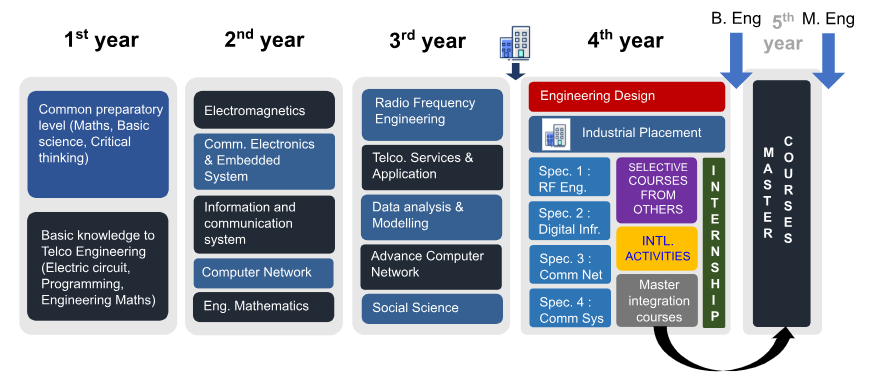
Our curriculum structure can be seen in this picture below. If students are interested in the fast-track program, they can begin taking master’s courses for additional credits in their fourth year. They will complete all the master’s courses by the end of their fifth year. At the end of the fourth year, they will receive their bachelor’s degree, and upon completing the fifth year, they will earn their master’s degree.
| Code | Course Name | Credits |
|---|---|---|
| MA1101 | Mathematics I | 4 |
| FI1101 | General Physics I | 3 |
| KI1101 | General Chemistry I | 3 |
| WI1101 | Pancasila | 2 |
| WI1102 | Computational Thinking | 2 |
| WI1103 | Introduction to Principles of Sustainability | 2 |
| WI1111 | Basic Physics Laboratory | 1 |
| WI1112 | Basic Chemistry Laboratory | 1 |
| Total | 18 | |
| Code | Course Name | Credits |
|---|---|---|
| WI2001 | Introduction to Engineering and Design | 3 |
| WI2005 | Indonesian Language | 2 |
| ET1201 | Discrete Mathematics | 2 |
| ET1202 | Electric Circuit | 3 |
| ET1203 | Programming | 3 |
| MA1201 | Mathematics IIA (for Natural Sciences and Engineering) | 4 |
| WI2003 | Sports | 1 |
| Total | 18 | |
| Code | Course Name | Credits |
|---|---|---|
| ET2101 | Probability and Statistic | 3 |
| ET2102 | Communication Electronics | 3 |
| ET2103 | Continuous Time Signal Processing | 3 |
| ET2104 | Computer Networks | 3 |
| ET2108 | Telecommunication Laboratory Works I | 1 |
| MA2072 | Engineering Mathematics IA | 3 |
| BI1011 | Biology A | 2 |
| Total | 18 | |
| Code | Course Name | Credits |
|---|---|---|
| ET2201 | Communication System | 3 |
| ET2202 | Electromagnetics | 3 |
| ET2203 | Digital System Design | 3 |
| ET2204 | Machine Learning for Telecommunications | 3 |
| ET2208 | Telecommunication Laboratory Works II | 1 |
| ET2209 | Telecommunication Laboratory Works III | 1 |
| MA2074 | Engineering Mathematics IIA | 3 |
| WI2002 | Artificial Intelligence and Data Literacy | 2 |
| Total | 19 | |
| Code | Course Name | Credits |
|---|---|---|
| ET3101 | Modern Digital Communication Systems | 3 |
| ET3102 | Transmission Lines and Antennas | 3 |
| ET3103 | Signal Processing in Discrete Time | 3 |
| ET3104 | Performance Engineering for Telecommunications | 3 |
| ET3108 | Telecommunication Laboratory Works IV | 1 |
| ET3109 | Telecommunication Laboratory Works V | 1 |
| WI201X | Religion | 2 |
| WI2006 | Civic Education | 2 |
| Total | 18 | |
| Code | Course Name | Credits |
|---|---|---|
| ET3201 | Optical Networks | 3 |
| ET3202 | Wireless Access Network | 3 |
| ET3203 | Network Automation and Software Defined Networking | 2 |
| ET3204 | Connected Services and Cloud Computing | 3 |
| WI2022 | Project Management | 2 |
| ET3206 | Professional Ethics | 2 |
| ET3208 | Telecommunication Laboratory Works VI | 1 |
| WI2004 | English | 2 |
| ET4102 | Final Assignment 1 & Seminar | 2 |
| Total | 18 | |
| Code | Course Name | Credits |
|---|---|---|
| – | Student Exchange | * |
| – | Student Exchange | * |
| – | Student Exchange | * |
| – | Student Exchange | * |
| – | Student Exchange | * |
| – | Student Exchange | * |
| Total | *) | |
| Code | Course Name | Credits |
|---|---|---|
| ET4101 | Practical Work | 2 |
| ET4202 | Final Works II | 4 |
| ET4241 | Video Compression and Communications | 3 |
| ET4243 | Advanced Machine Learning for Telecommunications | 3 |
| ET4244 | Telecommunication Optimization | 3 |
| – | Electives | ** |
| Total | 17 | |
Internationalization Scheme
- Mandatory International Exposure
- Type: Student Exchange
- Required Duration : minimum 1 Semester in the fourth year
- Current Partners : University of Groningen, Waseda University, Universiti Malaya, and Hanyang University*
*) = At present, ITB does not have a formal Memorandum of Understanding (MoU); however, a number of students are benefiting from an exchange program there.
For further semester exchange, you can visit
https://partnership.itb.ac.id/semester-exchange/
- Student Exchange Costs
The amount of money to be spent varies, depending on:
- The fees charged by the selected partner university. However, when ITB establishes a Memorandum of Understanding (MOU) with partner universities, exchange students are responsible solely for their tuition fees to ITB. This arrangement allows students to focus on their educational experience abroad, as they only need to cover their living expenses. This opportunity not only enhances their academic journey but also minimizes financial burdens, making studying abroad more accessible and rewarding.
- The location related costs can be see in Table 1 below.
| MONTHLY LIVING EXPENSES FOR STUDENTS IN EXCHANGE PROGRAM (TUITION FEES NOT INCLUDED*) | ||||
|---|---|---|---|---|
| Item | Tokyo, Japan | Groningen, Netherlands | Kuala Lumpur, Malaysia | Seoul, Korea |
| Dormitory | ¥ 55.000 | NA | RM 200 – 600 | KRW 300.000 |
| Off‑campus | ¥ 70.000 – 100.000 | € 350 – € 900 | RM 600 – 1.500 | KRW 450.000 |
| Groceries | ¥ 26.000 – 32.000 | € 150 – € 400 | RM 200 – 350 | KRW 400.000 |
| Transportation | ¥ 3.000 – 7.000 | € 30 – € 65 | RM 20 | NA |
| Personal expenses | ¥ 4.000 – 7.000 | € 150 – € 200 | RM 100 – 200 | KRW 250.000 |
| Health insurance | ¥ 2.000 – 6.000 | € 100 – € 120 | RM 50 | KRW 200.000 |
| Study cost | NA | € 80 – € 100 | NA | NA |
| Monthly total cost | ¥ 75.000 – 101.000 | € 1.100 – € 1.630 | RM 1.500 – 20.000 | KRW 950.000 – 1.100.000 |
| Footnote | * Monthly living expenses do not include tuition fees. | |||
Future collaboration for Dual Degree Program (in process)
| Partner University | Academic Scheme | Requirement | Expenses |
|---|---|---|---|
| KU Leuven, Belgium | Student gets Bachelor Degree from ITB and from KU Leuven Scheme: 2 + 2 |
Passed all courses at STEI with min. GPA 3.25 out of 4.0 in 6th Semester IELTS: 6.5 |
Accommodation: €450–€670/month Groceries: €250–€350/month Public Transport: €20/month Educational Materials: €40–€60/month Health Insurance: €8–€10/month Mobile/Internet: €15–€30 (mobile)/month Leisure: €200–€300/month |
| University Duisburg Essen (UDE), Germany | Student gets Bachelor Degree from ITB and from UDE Scheme: 3 + 1 |
Passed all courses at STEI with min. GPA 3.25 out of 4.0 in 6th Semester Industrial Internship: 10 weeks German Level: B2 IELTS: 6.5 |
Tuition fees: — Student body contribution: €320/semester Accommodation: €350/month Groceries: €200–€300/month Public Transport: — Educational Materials: — Health Insurance: €110/month Mobile/Internet: €50/month Leisure: €200–€300/month |
| Curtin University, Australia | Student gets Bachelor Degree from ITB and from Curtin University Scheme: 3 + 1 |
Passed all courses at STEI with min. GPA 3.25 out of 4.0 in 6th Semester IELTS: 6.5 Industrial Internship: 10 weeks |
Accommodation: AUD 1,000/month Groceries: AUD 600/month Public Transport: — Educational Materials: — Health Insurance: AUD 55/semester Mobile/Internet: AUD 60–120/month Leisure: AUD 80–150/month |
Tuition fee:
• If the partner university does not charge a tuition fee, students are required to pay 50% of the Tuition Fee (UKT) to ITB.
• If the partner university charges a tuition fee, students are required to pay 5% of the Tuition Fee (UKT) to ITB.
Career Prospects
Graduates of the Telecommunication Engineering Program will have broad career prospects, as telecommunication engineering competencies are needed across a wide range of national and multinational sectors. These include telecommunication operators and vendors; the satellite communications industry; radio, television, and broadcasting; the multimedia industry; the radar and navigation industry; banking and financial institutions; the oil and mining industry; research and educational institutions; government agencies; academic professions and research organizations; entrepreneurs and consulting/contracting companies; the creative industry; the aviation and aerospace industry; the armed forces and maritime sector; the electric power industry; internet service providers; and many others.
Alumni Stories
Faishal Zharfan
Telecommunications Engineering taught me fundamental knowledge that has been extremely useful for the research I am currently conducting. The lecturers are also fun and approachable.

Naufal Zaidan Nabhan
Studying in the Telecommunications Engineering program at ITB has been a blessing for me. ET is a fairly niche major, and since the internet has become a commodity, several courses include hands-on components, making it easier to visualize how telecommunication theories are implemented in practice.
In addition, lab sessions help make the lessons more tangible. There are also certifications that add extra value for the workplace—significantly boosting one’s value, especially in a professional environment.

Bagas Prayogo
As an undergraduate alumnus of Telecommunications Engineering, I am truly grateful to have studied in this program. I gained not only strong technical understanding in networking, but also training to think critically and adapt to the rapid pace of technological change. The career prospects are broad and continue to grow, in line with the increasing industry demand for talent in telecommunications and digital technology.
My active involvement in the student association (IMT “Signum” ITB) was also very valuable, as it developed leadership, teamwork, and communication skills that are highly relevant in the professional world. This combination of technical competence and organizational experience has become a strong foundation for growth and contribution across various industries.

Muhammad Aidil Akbar Amin
The ET program provides a strong foundation that bridges theory and practice in digital technology. The curriculum is industry-relevant, the lecturers are supportive, and the environment is both challenging and collaborative. ET shapes graduates who are ready to contribute and keep growing in the world of technology.
Enrollment Information
Learn about the registration procedures and application requirements to begin your academic journey at the School of Electrical Engineering and Informatics, ITB.
 English
  Indonesian