
Nur Ahmadi, S.T., M.Eng., Ph.D., DIC.
elektronika
Email : nahmadi@itb.ac.id
Nur Ahmadi adalah dosen dan peneliti di Sekolah Teknik Elektro dan Informatika (STEI), Institut Teknologi Bandung (ITB), serta berafiliasi dengan Pusat Artificial Intelligence dan Pusat Mikroelektronika ITB. Ia menyelesaikan pendidikan Sarjana Teknik Elektro di ITB pada tahun 2011, Magister di bidang Communications and Integrated Systems dari Tokyo Institute of Technology, Jepang, pada tahun 2013, dan meraih gelar Ph.D. di bidang Electrical and Electronic Engineering dari Imperial College London, Inggris, pada tahun 2020. Disertasinya berfokus pada pengembangan metode signal processing dan deep learning untuk intracortical brain-machine interfaces. Atas kontribusi risetnya, ia menerima Travel Grant Award pada IEEE UKCAS 2018 di Glasgow, Skotlandia dan Young Researchers Poster Award pada IEEE BioCAS 2019 di Nara, Jepang.
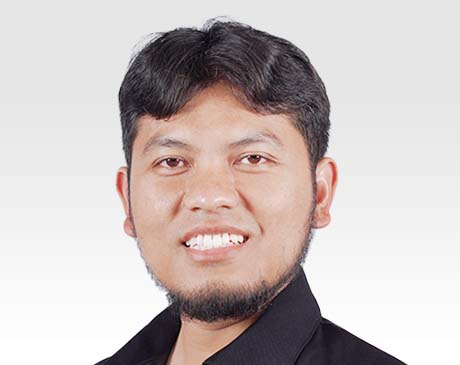
Selain aktif dalam riset dan publikasi, Nur saat ini menjabat sebagai Deputi Direktur Bidang Riset dan Diseminasi, Direktorat Riset dan Inovasi (DRI) ITB, peran yang berfokus pada fasilitasi dan promosi riset serta diseminasi ilmiah di lingkungan akademik ITB. Ia juga saat ini menjadi Ketua IEEE Solid-State Circuit Society (SSCS) Chapter Indonesia dan Wakil Ketua IEEE Circuits and Systems Society (CASS) Chapter Indonesia. Ia juga pernah menjadi Visiting Researcher di kampus top dunia, seperti Imperial College London (sejak 2023) dan University of Cambridge (2023), serta terlibat dalam berbagai proyek riset yang menggabungkan teknologi AI, wearable device, dan sistem nirkontak untuk aplikasi kesehatan dan pemantauan real-time. Bidang keahlian dan minat risetnya meliputi biomedical signal processing, artificial intelligence dan machine learning, brain-machine interface dan neurotechnology, serta circuits and systems untuk aplikasi biomedis/kesehatan dan teknologi cerdas.
- Pembangunan Model dan Prototipe Deteksi Dini Gangguan Kesehatan Mental berdasarkan Ucapan atau Percakapan Lisan dengan Pendekatan Self-Supervised Contrastive Learning (SSCL) (2026)
- Modelling and Control of a Novel Foldable Fabric-Based Soft Robot for Minimally Invasive Surgery (2026)
- Energy-Efficient Edge AI System-on-Chip (SoC) Based on Multi-Core RISC-V with Integrated AI Accelerator (2026)
- Pengembangan Metode Pemrosesan Sinyal dan AI Neuromorfik yang Efisien Untuk Brain-Machine Interface (2025)
- Towards Foldable Fabric-Based Soft Robot for Minimally Invasive Surgery (2025)
- Torus-Based Fully Homomorphic Encryption Hardware Accelerator for Secured Deep Learning (2025)
- Overseas Research Grant, The Asahi Glass Foundation 2025 (2025)
- Pengembangan Sistem Pengestimasi Denyut Jantung Untuk Multisubjek Secara Nirkontak Berbasis Remote PPG dan AI (2025)
- Perancangan Hardware Decoder Brain-Machine Interface (BMI) Berbasis Spiking Neural Network (SNN) dan Implementasinya pada FPGA (2025)
- Pengembangan Bahan Ajar dan Pembelajaran Berbasis Proyek untuk Mata Kuliah EL2003 Struktur Diskrit (2025)
- Equity2025 – Sistem Pengenalan Aktivitas Manusia Secara RealTime dan Akurat Berbasis Fusi Multisensor dan Edge AI pada Perangkat Wearable (2025)
- Pembangunan Sistem Perekaman Data Multimodal Articial Intelligence untuk Deteksi Kecemasan (2025)
- Pengembangan Aplikasi mHealth, Perangkat Wearable, dan Artificial Intelligence Untuk Prediksi Bunuh Diri pada Pasien Kesehatan Mental (2024)
- RU3P2024@Pengembangan Perangkat Wearable Cerdas Untuk Pemantauan Kondisi Kesehatan Jiwa (2024)
- Unobtrusive Monitoring Technology for Dementia Home Care Using Radar and Edge AI (2024)
- Inovasi dan Peningkatan Pembelajaran Mata Kuliah Struktur Diskrit Berbasis Student Centered Learning (SCL) (2024)
- Hardware Accelerator Design of Deep Reinforcement Learning for Continuous Control in Mobile Robots (2024)
- Sistem Pemantau Kesehatan Berbasis Wearable/Mobile Device dan Artificial Intelligence – Tahun ke-2 (2022)
- A Contactless and Continuous Vital Sign Monitoring System Using Radar Technology and Artificial Intelligence (2022)
- Penerapan Teknologi Artificial Intelligence Untuk Akuakultur (mitra: eFishery) (2022)
- Pengembangan Perangkat Wearable Pintar Untuk Pemantauan Laju Pernapasan Pasien Secara Kontinyu (2022)
- CHARM: Contactless Heart and Respiratory Monitoring based on Remote PPG and AI (2022)
- Flexible and Configurable Deep Reinforcement Learning (DLR) Processor for Smart Navigation in Factory System (2021)
- Sistem Pemantau Kesehatan Berbasis Wearable/Mobile Device dan Artificial Intelligence (2021)
- Access Control Development Within the Framework of an IOTA-Based Electronic Medical Record Management System (2026)
- FPGA-Based Hardware Accelerator for LWE Encryption and Decryption with TFHE Scheme (2025)
- Automated Digit Recognition and Measurement-Type Classification from Blood Pressure Monitor Images Using Deep Learning (2025)
- Automated Digit Recognition and Measurement-Type Classification from Blood Pressure Monitor Images Using Deep Learning (2025)
- Automated Digit Recognition and Measurement-Type Classification from Blood Pressure Monitor Images Using Deep Learning (2025)
- Deep Reinforcement Learning for Intrusion Detection System on the Internet of Things (2025)
- Investigation of Enhancement Strategies for Recurrent Spiking Neural Network based Brain-Machine Interface Decoding (2025)
- Investigation of Enhancement Strategies for Recurrent Spiking Neural Network based Brain-Machine Interface Decoding (2025)
- FPGA-Based Hardware Accelerator for LWE Encryption and Decryption with TFHE Scheme (2025)
- Investigation of Enhancement Strategies for Recurrent Spiking Neural Network based Brain-Machine Interface Decoding (2025)
- Comparative Analysis of Interbeat Interval and Heart Rate Variability Measurements from Wearable Devices (2024)
- A Novel Prediction Technique for Intermittent UWB Positioning System Using Hybrid LSTM-Trilateration (2024)
- Automated Acute Myocardial Infarction Detection Using Machine Learning from Phonocardiogram (2024)
- Real-Time Indoor Localization System Based on Wearable Device, Bluetooth Low Energy (BLE) Beacons, and Machine Learning (2024)
- Real-Time Estimation of Respiratory Rate Using Contactless FMCW Radar with Adaptive Filtering for Various Breathing Patterns (2024)
- Radar-Based Human Activity Recognition Using Optimized CNN on Edge Devices (2024)
- Radar-Based Human Activity Recognition Using Optimized CNN on Edge Devices (2024)
- Radar-Based Human Activity Recognition Using Optimized CNN on Edge Devices (2024)
- Comparative Evaluation of Fine-Tuned Hybrid Transformer and Band-Split Recurrent Neural Networks for Music Source Separation (2024)
- A Comparative Evaluation of Video Codecs for rPPG-based Heart Rate Estimation (2023)
- Indoor Localization System Based on Bluetooth Low Energy Beacons and Spiking Neural Networks (2023)
- Human Activity Recognition Based on Wearable Devices and Feedforward Neural Networks (2023)
- Human Activity Recognition Based on FMCW Radar Using CNN and Transfer Learning (2023)
- Signal Quality Assessment for Wearable Multichannel Photoplethysmography Signals (2023)
- Improved Spike-based Brain-Machine Interface Using Bayesian Adaptive Kernel Smoother and Deep Learning (2022)
- Contactless Respiratory Rate Monitoring Using FMCW Radar (2022)
- Design of PCB and Power Supply for Portable 6-Lead Electrocardiogram (ECG) (2022)
- Development and Evaluation of a Contactless Heart Rate Measurement Device Based on rPPG (2022)
- Reinforcement Learning Accelerator using Q-Learning Algorithm with Optimized Bit Precision (2022)
- Non-Contact Supervision of COVID-19 Breathing Behaviour with FMCW Radar and Stacked Ensemble Learning Model in Real-Time (2022)
- Respinos: A Portable Device for Remote Vital Signs Monitoring of COVID-19 Patients (2022)
- Inferring entire spiking activity from local field potentials (2021)
- Hardware Resource Reduction Using Winograd Approach on YOLOv3-Tiny (2021)
- FPGA Implementation of IoT-Based Health Monitoring System (2021)
- An inter-processor communication (IPC) data sharing architecture in heterogeneous MPSoC for OFDMA (2018)
- Highly stable analog front-end design for NFC smart card (2017)
- Performance comparison of denoising methods for heart sound signal (2016)
- Hardware architecture of time domain LTE baseband signal processor (2016)
- Flexible data sharing architecture of WiMAX heterogeneous Multiprocessor System on Chip (2016)
- Automatic segmentation and detection of heart sound components S1, S2, S3 and S4 (2016)
- VLC physical layer design based on Pulse Position Modulation (PPM) for stable illumination (2016)
- Ultrasonic sensor based contactless theremin using pipeline CORDIC as tone generator (2016)
- Architecture and FPGA implementation of LTE PSS and SSS synchronizer (2016)
- Establishment of Wi-Fi Display session between source and sink device in wireless Android screencasting (2016)
- Empirical mode decomposition (EMD) based denoising method for heart sound signal and its performance analysis (2016)
- CORDIC and Taylor based FPGA music synthesizer (2016)
- A pipelined CORDIC architecture and its implementation in all-digital FM modulator-demodulator (2015)
- An SoC architecture for real-time noise cancellation system using variable speech PDF method (2015)
- Design and implementation of visible light communication system using pulse width modulation (2015)
- FPGA implementation of CORDIC algorithms for sine and cosine generator (2015)
- Hardware implementation of montgomery modular multiplication algorithm using iterative architecture (2015)
- FPGA implementation of modified serial montgomery modular multiplication for 2048-bit RSA cryptosystems (2015)
- An optimal architecture of BCH decoder (2010)
Keyword
Electronics, Artificial Intelligence, Signal Processing, Biomedical Circuits & Systems, Brain-Machine Interfaces