


From Bandung to Okinawa: STEI ITB Students Showcase LSI Design Innovation on the International Stage
Bandung, stei.itb.ac.id/redesign — Students from the School of Electrical Engineering and Informatics, Institut Teknologi Bandung (STEI ITB), participated in the LSI Design Contest Okinawa 2026, an international competition that brings together university students from various countries in the field of Large Scale Integration (LSI) design and semiconductor systems. The final round of the competition was held at Ohama Nobumoto Memorial Hall, Ishigaki, Okinawa, Japan, providing a platform for participants to present their hardware design innovations.
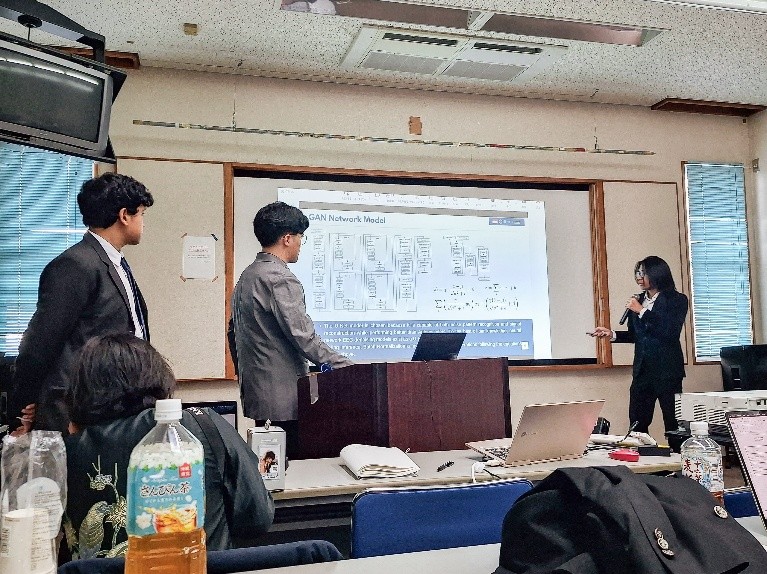
In this competition, two teams from STEI ITB presented projects that approached technological challenges from different perspectives. The first team developed an FPGA-based voice conversion system capable of transforming a person’s voice into another individual’s voice characteristics.
Through this implementation, the team performed several optimizations on both the software and hardware sides, including batch normalization folding, quantization-aware training, and block RAM (BRAM) synchronization to improve overall system efficiency.
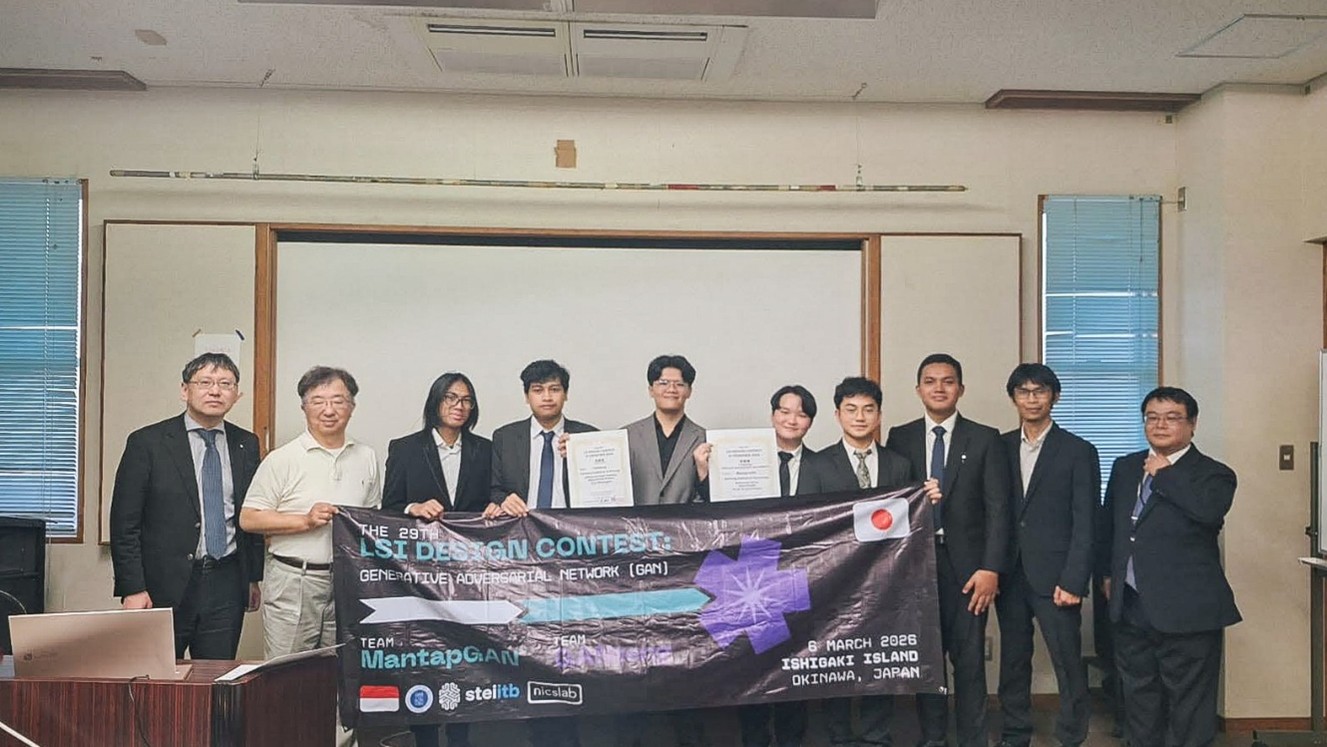
The MantapGAN team, consisting of Muhammad Farhan (EL’22), Randy Revaldo Pratama (EL’22), and Hifzhi Dinullah (EL’22), successfully achieved 1st Runner-Up in the competition. During the development process, Randy and Hifzhi focused on Register Transfer Level (RTL) design, while Farhan handled the modeling process. During the integration stage, all team members were involved in cross-checking, system integration, and debugging to ensure that the system operated optimally.
Meanwhile, another team named GANteng received the Fighting Spirit Award for their project titled “Area Efficient Unified Systolic Array for GAN-Based EEG Artifact Removal.” This project focused on removing noise from electroencephalography (EEG) signals by utilizing hardware acceleration during the inference process of an artificial neural network.

In their design, the team proposed the use of a systolic array architecture to perform convolution and transposed convolution operations. This architecture supports a U-Net model that had previously been trained using a Generative Adversarial Network (GAN) approach. This method enables EEG signal processing to be carried out more efficiently on hardware platforms.
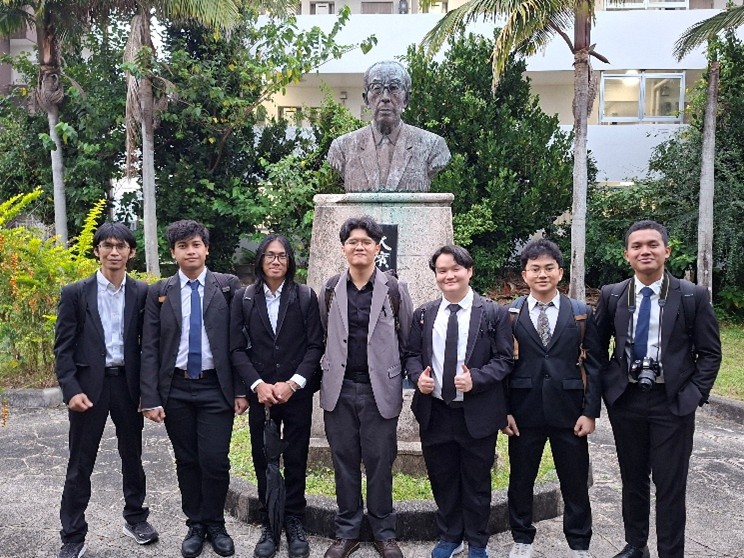
Tim GANteng terdiri dari Rizmi Ahmad Raihan (EL’23), Dharma Anargya Jowandy (EL’23), dan Aryo Wisanggeni (IF’23). Rizmi bertanggung jawab pada desain operasi convolution berbasis systolic array dan integrasi perangkat keras. Dharma mengembangkan modul transposed convolution serta komunikasi antara Processing System And Programmable Logic melalui AXI-custom. Sementara Aryo merancang arsitektur jaringan saraf berbasis U-Net dan WGAN untuk penghilangan derau sinyal EEG, sekaligus mengembangkan antarmuka antara Processing System And Programmable Logic.
The preparation for both teams began with the formation of groups in October 2025 as part of the VLSI course. The development process continued more intensively in early 2026, involving literature studies, system architecture selection, and implementation and testing phases before entering the final round of the competition.
For the students, participation in this competition served as an opportunity to test their academic capabilities while expanding their perspectives on the latest developments in LSI research and technology at the global level. The competition showcased a wide range of innovations from participating teams, from 3D graphics acceleration to signal processing systems for medical applications.
Through this experience, the participants not only presented their research outcomes but also interacted with the international semiconductor design community. This experience is expected to broaden students’ perspectives in developing LSI technologies that are increasingly relevant to the needs of global industry and research.