




Event Report – IEEETalk: How Will Autonomous Vehicle Transform Our New Capital?
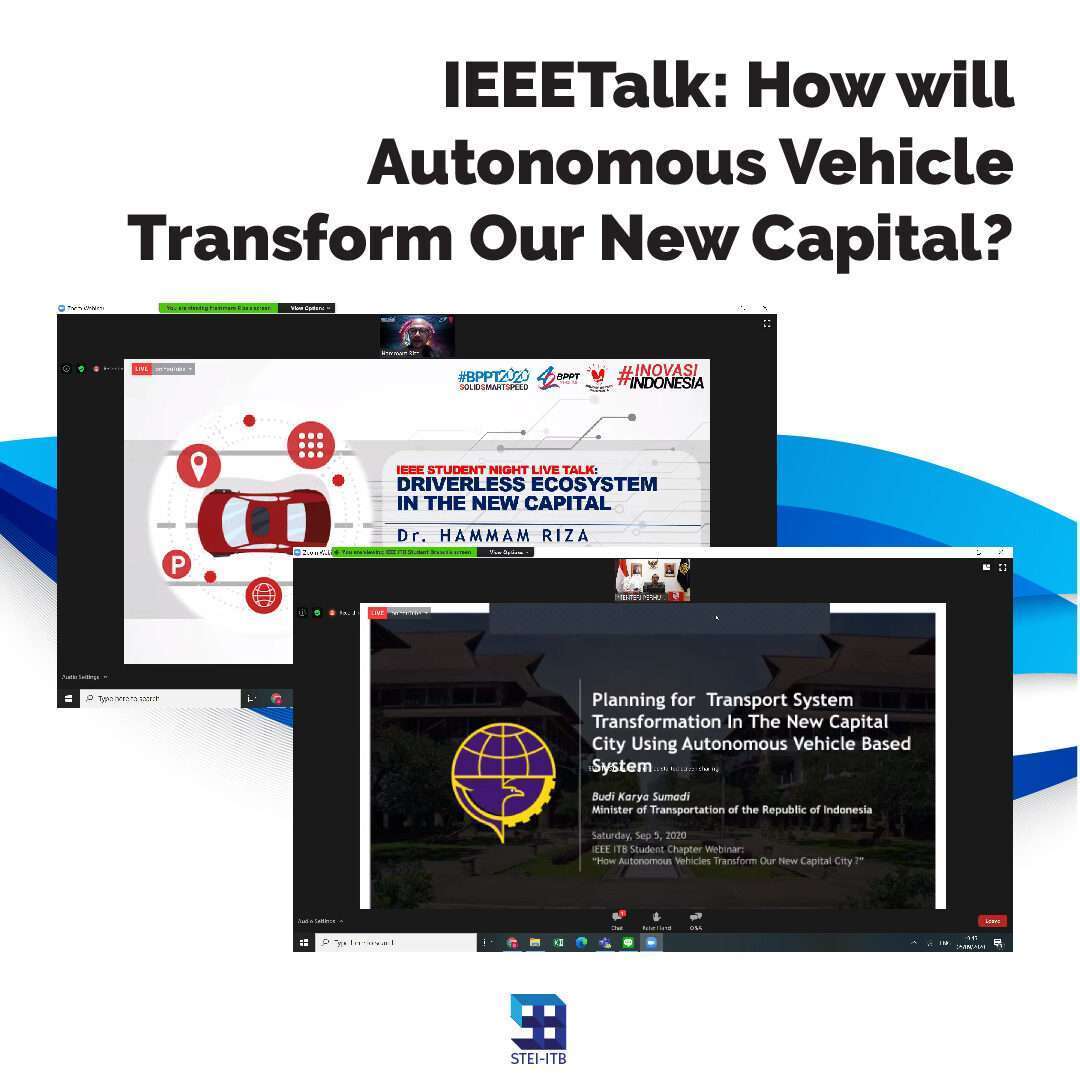
In September 2020, IEEE ITB Student Branch held the first webinar in the IEEETalk series of events. The webinar entitled “How Will Autonomous Vehicle Transform Our New Capital?” took place on Saturday, September 5, 2020, at 19.30-21.25 WIB through the ZOOM meeting platform which was attended by 278 participants, and also broadcast live on the YouTube channel of the School of Electrical Engineering and Informatics. This webinar was filled by well-known speakers such as Ir. Budi Karya Sumadi, Dr. Ir. Hammam Riza, M.Sc., Ms. Krithika Kandasamy, and Prof. Suhono Harso Supangkat, M. Eng.
This IEEETalk begins with a speech as an opening speech by Prof. Dr. Ir. Jaka Sembiring M.Eng. “Moving the capital will open up many opportunities for Autonomous Electric Vehicle to develop, as well as solve transportation problems in Jakarta,” said the ITB vice chancellor. The opening was then continued by Michael Kresna, as chairman of the IEEE ITB Student Branch who talked about the reasons for choosing the topic of Autonomous Electric Vehicle or AEV, namely the many doubts surrounding the effectiveness and possibility of AEV, but IEEE ITB SB believes that AEV has many opportunities to be implemented in the new capital.
As the Minister of Transportation of the Republic of Indonesia, Mr. Ir. Budi Karya Sumadi opened the first topic regarding the planning of an AEV-based transportation system in the new capital. “Future mobility with Autonomous Electric Vehicle technology needs to be implemented as part of the mass transportation system,” said Budi Karya. He emphasized that there are many aspects that must be considered in planning a city’s transportation system such as safety, regulation, and privacy. In this project, the ministry of public transportation can cooperate with many universities and industries. The Indonesian Minister of Transportation said that the government received all input from academics, professionals, and practitioners in designing an AEV-based transportation system in the new capital.
The second topic regarding driverless ecosystems in the new capital was brought by Dr. Ir. Hammam Riza, M.Sc. He explained that the new capital city will have an integrated transportation system and based on AEV. Mr. Hammam said that President Joko Widodo had conveyed on various occasions the plan to build a smart transportation system in the new capital. The head of BPPT also informed that the ministry is trying to make the transportation system for the new capital safe, with a sustainable AEV ecosystem, and modern roads.
On the other hand, a different discussion regarding the mobility of AEV in terms of technology and business was delivered by Ms. Krithika Kandasamy. He explained about the AEV projects by ST Engineering and their vision. One of the webinar participants asked how the AEV business opportunity in Indonesia was, “The specifics depend on the different ways of thinking and policies of each country. Once the government starts to focus and detail in the work, it will slowly start to become more certain and persistent. ” Krithika said. According to Krithika, apart from machine learning, there are many other technological opportunities that can be deepened in AEV, such as deep learning and cyber security which will be important keys to be implemented.
Of the three topics at the start, Prof. Suhono Harso Supangkat, M.Eng brought up the last topic regarding City Transformation and Autonomous Vehicle. He explained the definition, model, and integrating AEV into Smart Capital City. According to Prof. Suhono, we must strive to build a transportation system that is flexible, reliable, comfortable, efficient, and intelligent. When there were participants who asked about the readiness of AEV to be implemented in big cities in Indonesia, Prof. Suhono said “Indonesia is not ready. Big cities in Indonesia are still in the process and development towards smart cities. Don’t expect AEV to replace high-end automotive drivers and realize a driverless ecosystem in the next 10 years in today’s cities. But in the new capital, AEV has a greater chance of being implemented “, he said, in response to the closing of the QnA session on Saturday night, September 5, 2020 at the IEEETalk event.
This program can also be watched again on the YouTube channel of STEI ITB.