Muhammad Naufal Wahyu Athallah
STE-ITB
Mukti Hasanain
STEI ITB
Burhanuddin Halimi, S.T., M.T., Ph. D
STEI ITB
Abstrak
With the increasing trend of renewable energy in Indonesia, the use of solar panels/modules in rooftop solar power plants is increasingly widespread. Although solar modules utilize sunlight, there is a problem when the panel temperature increases, causing a decrease in efficiency. One solution that has been widely implemented is a passive cooling method using a heat sink on the back of the panel to increase the contact area with the air to reduce the panel temperature. This study began by comparing three heat sink orientations - straight, circular, and zigzag - using Ansys software. Simulation results showed the straight orientation to be the best based on the criteria of total weight and initial cost. This heat sink was then combined with another passive cooling method, namely PCM (Phase Change Material). The simulation results of the combined method showed a more significant temperature reduction with an average PV cell temperature of 47.94°C, making it an alternative solution to improve the passive cooling performance of solar panels.
Kata kunci: solar PV, pendinginan pasif, heat sink, phase change material
Latar Belakang
Solar module efficiency generally ranges from 15-20%. When photovoltaic cells experience an increase in temperature, the open-circuit voltage decreases, resulting in a decrease in output power, as shown in Figure 1.
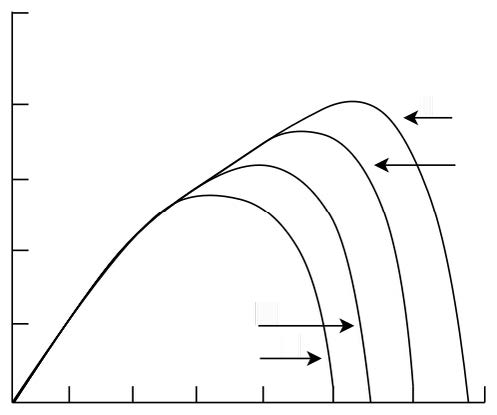
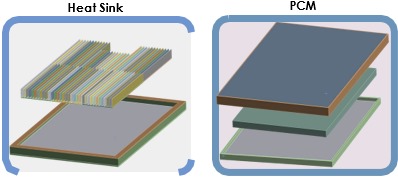
Solar module efficiency generally ranges from 15-20%. When photovoltaic cells experience an increase in temperature, the open-circuit voltage decreases, resulting in a decrease in output power, as shown in Figure 1.
The use of passive cooling is considered to have advantages because it does not require additional energy to obtain a cooling effect and is quite simple to obtain compensation for reduced panel output power in cases of limited land.
In this study, a cooling method was chosen using a heat sink that works by expanding the surface area exposed to the wind and PCM using materials that are capable of storing and releasing energy in the form of heat at certain temperatures.
Metodologi
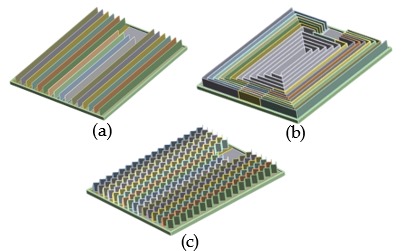
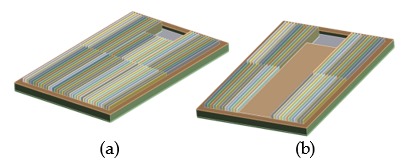
The initial part of this research is to compare the orientation heat sink straight, circular, and zig-zag with a 100 Wp PV panel as a reference.
Dilakukan penentuan orientasi heat sink best based on cooling effect, additional weight, and investment cost.
After finding the best one, the second part of the research was to compare it with the method combined with PCM. The panel used had a capacity of 50 Wp with dimensions heat sink refers to those available on the market. The PCM is placed in a container attached to the back of the panel.
The assessment was conducted based on the same criteria to determine the capability of the combined method as a passive cooling solution for solar PV.
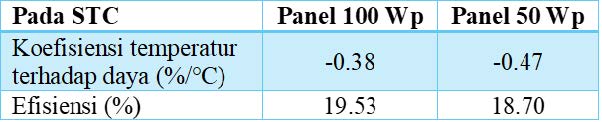
The simulation was conducted under steady-state conditions. Irradiation was applied to the front of the panel, assuming no slope, with values varying from 1000 W/m² to 600 W/m². Wind was represented with a convection coefficient of 10 W/m²°C, equivalent to a wind speed of 5 m/s. Reference values for power, efficiency, and temperature coefficient to power for each panel under Standard Test Condition (STC) are shown in the table below.
The calculation of output power and efficiency can be done using the following equation.

Results and Discussion
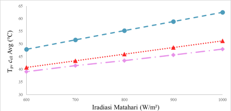
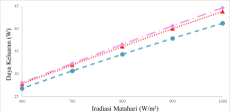
As shown in Figures 5 and 6, design A has the lowest effectiveness. However, design A has the lightest weight and lowest investment cost due to the low level of market availability With higher effectiveness and no significant differences in terms of weight and investment costs, the combined method is the best cooling solution.


Kesimpulan
Based on several criteria, a straight-oriented heat sink is the best orientation. Simulation results from the combined method show greater effectiveness with insignificant differences in weight and investment costs, making it the best solution for passive cooling of solar modules.
Publication
M. N. W. Athallah and B. Halimi, “ Computational Analysis of Combined Heat Sink and Phase Change Material as a Passive Cooling Method for Solar Photovoltaic ,” The 6th International Conference on Power Engineering and Renewable Energy (ICPERE), Indonesia, November 2024