Dr. Gusti Ayu Putri Saptawati, M.Comm
STE-ITB
Dr. Agung Dewandaru, ST, M.Sc
STEI ITB
Abstrak
One of the stages in job recruitment is the job interview, which is a stage that requires a lot of resources including costs, energy, and time. This stage can be simplified or minimized by the development of a web application interview summarization system. The web application interview summarization system can simplify the job interview stage in job recruitment by answering current problems encountered. The web application was developed using a client-server and microservice architecture with a REST API communication mechanism. Testing on the web application interview summarization system was carried out manually based on functional requirements and divided into component and system levels. Testing at the component and system levels fulfills functional requirements that answer job interview problems. The selection of client-server and microservice architectures and REST API-based communication mechanisms appropriate for use in the web application interview summarization system is weighed from the architectural goals that are in accordance with the needs of the interview summarization system. The web application interview summarization system can be further developed by reconsidering the appropriate storage and validation mechanisms.
Kata kunci: interview summarization, job recruitment
Pendahuluan.
One stage in the recruitment process is the job interview, which consists of a conversation between a job applicant and a company representative, either directly through physical interaction or indirectly through conference calls such as Zoom and Google Meet. The interview will yield a transcript or notes of the applicant's answers. Based on these answers, the company will pay attention to certain keywords that are relevant to the company. The company will then determine the level of each competency required based on these keywords. This allows the company to assess applicants and determine their suitability for the company.
The need for technological solutions to assist in the interview stage of the job recruitment process can be answered by creating web application interview summarization system Machine learning-based. This solution is a web application that reduces resource requirements in the interview phase by automatically evaluating the interview summary results using an interview summarization system. The focus of this research is the development of a web application that can process interviews into summary results by integrating the results of speech-to-text and text summarization models.
Research methods
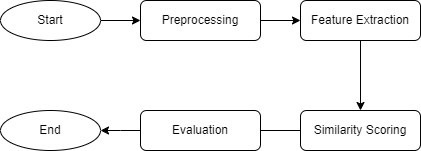
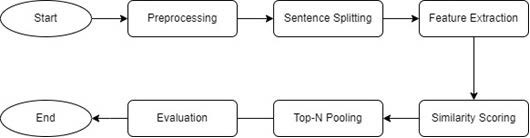
There are two main stages in deducing applicant competencies from interview summaries. Stage 1 is the feature extraction stage from the interview text. The IndoBERT, XLM-RoBERTa, and Cohere models are used to extract features from the text. Meanwhile, stage 2 is the text similarity stage, which uses regular text similarity without any modifications. This method compares all text in the transcript with the description of each level in a competency. In addition, a text similarity method with a modification of top-N pooling is also implemented, namely by comparing each sentence in the transcript text separately with the description of each level in a competency.
This is done to measure text similarity. After that, a similarity assessment is carried out using cosine similarity between each sentence in the transcript text and the description of each level in each competency in the competency dictionary. Next, a top-N pooling-based assessment is used by taking the N sentences that are most relevant and influential in the text similarity assessment process, in other words, the sentences with the highest cosine similarity value for each level in each competency, which are then averaged to obtain the final similarity value for each level in each competency. Then, an evaluation is carried out on the test data to check how many texts in the test data have the same competency level as the predicted competency level generated by the model based on the highest level similarity value for a competency.
Evaluasi Hasil Eksperimen
Based on the experiments that have been conducted, it was found that in the three models used, the configuration using the text similarity method without modification provided slightly better accuracy than the configuration using the text similarity method with top-N pooling modification. Based on the experiments that have been conducted, it was found that in both text similarity methods used, the IndoBERT, XLM-RoBERTa, and Cohere models produced the same best accuracy value, even with different parameter configurations. However, the three models have different computational times, with the fastest model being Cohere, followed by IndoBERT in the second fastest position, and XLM-RoBERTa as the model that requires the most computational time. Cohere has the fastest computational time because the Cohere model already has a dedicated server that provides API services to use which can be accessed by users with certain limitations, according to the type of service purchased.
Kesimpulan
The unmodified text similarity method is more suitable for conducting competency assessment processes than the modified top-N pooling text similarity method. The advantage of the unmodified text similarity method is that it obtains the overall context of a text, making it more suitable for texts containing sentences with interconnected contexts and with relatively low computational costs. The disadvantage of the unmodified text similarity method is the sensitivity of changes in similarity values to changes in text content.
The advantage of the text similarity method with modified top-N pooling is that it obtains sentences with the most relevant context to a text, making it more suitable for texts that are only partially relevant. The disadvantage of the text similarity method with modified top-N pooling is the loss of the overall context of the text and the relatively high computational cost.