Kridanto Surendro
STE-ITB
Neng Ayu Herawati
STE-ITB
Abstrak
The Indonesian government is committed to reducing greenhouse gas emissions by 29%, equivalent to 834 million tons of CO2e, by 2030. The energy sector is the main priority for emission reduction, with a target reduction of 314 million tons of CO2e. One method of reducing emissions is through carbon trading and the implementation of a carbon tax scheme in the carbon trading sector at coal-fired power plants starting in 2022. Several studies on GHG emissions only focus on calculating carbon emissions and have not applied prediction models. Meanwhile, the carbon emission prediction conducted by Zhu et al. only uses a regression model, so the prediction results will depend on independent variables that cannot yet make long-term predictions. This study will involve a carbon emission prediction model to provide information for decision makers in optimizing carbon emission predictions.
Keyword: Model Prediksi, Emisi Karbon, Machine Learning
Pendahuluan
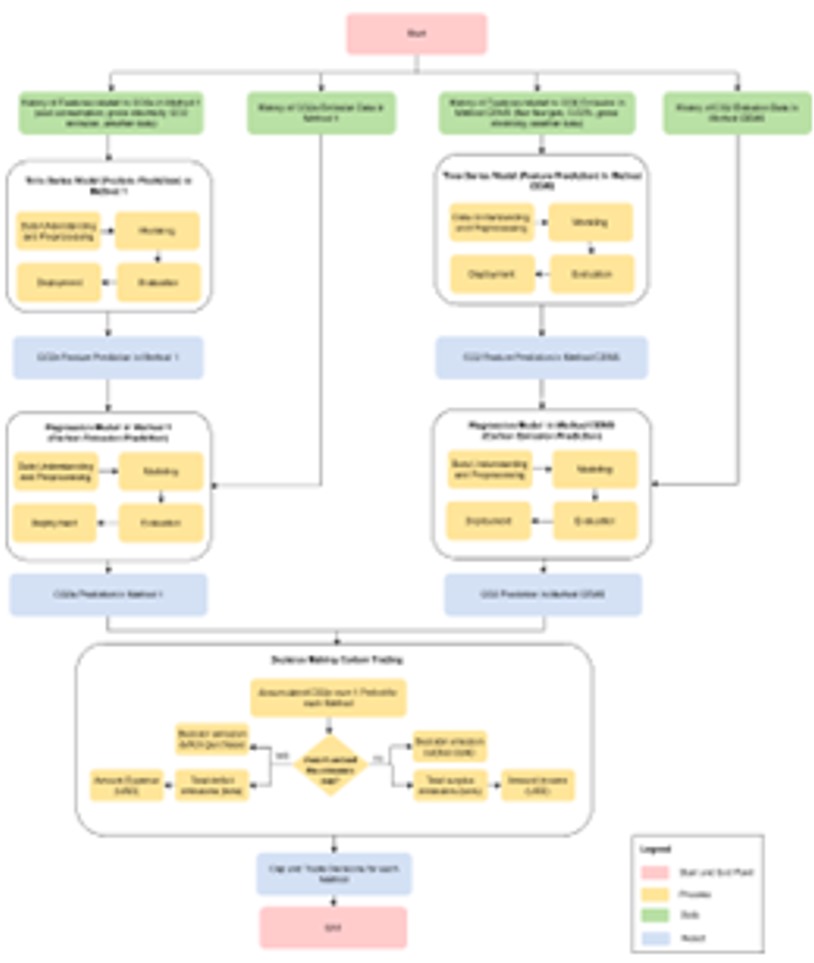
In this study, a predictive model was developed using machine learning, incorporating time series and regression models for a Steam Power Plant (PLTU). The time series model was used to predict each feature or variable as input to the regression model to predict carbon emissions.
Then, carbon trading decision information is generated using rule-oriented decision support systems. The carbon emission prediction results are used to inform carbon trading decisions in the next period. This research will involve specific data based on activity at the coal-fired power plant (PLTU), using daily granularity for greater accuracy and greater data collection to improve model performance.
Carbon emission prediction modeling will compare model results using linear regression and Method 4, or CEMS. The data used in the CEMS method is real-time data on each unit's operational time and gross electricity. Furthermore, the data used in Method 1 consists of historical activity converted to CO2e emissions, namely CO2, CH4, and N2O emissions calculated using Global Warming Potential (GWP) values, along with gross electricity data.
Research Methodology
The methodology used in this research is the Design Science Research Methodology (DSRM). The research stages in DSRM can be seen in Figure 1. DSRM has six research stages starting from problem identification, defining research objectives, design, creation, demonstration, evaluation, and communication.


Discussion and Results
Based on the results of the best model test scores are:
a. Linear Regression:
Linear Regression is the best model because the data in the unit has a linear relationship between features and linear predictions are better.
The effectiveness of Linear Regression as the best model shows that the data has a strong linear relationship, making it easier for the model to make more accurate predictions.
b. Random Forest Regression:
Random Forest Regression is the best model in Unit 8, this is because the data characteristics in Unit 8 have more complex relationships.
The success of Random Forest Regression as a model in Unit 8 shows that the data in this unit is more complex or non-linear so that Random Forest Regression can capture this relationship better than other models.

Kesimpulan
This research produces a predictive model that can provide information on carbon emissions, coal fuel consumption, and gross electricity to optimize carbon emissions, as well as information that can support decision-making in carbon trading activities. The research results can be used to inform coal-fired power plants (PLTU) in planning more effective carbon trading strategies by comprehensively considering environmental and financial factors.