Kridanto Surendro
STE-ITB
Abstrak
In today's digital era, universities are using Information Technology equipment extensively to support the teaching and learning process. However, there is still a lack of awareness about the emissions generated by the learning process and the environmental impact of data centers or servers. In fact, IT equipment frequently used by end-users in universities, such as laptops, tablets, smartphones, and printers, produces 1.5 to 2 times more carbon dioxide emissions than data centers. This is further supported by the fact that universities tend to have far more end-user devices than data centers or servers.
The problem in this research is that there is no Information Technology equipment management system in universities that considers the end-of-life (EOL) aspects of IT equipment and emission aspects, while similar technologies in industry are increasingly paying attention.
Keyword: Model Perhitungan, Jejak Karbon, Machine Learning, TIK
Pendahuluan
Estimating carbon dioxide emissions by observing the electricity consumption of IT equipment at universities is necessary to determine potential negative impacts. Calculations focus on secondary emissions, which differ between universities. At the University of Cape Town in South Africa, secondary emissions reached 7.3 t CO2, accounting for 82% of the organization's emissions. The University of Leeds in the UK uses smaller emissions, with electricity accounting for only 32% of their total emissions. This difference in percentages also serves as a guideline for ITB's emission estimates based solely on external electricity.
Organizations can manage emissions generated by IT equipment by managing the life cycle of their equipment. Initial emission calculations have been conducted by ITB previously at a large level in the equipment life cycle management process, namely with IT emissions related to life value and will be very time. However, obsolete IT equipment has not been managed with electronic material management (EMM) in the Bumil regulations. Therefore, ITB needs to develop an IT equipment management system plan based on the total emission footprint released during the life cycle, as well as EOL management related to the value that can be generated from owned assets.
Research Methodology
Problem Identification and Research Scope
Collecting information about the problem, data coverage, and determining a feasible research scope.
Pemahaman Konsep
Searching for research references and understanding fundamental concepts in the form of literature studies.
System Design
Design the system according to defined design methods.
System Evaluation
Evaluate the results of carbon calculations, predictive modeling, and the DSS system as a whole.


Discussion and Results
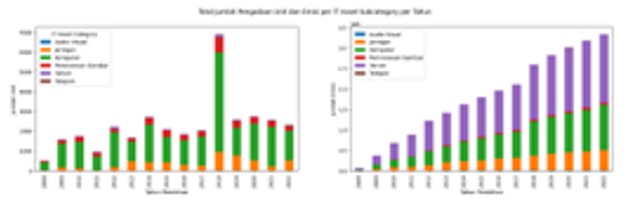
Modeling was performed to gain a deeper understanding of the data through various data visualizations. Figure 3 shows the number of IT asset procurements, which has remained relatively stable each year, except in 2018, where it doubled compared to the previous year. This indicates that procurement in 2018 focused on increasing IT equipment procurement.
There are differences between IT asset categories from a procurement perspective. In 2018, there was significant asset procurement, the majority of which fell into the server category.

Kesimpulan
The research focuses on designing an IT equipment management system capable of providing insights to ITB stakeholders. The system is designed to provide decision option scenarios that can assist in making decisions regarding procurement or asset management. This system considers EOL management and emission estimation. This system is realized in an Intelligent Decision Support System (DSS) that uses predictive models to estimate future emissions. The system is expected to assist ITB in managing IT equipment and EOL management, while also helping reduce greenhouse gas emissions globally.