Nur Ahmadi
STEI ITB
Pendahuluan
The EL2003 Discrete Structures course provides an understanding of discrete mathematics and its applications in Electrical Engineering. This course is roughly divided into: (1) fundamental concepts of discrete mathematics: definition, proof, sets, functions, relations. (2) discrete structures: modular arithmetic, graphs, state machines, counting. In the Student Centered Learning (SCL) course design, students will learn through several lecture methods besides lectures, namely students will do hands-on regarding the selection of certain algorithms in discrete structures (e.g. sorting, counting, traveling salesman problem, Huffman tree, etc.). Students will also learn methods for measuring the complexity of an algorithm. It is expected that students will gain a comprehensive understanding from the theoretical level to implementation in code and simulation.
Keyword: struktur diskrit, student centered learning, hands-on.
Metode
The expected outcomes from learning from this course are as follows:
- Participants can relate the themes involved to discrete structures.
- Participants can identify contributors in the subject area.
- Participants will be able to articulate the differences between discrete and continuous models.
- Participants will be able to explain how electrical and computer engineering can utilize discrete structures.
For the SCL design in the EL2003 course, students will do several things, namely:
- Pertemuan sinskron tatap muka
- Practice working directly on several questions related to discrete structure theory based on the material provided.
- The course assignment is in the form of a group project to implement an algorithm in a discrete structure using a programming language and visualization/animation.
The book sources used for material and project development are:
- Kenneth H. Rosen. Discrete Mathematics and Its Applications, McGraw Hill.
- Richard Johnsonbaugh. Discrete Mathematics. Pearson.

Tugas Berbasis Proyek
The EL2003 Discrete Structures class consists of 59 third-semester Electrical Engineering students. This project-based assignment is given in the chapter on algorithms and complexity. Each group consists of 6-7 people, each with a different topic. The topic options are listed in the following table.
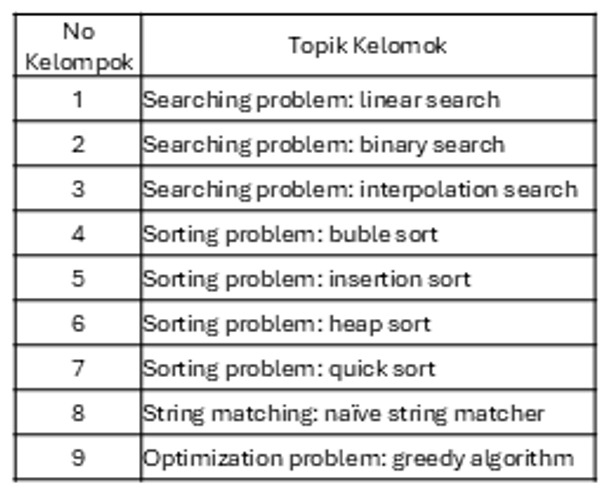
This assignment report consists of: 1. Overview or introduction to the algorithm, 2. Detailed explanation of mathematical formulation, 3. Implementation and testing.
This assignment will be presented by groups, with different divisions of time between presenting, answering questions, and asking questions of other groups. The following is an example of documentation of group representatives presenting their projects.

Hasil
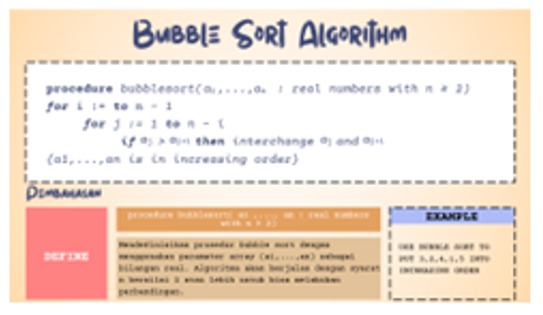
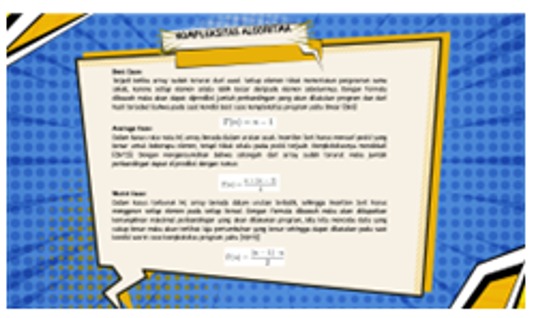
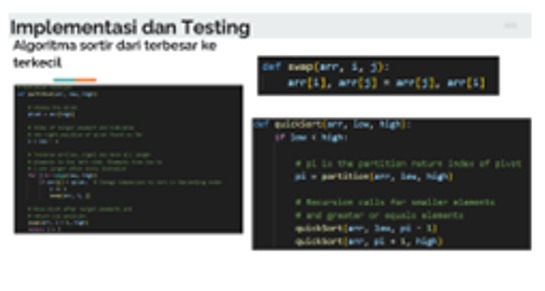
Project reports were compiled in the form of a document report (.docx) and presentation slides (.pptx). Each group presented their topic effectively, covering the overview, how it works, implementation in the form of programming code, and testing. Some slides from the group presentations can be seen in the image below.

Kesimpulan
By using a student-centered learning (SCL) approach through group projects that cover everything from theoretical overviews to code implementation and testing, students gain a deeper understanding of the material. Furthermore, collaborative assignments provide students with the opportunity to practice working collaboratively and dividing up the workload. Presentations train students to communicate effectively and convey the material effectively orally.