Prof. Dr. Ir. Suwarno, MT.
School of Electrical Engineering and Informatics
Dr. Eng. Rachmawati, S.T., M. Eng.
School of Electrical Engineering and Informatics
Retno Aita Diantari, S.T., M.T.
School of Electrical Engineering and Informatics
Della Vega Zulfa, S.T., M.T.
School of Electrical Engineering and Informatics
Abstract
Indonesia faces challenges in the reliability of its electricity transmission system due to pollution in industrial and coastal areas. This research improves the performance of high-voltage ceramic insulators with Room Temperature Vulcanized (RTV) silicon coatings containing nano-silica (nSiO2). The addition of nSiO2 increases the hydrophobicity and resistivity of the surface, reducing leakage current. Several nSiO2 compositions were tested to find the optimal concentration, with an alternative blend of gondorukem material to improve coating performance.
Keyword: nanosilica filler, RTV Silicone Rubber, arus bocor, isolator pasangan luar.

Introduction
The reliability of electrical systems is significantly impacted by high-voltage insulators, which contribute up to 35% of system failures. In polluted areas, such as industrial and coastal areas, pollutants increase the surface conductivity of insulators, triggering leakage currents, dry band arcing, and even flashovers. This causes significant disruptions, particularly in Indonesia, with its tropical climate and long coastline.
This research aims to improve insulator performance with Room Temperature Vulcanized (RTV) silicone coatings containing nano-silica (nSiO2). This additive increases hydrophobicity and pollution resistance, reducing the risk of leakage current and corrosion. This solution is expected to support the reliability of electricity transmission systems in highly polluted tropical regions (Figure 1).
Research Method
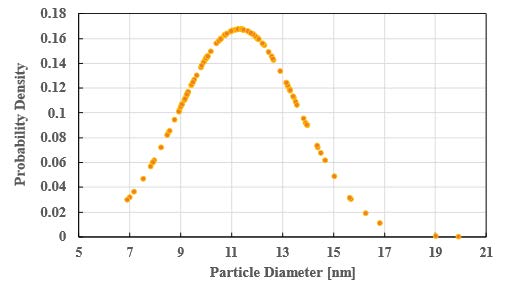
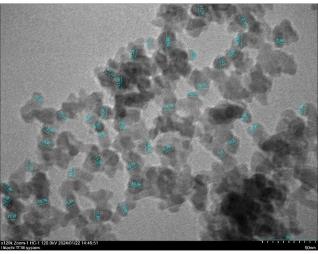
In this study, two alternative new materials were used: a silicone rubber matrix with nanosilica filler particles with a diameter of ~11 nm (Figure 4), and Gondorukem material mixed with a silicone rubber matrix. For both material mixtures, material composition optimization was carried out through permittivity, surface resistivity, and hydrophobicity tests.
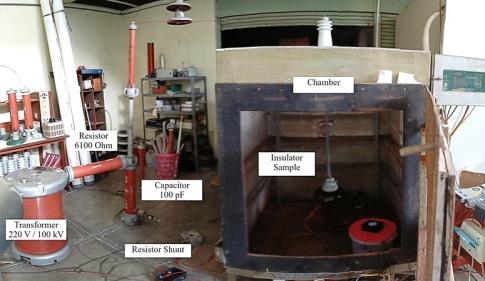
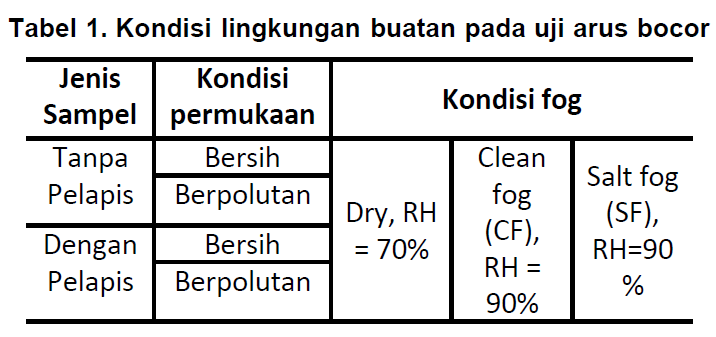
mixture of materials with the optimum composition was selected and then applied to the ceramic insulator using a spray method. Next, leakage current, hydrophobicity, and SEM tests were performed on insulator samples with and without coating, as shown in Figure 2.
NaCl and kaolin were used as pollutants. 512.65 mg NaCl was used as ESDD and 2563.24 mg kaolin was used as NSDD. According to IEC 60815 (2008), these concentrations indicate a very high level of site pollution severity.

Discussion & Result
Hasil Uji TEM & Distribusi diameter partikel pengisi nanosilica [1]
Karakteristik elektrik pelapis RTVSiR/nSiO2 [2]
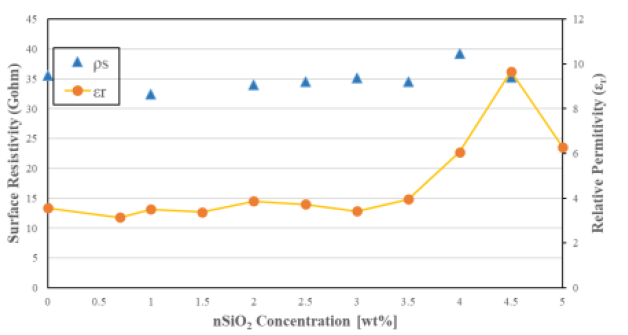

The optimal composition for the RTV SiR/nSiO2 coating is 4 wt% nSiO2 with the following properties:
• Tahanan permukaan tertinggi (Gambar 5)
• Permittivity: Significant increase at 4 and 4.5 wt%c, optimal performance (Figure 5).
• Hydrophobic surfaces with contact angles greater than 90° (Figure 6)
The same test results with Gondorukem/RTV SiR material showed that the addition of 5 wt% gum rosin to RTV silicone rubber can improve the characteristics of the insulator coating material as indicated by an increase in the contact angle of 7.850 and a decrease in the magnitude of the leakage current by up to 9.42% at 70% relative humidity, 7.1% at 80% relative humidity and 10.02% at 90% relative humidity, when compared with the RTV SiR coating alone [3].
Conclusion
Modification of RTV silicone rubber material was successfully implemented by adding nanosilica additives where 4 wt% is the optimum concentration. As an alternative, Gondorukem natural material can also improve the surface characteristics of the coating if mixed with RTV silicone rubber material with a composition of 5 wt%/95 wt%. The modification of the material increases hydrophobicity, permittivity, surface resistivity, so it can suppress the large leakage current on the insulator surface. The reduction in the cross product of leakage current and THD is as follows.
– 27-52% for salt fog conditions
– 12-31% for clear fog conditions
– 68-76% for dry conditions
Referensi/Output
[1] Della Vega Zulfa, et al, ICE3IS, online, Indonesia, Agustus 2024 (presented).
[2] Agustinus D. Nalendra, et al, ICPERE 2024, 11B-7, Nov 2024 (presented).
[3] Retno A. Diantari, et al, Emerging Science Journal, Nov 2024 (submitted)