Muhammad Shiddiq Sayyid Hashuro, S.T., M.Eng., Ph.D
STEI-ITB
Indira Mona Farhany
STEI-ITB
Abstract
Intracranial aneurysms are critical conditions with high mortality rates, particularly when ruptured, causing subarachnoid hemorrhage. Despite coiling procedures being the recommended treatment, limited training opportunities hinder their adoption. This study developed ICA vessel phantoms using 15%wt PVA-H (80% DMSO, 20% distilled water) with a compliance of 32.8 mm/mmHg x 10″, dosely mimicking cerebral blood vessels. The phantoms include artificial brain tissue, made from 2.2% wt silicone or 5%wt PVA-H, replicating grey matter elasticity. Additionally, a Newtonian blood analog fluid with a density of 1073.7 kg/m3 and viscosity of 3.81 ± 0.34 mPa·s was created. These phantoms show promise as training tools, with further integration comprehensive application.
Keyword: Intracranial needed for Intracranial Aneurysm, Coiling Procedure, Cerebral Blood Vessel Phantom, Brain Tissue Phantom, Blood Mimics Fluid.
Introduction
Intracranial aneurysms, caused by weakened cerebral blood vessel walls, affect 1.8% -3% of the global population. Aneurysms in the internal carotid artery (ICA) are particularly critical due to elevated blood flow and pressure, which increase the risk of rupture and severe neurological damage, Endovascular coiling, recommended as a safer alternative to surgical dipping, remains underutilized due to limited training opportunities, despite requiring precise technical skills and device understanding. This highlights the need for realistic training tools.
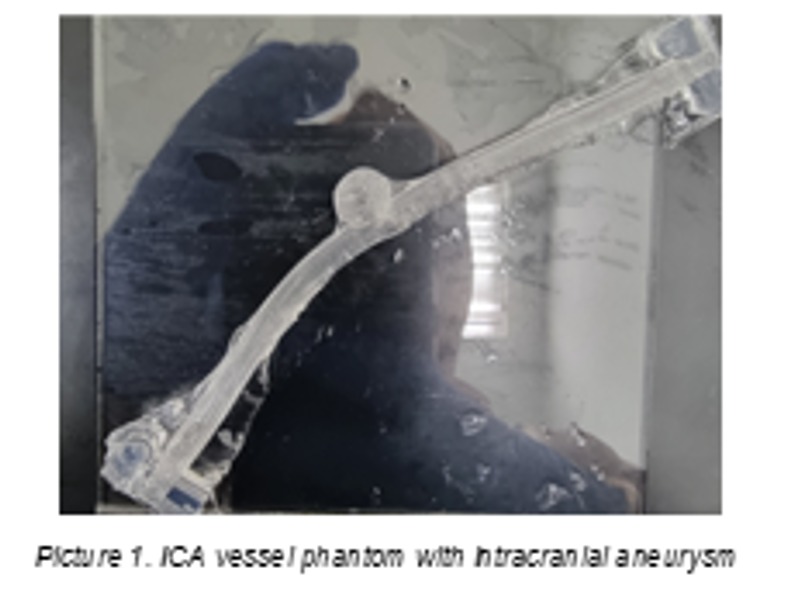
In this study, ICA vessel phantoms with intracranial aneurysms were fabricated using polyvinyl alcohol hydrogel (PVA-H), a material known for its tunable mechanical properties. The phantoms replicate the compliance and elasticity of blood vessels and include brain tissue analogs and blood-mimicking fluids to enhance realism.
The development of these phantoms integrates findings from related studies to enhance their effectiveness as a learning medium. Designed for use with a sensor-based platform that measures contact forces during coiling procedures, the setup facilitates performance evaluation, providing objective feedback to refine skills and improve training outcomes.
Research Method
PVA-H was used in the fabrication of ICA vessel phantoms with intracranial aneurysms. The PVA used was PVA 17 JF powder, with a DMSO and distilled water ratio of 80% 20%. PVA-H was utilized to create ICA vessel phantoms with intracranial aneurysms, using PVA 17 JF powder with an 80% DMSO and 20% distilled water solution. Concentrations of 12%wt and 15%wt PVA-H were tested to determine which best mimics ICA vessel compliance. The mixture was heated to 150-180°C, stirred at 200-300 rpm, and vacuumed at 70°C to remove air bubbles.
It was then molded using resin and PVA filament molds, followed by dissolving the inner mold in distilled water for 14 hours. The phantom was soaked in ethanol for 24 hours to remove DMSO and stored in distilled water.
The brain tissue phantom was fabricated using a material composition of 2.2%wt silicone, 1.8%wt silicone, 5%wt PVA-H (80% DMSO, 20% distilled water), and 5%wt PVA-H (40% DMSO, 60% distilled water). The process for creating the PVA-H-based phantoms was the same as for the blood vessel phantoms, with the only difference being the concentration. For the silicone material, the fabrication involved mixing silicone with a curing agent until homogenous, followed by vacuuming at -0.8 to -0.9 bar at 50°C. The mixture was then cured for 24 hours under vacuum. The silicone phantom can be stored at room temperature.
The blood mimicking fluid (BMF) was made using glycerin and distilled water as the base materials. The glycerin used was 99% glycerin from Rofa Laboratory Centre. In this study, three compositions were utilized: BMF 1 with 40% v/v glycerin and 60%w/v distilled water, BMF 2 with 40% v/v glycerin, 59.98%w/v distilled water, 0.01%wt xanthan gum, and 0.01% wt starch, and BMF 3 with 33% v/v glycerin and 67% v/v distilled water. The preparation process involved heating the glycerin first, followed by the gradual addition of the other components one by one. The mixing process was carried out at a temperature of approximately 50-60°C, with a rotational speed of 300-600 rpm, where the temperature, rotation speed, and mixing time varied depending on the specific ingredient being added.

Discussion & Result
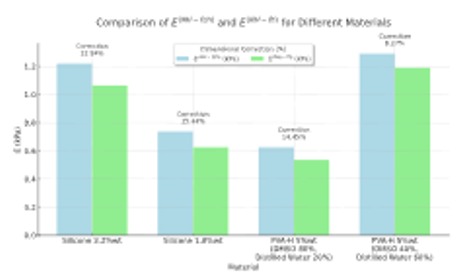
The ICA vessel phantom with an intracranial aneurysm was tested for qualitative accuracy, dimensional fidelity, and compliance using hydrostatic pressure tests, w The graph in Picture 2 highlights that 15% wt PVA-H exhibits notably better mechanical properties compared to 12% wt PVA-H. The 15%wt PVA-H material dosely replicated real ICA vessel compliance, achieving a value of approximately 32.8 (mm/mmHg x 10-3), making it an effective tool for simulating the mechanical properties of brain vessels with aneurysms for research and training purposes.
The brain vessel phantom was modified to better replicate the physiological conditions of an intracranial aneurysm. As shown in Figure 3, macroindentation tests identified two samples with elastic modulus dosely matching gray matter, effectively mimicking the ICA’s natural environment. Using 2.2% wt silicone and 5%wt PVA-H (40% DMSO, 60% distilled water), the phantom successfully simulated the tissue surrounding the ICA with an aneurysm, enhancing its relevance for research and training.
Additionally, the blood mimicking fluid (BMF) was tested for viscosity and density. The viscosity of BMF 3 was measured using a Brookfield viscometer, which provided accurate readings of 3.81 P. The density, calculated based on mass and volume, was approximately 1073.7 kg/m3. Both values fall within the IEC 1685 draft standards, confirming the suitability of BMF 3 for realistic blood simulation in the phantom model, ..
Conclusion
The development of ICA phantoms with intracranial aneurysms replicates mechanical and anatomical properties of cerebral vessels, including compliance, elasticity, and physiological conditions. Enhanced with artificial brain tissue and blood- mimicking fluid, these phantoms provide a realistic platform for training coiling procedures.
Integration with sensor-based platforms from other studies can facilitate detailed performance evaluation and offer objective feedback to support skill refinement. This study provides a foundation for the development of tools that can enhance interventional training and contribute to improved procedural practices.