MAGISTER INFORMATIKA
The Master of Informatics study program aims to equip its graduates with critical, innovative, and professional thinking skills to compete globally in the field of Informatics, as well as to develop research-based knowledge and technology for the field of Informatics. The scientific fields of the Master of Informatics study program include the basic scientific fields of computing (Fundamentals of Computing) and scientific fields according to their options. There are eight options, namely Computer Science (CS), Software Engineering (SE), Media and Mobile Technology (MMT), Data Science (DS), Artificial Intelligence (AI), Cyber Security (CSec), Information Systems (IS), and Information Technology (IT). The types of programs in the Master of Informatics study program consist of: Regular, By Research/Project, Executive and Multidisciplinary
General Description & Curriculum
Master Program in Informatics has some objectives to produce graduates with profiles as Engineers, Managers, Consultants, or Researchers in the field of Informatics who have the following general competences during the early stages of their careers (3-5 years after graduation), namely:
- Our graduates will have critical thinking, innovative, and professional aspects to compete globally in the field of informatics.
- Our graduates will successfully pursue advanced study or engage in professional development.
- Our graduates will have managerial capabilities in research in the field of informatics.
Student outcomes of the Master Program in Informatics are as follows.
- Students will be able to analyze problems in the field of Informatics or other fields of science to identify computing-based solutions.
- Students will be able to design and build computing-based solutions through an interdisciplinary or multidisciplinary approach
- Students will be able to evaluate computing-based solutions that fulfill the requirements through an interdisciplinary or multidisciplinary approach.
- Students will be able to develop research-based knowledge and technology in the field of informatics by engineering and developing specific scientific fields, including:
a. algorithms or computational theory to solve actual and contemporary problems (computer science track), or
b. software engineering, including developing reliable, innovative, and easy-to-maintain large-scale software (software engineering track), or
c. the concept, architecture, and technology of media and mobile devices, including developing the media and mobile device applications using the principles of human and computer interaction as well as good and appropriate software engineering methodologies (media and mobile technology track), or
d. management, processing, and interpretation of large and complex datasets for extraction of critical information and knowledge (data science track), or
e. artificial intelligence concepts, technologies, and applications, including using the suitable tools to deliver an effective and efficient artificial intelligence solution (artificial intelligence track), or
f. the development, operation, and testing of cybersecurity systems (cybersecurity track), or
g. information system governance at the enterprise level to maximize the potential of the system and to minimize its risks using information technology resources efficiently (information systems track), or
h. the analysis, modeling, design, construction, and development of information technology-based systems (information technology track)
i. Development, operation, and security testing of cyber systems (CSec option). - Students will be able to communicate effectively in diverse professional and academic contexts.
- Students will be able to function effectively in team activities by their field of knowledge.
There are 8 (eight) tracks, as follows Computer Science (CS), Software Engineering (SE), Media and Mobile Technology (MMT), Data Science (DS), Cyber Security (CSec), Artificial Intelligence (AI), Information System (IS), and Information Technology (IT).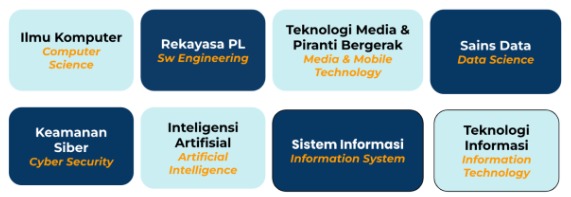
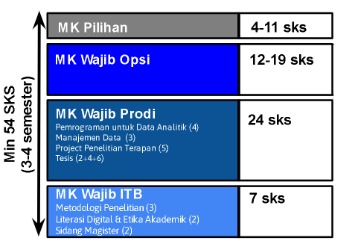
The curriculum of the Master Program in Informatics, comprising a total of 54 credits, is divided into 3 semesters with a maximum load of 18 credits per semester, following the composition below. For the multidisciplinary program scheme and the Double Degree program scheme, the curriculum is structured over 4 semesters.
ITB mandatory : 7 credits
Study Program mandatory : 12 credits of structured courses + 12 credits of Thesis
Track mandatory : 12-19 credits
Elective : 4-11 credits
The study period is scheduled within 3 to 4 semesters. The course structure of the Master Program in Informatics for 3 semesters is as follows. Students take 18 credits per semester.
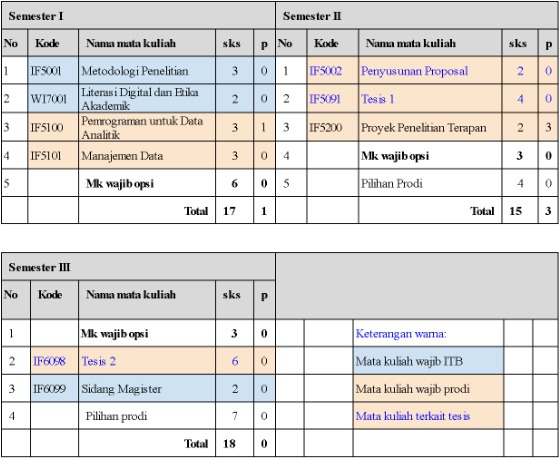
| No | Code | Course | Credits |
| 1 | IF5001 |
Research Methodology
|
3 |
| 2 | WI7001 |
Digital Literacy and Academic Ethics
|
2 |
| 3 | IF5100 |
Programming for Data Analytics
|
3 |
| 4 | IF5101 |
Data Management
|
3 |
| 5 | IF5002 |
Proposal Preparation
|
2 |
| 6 | IF5091 |
Thesis 1
|
4 |
| 7 | IF5200 |
Applied Research Project
|
2 |
| 8 | IF6098 |
Thesis 2
|
6 |
| 9 | IF6099 |
Master's Session
|
2 |
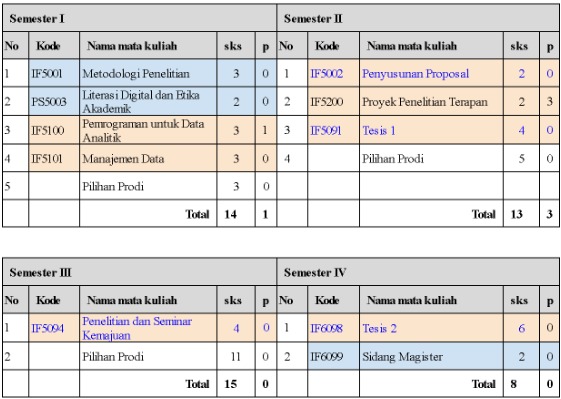
The course structure of the Master Program in Informatics for 4 semesters is as follows. Students take 11–16 credits per semester.

Specifically for the Research-based Master's track, the course composition is arranged according to the following structure, and the curriculum is designed over 4 semesters.
ITB mandatory : 7 credits : 7 sks
Required Study Program Study Program mandatory : 12 credits of structured courses + 16 credits of Thesis
Choice Electives : 19 credits
The course structure of the Master Program in Informatics for the Research-based Master's track is as follows.
Students in the Computer Science (CS) track are expected to develop research-based knowledge and technology in the field of Informatics by designing and developing algorithms or computational theories that can address current and real-world problems.
Compulsory courses for the Computer Science (CS) track:
| No | Code | Matakuliah | Credits | P |
| 1 | IF5110 |
Algorithm Design
|
3 | 0 |
| 2 | IF5111 |
Mathematics for Computer Science
|
3 | 0 |
| 3 | IF5210 |
Compiler Design
|
3 | 0 |
| 4 | IF5112 |
Advanced Distributed Systems
|
3 | 0 |
Students in the Software Engineering (SE) track are expected to develop research-based knowledge and technology in the field of Informatics by designing and developing large-scale software products that are reliable, innovative, and maintainable.
Compulsory courses for the Software Engineering (SE) track:
| No | Code | Matakuliah | Credits | P |
| 1 | IF5120 |
Software Requirement Engineering
|
3 | 0 |
| 2 | IF5121 |
Software Design
|
3 | 0 |
| 3 | IF5220 |
Software Quality
|
3 | 0 |
| 4 | IF5221 |
Software Product Innovation
|
1 | 3 |
| 5 | IF6120 |
Software Evolution
|
3 | 0 |
Students in the Media and Mobile Technology (MMT) track are expected to develop research-based knowledge and technology in the field of Informatics by designing and developing concepts, architectures, and technologies for media and mobile devices, as well as developing applications for media and mobile devices using principles of human-computer interaction and proper software engineering methodologies.
Compulsory courses for the Media and Mobile Technology (MMT) track:
| No | Code | Matakuliah | Credits | P |
| 1 | IF5130 |
Software Engineering for Game Domain
|
3 | 0 |
| 2 | IF5131 |
Multimedia Data Processing and Management
|
3 | 0 |
| 3 | IF5230 |
Mobile Technology and Application
|
3 | 0 |
| 4 | IF6130 |
Interactive Media Technology & Application
|
3 | 0 |
Students in the Data Science (DS) track are expected to develop research-based knowledge and technology in the field of Informatics by designing and developing the management, processing, and interpretation of large and complex datasets for the extraction of important information and knowledge.
Compulsory courses for the Data Science (DS) track:
| No | Code | Matakuliah | Credits | P |
| 1 | IF5140 |
Machine Learning
|
2 | 0 |
| 2 | IF5141 |
Data Mining
|
3 | 1 |
| 3 | IF5240 |
Business Intelligence and Analytics
|
3 | 1 |
| 4 | IF5241 |
Big Data System
|
3 | 0 |
| 5 | IF6097 |
Industrial Internship
|
3 | 0 |
Students in the Artificial Intelligence (AI) track are expected to develop research-based knowledge and technology in the field of Informatics by designing and developing concepts, technologies, and applications of artificial intelligence, including appropriate tools as effective and efficient AI solutions.
Compulsory courses for the Artificial Intelligence (AI) track:
| No | Code | Matakuliah | Credits | P |
| 1 | IF5150 |
Advanced Artificial Intelligence
|
3 | 0 |
| 2 | IF5151 |
Mathematics for Artificial Intelligence
|
3 | 0 |
| 3 | IF5250 |
Deep Learning
|
3 | 1 |
| 4 | IF5251 |
Artificial Intelligence in Production
|
3 | 0 |
| 5 | IIF6150 |
Trustworthy Artificial Intelligence
|
3 | 0 |
| 6 | IF6151 |
Artificial Intelligence Individual Project
|
3 | 0 |
Students in the Cybersecurity (CSec) track are expected to develop research-based knowledge and technology in the field of Informatics, particularly in the development, operation, and testing of cybersecurity systems.
Compulsory courses for the Cybersecurity (CSec) track:
| No | Code | Matakuliah | Credits | P |
| 1 | IF5161 |
Data and Software Security
|
3 | 0 |
| 2 | IF6160 |
System Security & Privacy
|
3 | 0 |
| 3 | IF5260 |
Digital Forensics
|
3 | 0 |
| 4 | IF5160 |
Cybersecurity Operations
|
3 | 0 |
| 5 | IF6161 |
Cybersecurity Individual Project
|
3 | 0 |
Students in the Information Systems (IS) track are expected to develop research-based knowledge and technology in the field of Informatics by designing and developing Information Systems governance at the enterprise level to maximize system potential and minimize risks through the efficient use of Information Technology resources.
Compulsory courses for the Information Systems (IS) track:
| No | Code | Matakuliah | Credits | P |
| 1 | IF5170 |
Digital Strategy
|
3 | 0 |
| 2 | IF5171 |
System Thinking
|
3 | 0 |
| 3 | IF5270 |
Applied Artificial Intelligence for Enterprise
|
3 | 1 |
| 4 | IF5271 |
Information System Sustainability
|
3 | 0 |
| 5 | IF6170 |
Data Governance
|
3 | 0 |
Students in the Information Technology (IT) track are expected to develop research-based knowledge and technology in the field of Informatics by designing and developing the analysis, modeling, design, construction, and advancement of information technology-based systems.
Compulsory courses for the Information Technology (IT) track:
| No | Code | Matakuliah | Credits | P |
| 1 | IF5180 |
Digital Twin Technology
|
3 | 0 |
| 2 | IF5181 |
Information Technology Platform
|
3 | 0 |
| 3 | IF5280 |
Digital Security, Privacy, and Forensics
|
3 | 0 |
| 4 | IF6180 |
Digital Transformation and Enterprise Architecture
|
3 | 0 |
General Information
Wisudawan Program Magister Informatika, Oktober 2023
Wisudawan Program Magister Informatika, Juli 2023
Wisudawan Program Magister Informatika, April 2023
Wisudawan Program Magister Informatika, Oktober 2022
Wisudawan Program Magister Informatika, Juli 2022
Wisudawan Program Magister Informatika, April 2022
Wisudawan Program Magister Informatika, Oktober 2021
Wisudawan Program Magister Informatika, Juli 2021
Wisudawan Program Magister Informatika, April 2021
The Bachelor and Master's Integration Program (PPSM) aims to increase the number of ITB undergraduate students who continue their studies in the Master's Program, with a study period that meets the integration program's target. This is done to achieve one of the indicators of the ITB Strategic Plan 2021-2025, namely a 40% postgraduate student percentage by 2025. Based on the fulfillment of basic competencies. computing, there is a general scheme or unification of cognate and non-cognate Bachelor-Masters degrees with the Informatics Masters Study Program, which is divided into three categories as follows:
- Linear, for undergraduate students who have met all basic competencies. Based on the curriculum, undergraduate programs that meet these requirements are those from STEI-K (Informatics Engineering and Information Systems & Technology).
- Semi-linear, for undergraduate students who have fulfilled some of the basic competencies. Based on the curriculum, the undergraduate programs that fulfill this requirement are those from STEI-R (Electrical Engineering, Telecommunication Engineering, Biomedical Engineering, Electrical Power Engineering).
- Non-linear, for undergraduate students who do not yet have basic competencies. Other study programs outside of STEI can generally be categorized as non-linear, except for those that have basic competencies. computing. Evaluation of study programs outside the STEI environment whether they are included in the semi-linear or non-linear category will be carried out on a case-by-case basis when the related undergraduate study program students register for this program.
Basic Competency Table Computing
| Basic competencies | Description |
|---|---|
| Programming |
|
| Database |
|
| Discrete Mathematics |
|
| Computer System |
|
The course structure of the PPSM Informatics Masters Study Program is as follows.
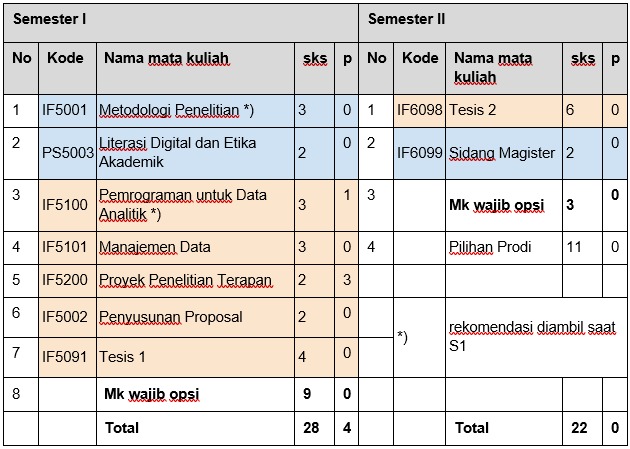 PPSM students are required to undertake a continuous TA Thesis, which is the implementation of TA in the undergraduate program and thesis in the master's program with a continuous topic so that it is part of the work/research in the same area. Related to the category of PPSM program participants, the rules for implementing a Continuous TA Thesis are defined as follows.
- Linear: students are required to carry out a Continuing Thesis TA with the same topic and supervisor.
- Semi-linear: Students are advised to undertake a Continuous Thesis TA with a topic that is possibly multidisciplinary in nature with the student's undergraduate program field and with a supervisory team that can come from the student's undergraduate study program and from the Informatics Master's study program. However, if not, then students are required to undertake a TA with a topic in the field of computing, even though it is not continuous with the thesis topic in the Informatics Master's Study Program and can be carried out with a different supervisor.
- Non-linear: students are advised to undertake a Continuous Thesis TA with a topic that is possibly multidisciplinary in nature with the student's undergraduate program field and with a supervisory team that can come from the student's undergraduate study program and from the Informatics Master's Study Program. However, if not, then students are advised to take a TA topic in the field of computing, although it is still possible to take another topic outside the field of computing according to the field of their study program, so that it can be carried out with a different supervisor than the thesis.
The general management plan for the Continuous Thesis TA is as follows.
- Supervisor requirements:
The Continuous Thesis TA is carried out with the same supervisor for both the TA and the Thesis. The maximum number of supervisors is 2 people, both for the TA and the Thesis. If there is only 1 supervisor, then the supervisor must be eligible as the main supervisor in the undergraduate study program and the Master of Informatics Study Program. If there are 2 supervisors, then one of the supervisors must be eligible as the main supervisor in the Master of Informatics Study Program and the rules for the order of the main and assistant supervisors follow the rules in the undergraduate study program and the Master of Informatics Study Program. The list of supervisors for the Master of Informatics Study Program can be accessed at Dosen Pembimbing Tesis Magister Informatika ITB. - Topic requirements:
- The topic of the Continuing Thesis TA must be within the scope of the computing field.
- The topic of the Continuing Thesis TA must consider the appropriate level of knowledge and depth and must can be divided clearly target untuk proses TA di program sarjana dan target proses tesis di program magister.
- The topic of the Continuing Thesis TA must consider the appropriate level of knowledge and depth and must
- Thesis topics for Continuing Thesis Projects can come from prospective supervisors or from student proposals. If the proposal originates from the student, it must be consulted with and approved by the supervisor.
- Student data collection:
Before the 7th semester of the undergraduate student program begins, the PPSM implementation team held a meeting and socialization with all students participating in the PPSM program who were due to take their TA in the 7th semester. Students were asked to submit their TA Thesis taking plan to get information about participants who would take the Continuous Thesis TA, especially for students from the semi-linear and non-linear categories. - Topic and supervisor allocation procedures:
- For all students who will undertake a Continuous Thesis TA, the PPSM implementation team coordinates with all TA implementation teams in all related student study programs and the thesis implementation team of the Master of Informatics Study Program to coordinate the allocation of Thesis TA topics and supervisors for the students concerned.
- The process of allocating the topic and TA Thesis supervisor can be a special case in the allocation of the topic and TA supervisor in the student's undergraduate study program and the procedure can be adjusted to the procedure in each undergraduate study program provided that the topic requirements (see point 2) and supervisor (see point 1) are met.
- After students are allocated a topic and supervisor, students report the Continuing Thesis TA planning proposal that has been signed by the student and supervisor to the PPSM implementation team.
- The topic and supervisor allocation process can begin before semester 7 begins and must be completed no later than the 7th week of semester 7 of the student's undergraduate program.
- Taking related courses:
a. Taking TA course in undergraduate study programs- Assumption: There are TA-I courses in semester 7 and TA-II in semester 8 in each undergraduate study program.
- Students carry out the Continuous Thesis TA portion for the undergraduate program by following the TA implementation procedures in their respective study programs with the following note: in submitting the TA proposal, the topic and planning for the implementation of the Thesis must also be included.
- Students take the TA-I course in semester 7. All or part of the topic and supervisor allocation process can be done in this semester (see point 4.d.)
- TA-II courses are taken in semester 8.
- Taking Research Methodology and Thesis course This is implemented after the student changes status to a Master of Informatics student. The Research Methodology course is taken in semester 1 and the Thesis course is taken in semester 2 and is implemented according to the procedures and regulations applicable in the Master of Informatics study program.
Note: In submitting the thesis proposal, the results of the TA must be submitted which will be continued in the thesis.
- During the Continuing Thesis TA implementation, students are not permitted to change topics and supervisors, especially from TA to Thesis. Changing topics or supervisors may be done for certain emergency reasons and follow procedures established by the Informatics Master's Program and acknowledged by the PPSM implementation team.
The Master Program in Informatics at the School of Electrical Engineering and Informatics, ITB, offers a Dual / Double Degree Program (DDP) in collaboration with several partner universities abroad. Students participating in the DDP can obtain degrees from both institutions—one from ITB and one from ITB’s partner university overseas.
Students may begin their studies in the Master Program in Informatics at ITB and attend courses at ITB during the first year, following the ITB Master in Informatics curriculum. In the second year, they will continue their studies at a partner university abroad. The reverse also applies for students from partner universities: they will follow the curriculum at their home university during the first year, and then continue their second year of study at ITB.

Currently, the Master Program in Informatics at ITB offers a Dual / Double Degree Program (DDP) in collaboration with the following four partner universities:
1. Toyohashi University of Technology – Computer Science & Engineering (Japan)
Toyohashi University of Technology – Computer Science & Engineering (Japan)
The TUT-ITB DDP was formally initiated with the Agreement for Double Master’s Degrees between Toyohashi University of Technology (TUT) and Institut Teknologi Bandung (ITB) on August 18, 2023, and the Addendum Agreement for Double Master’s Degrees between the Department of Computer Science and Engineering, TUT and the Informatics Program, ITB on August 22, 2023. Website link: https://www.tut.ac.jp/english/introduction/publications.html Agreement for Double Master’s Degrees between Toyohashi University of Technology (TUT) and Institut Teknologi Bandung (ITB) August 18, 2023, and Addendum Agreement for Double Master’s Degrees between Computer Science and Engineering TUT and Informatics ITB August 22, 2023.
Link web: https://www.tut.ac.jp/english/introduction/publications.html
2. Singapore Management University – Master of IT in Business (Singapore)
This program is officially listed under the LPDP Double Degree Scholarship Program.
https://lpdp.kemenkeu.go.id/storage/beasiswa/kebijakan-umum/file/public_policy_file_1737168598.pdf
Other scholarships: Soegiarto Adikosoemo Postgraduate Scholarship
Website Link: https://masters.smu.edu.sg/programme/master_of_it_in_business/community-stories/bridging_borders_and_minds_smuitb_double
3. Grand Valley State University – College of Computing
Website Link: https://www.gvsu.edu/computing/itb-international-agreements-191.htm
4. La Trobe University –
INFORMATION FOR FOREIGN STUDENTS
1. Study Permit & Visa Application
Necessary documents: https://partnership.itb.ac.id/pre-arrival/
Visa Fee : IDR 6,500,000,00 (subject to change)
Process flow:
| Procedures | |
| Applicant | Receive the Letter of Acceptance (LoA) from ITB |
| Applicant |
send all required documents to IRO ITB. Necessary documents: https://partnership.itb.ac.id/pre-arrival/ After IRO ITB receives all required documents, it takes 2-3 months for your study permit and visa. Visa fee is about 6.5 – 9 millions IDR |
| . |
Process study permit online to Director of Institutional Affairs, DIKTI, Jakarta. After obtaining a study permit from DIKTI, proceed with online application for E-Visa C-316 to the Directorate General of Immigration, Jakarta. |
| Applicant | Receive E-Visa C-316 approval from The International Relations Office Institut Teknologi Bandung (IRO ITB). |
2. Guide for ITB accommodation
ITB Student dormitory information : https://asrama/ditsp.itb.ac.id/asrama/1/
Necessary information & documents: photo, phone number, birthday, birthplace, current addres (with postcode), guardian name, guardian phone number, emergency contact
Process flow:
| Procedures | |
| Applicant |
provide all required information to STEI Office. After STEI Office receives all required information, it takes 1-2 weeks . Dormitory rent is about 1.5 millions IDR per month. |
| . | The Directorate of Facilities and Infrastructure, through the Housing Service Section |
| Applicant | Receive accommodation confirmation from STEI officer. |
Administrative Form
- Supervisor Form from Outside ITB
- Topic/Supervisor/Add Supervisor Change Form
- Master's Informatics Thesis Seminar Proposal Form (offline)
- Master's Informatics Thesis Seminar Proposal Form (online)
- Thesis Defense Requirements Form
- Master's Informatics Thesis Defense Proposal Form (offline)
- Master's Informatics Thesis Defense Proposal Form (online)
- Link to the plagiarism check upload form for Master of Informatics students' papers
Guidelines and Rules
- Online Thesis Seminar Guide
- Online Thesis Defense Guide
- Guidelines for Implementing Postgraduate Seminars/Seminars
- Master's Thesis Proposal Template IF
- Systematics of Progress Report IF5091/IF5092 Research Implementation 1/ 2
- MBR Research Proposal Template
- MBR Interview Guide
- Master's Thesis Implementation Guide for IF (2022)
- Industrial KP Guidelines S2 IF & Administration