Doctoral Program of Electrical Engineering and Informatics
The Doctoral Program in Electrical and Informatics Engineering aims to prepare students to conduct independent research in their field of interest and actively contribute to the fields of electrical and informatics engineering. The doctoral degree will be awarded to students who demonstrate a deep understanding of the relevant field and the ability to conduct independent and original research that is publishable in journals.
The Electrical and Informatics Engineering doctoral program includes knowledge in the fields of Electrical Engineering, Telecommunications, Electronics, Computers, Control & Computer Systems, Biomedicine, Software & Data Engineering, Informatics, and Information Technology.
This program is designed so that its graduates can demonstrate the ability and skills to conduct independent research in one or more branches within the aforementioned fields through original research. The results of this research should ideally contribute to the body of knowledge in electrical and informatics engineering or reveal new problems which, according to the principles of engineering science, can be proven in a dissertation without doubt.
General Description & Curriculum
- Graduates will be able to become independent professional researchers in the field of Electrical and Informatics Engineering or related fields.
- Graduates will be able to supervise student research at all levels of higher education or carry out product/technology innovations in their workplace.
- Graduates will demonstrate leadership in research activities or in their professional careers.
Graduate Outcomes of the Study Program
- Critical Thinking Skills:
- Able to identify relevant scientific publications in the field of Electrical and Informatics Engineering, and able to understand, evaluate, and apply the information contained within them.
- Possesses an in-depth mastery of current theories, techniques, and tools in their area of specialization, and is able to apply them creatively in research activities.
- Ability to Identify Research Problems:
- Fully understands the characteristics, developments, stages, and ethical values of scientific research.
- Able to extract the essence and novelty from existing research findings, and critically evaluate them within the scope of Electrical and Informatics Engineering.
- Able to identify new research problems whose solutions fall within the scope of the knowledge and expertise they possess.
- Ability to Conduct a Research Program:
- Able to develop a systematic research plan that can be executed within the given time constraints and available resources.
- Understands and masters research methodologies, techniques, and scientific approaches, and is proficient in applying them to problem-solving in the field of Electrical and Informatics Engineering, especially in their area of specialization.
- Able to improve existing techniques or develop new techniques in the process of solving complex research problems, thereby contributing to the body of scientific knowledge.
- Ability to Communicate Research Findings:
- Able to actively participate in the academic community, communicate with peers in the scientific community, and engage with the broader public related to the field of Electrical and Informatics Engineering.
- Able to organize research findings into scientific reports and publish them in reputable journals.
- Becomes a respected expert in the field of Electrical and Informatics Engineering, particularly in the branch of knowledge related to their dissertation.
Program Stages:
In general terms, the Curriculum of the Doctoral Program in Electrical and Informatics Engineering is divided into 4 Stages, namely:
Stage I or the Qualification Stage
At this stage, doctoral students are required to attend a number of courses, including the Qualifying Exam. These courses are taken to partially fulfill residency requirements and, if necessary, as preparation for the qualifying exam. The Qualifying Exam can only be taken after students have registered and taken courses for at least one semester. Students are deemed to have completed this stage if they pass the qualifying exam. This first stage must be completed within a maximum of two semesters.
The components assessed in the Qualification Examination stage are as follows:
- Issues discussed
- Methodology in the papers
- Main results of the papers
- Novelty elements of the papers reviewed
- Further development
- Mastery of the scientific basis for the field to be researched
Stage II or the Proposal Preparation Stage
At this stage, students are required to prepare a research proposal. Students are deemed to have completed this stage if their proposal is approved by the advisory team and deemed suitable for doctoral research by the assessment team. Students must complete this second stage within four semesters of starting the doctoral program.
The components assessed in the Proposal Test stage are as follows:
- Mastery of basic supporting scientific knowledge
- Understanding of the research problem
- Understanding of methodology
- Knowledge of the state of the art of the research topic State of The Art .
- Readiness to work independently
- Work drive and motivation dan motivasi
Stage III or the Research Stage
At this stage, students conduct research and are required to regularly report on their progress. At this stage, students also write up their research results in a dissertation and a scientific paper for publication as an international scientific publication. Students are considered to have completed this stage if:
- All courses, except the Dissertation Examination course, have been passed,
- the student has met the requirements for scientific publication, and
- the dissertation prepared by the student and approved by the supervisory team has been declared worthy of a doctoral dissertation by the assessment team.
The Doctoral Program Research Stage at STEI is divided into four stages of research progress as follows:
- Research and Progress Seminar I
- Prerequisites: Pass the Qualifying Exam and Research Proposal
- Graduation Requirements: Must be able to defend a convincing method for solving a research problem. Demonstrated by a report that includes acceptable analysis and arguments.
- Research and Progress Seminar II
- Prerequisites: Passed Research and Progress Seminar I
- Graduation Requirements: Have explored the proposed solution method in the First Progress Seminar as evidenced by the results of initial research.
- Research and Progress Seminar III
- Prerequisites: Passed Research and Progress Seminar II
- Graduation Requirements: Have produced a scientific contribution that can be published at an international conference in their field, as evidenced by a draft paper that has been approved by the Supervisory Team.
- Research and Progress Seminar IV
- Prerequisites: Passed Research and Progress Seminar III and International Conference Paper has been accepted.
- Graduation Requirements: Have produced a complete scientific contribution that is worthy of being written in a dissertation and draft for an international journal that has been approved by the supervisor.
Systematics of the Research Progress Seminar Report for Doctoral Students
Stage IV or the Dissertation Examination Stage
At this stage, students take exams to defend their dissertation and refine their writing. This fourth stage must be completed within a maximum of 10 semesters.
Curriculum Structure
Struktur Kurikulum S3 (2024)
Struktur Kurikulum S3 (2019)
Struktur Kurikulum S3 (2018)
Struktur Kurikulum S3 (2017)
Time information and the Zoom link will be provided via email or WhatsApp by the Academic Administration Office.
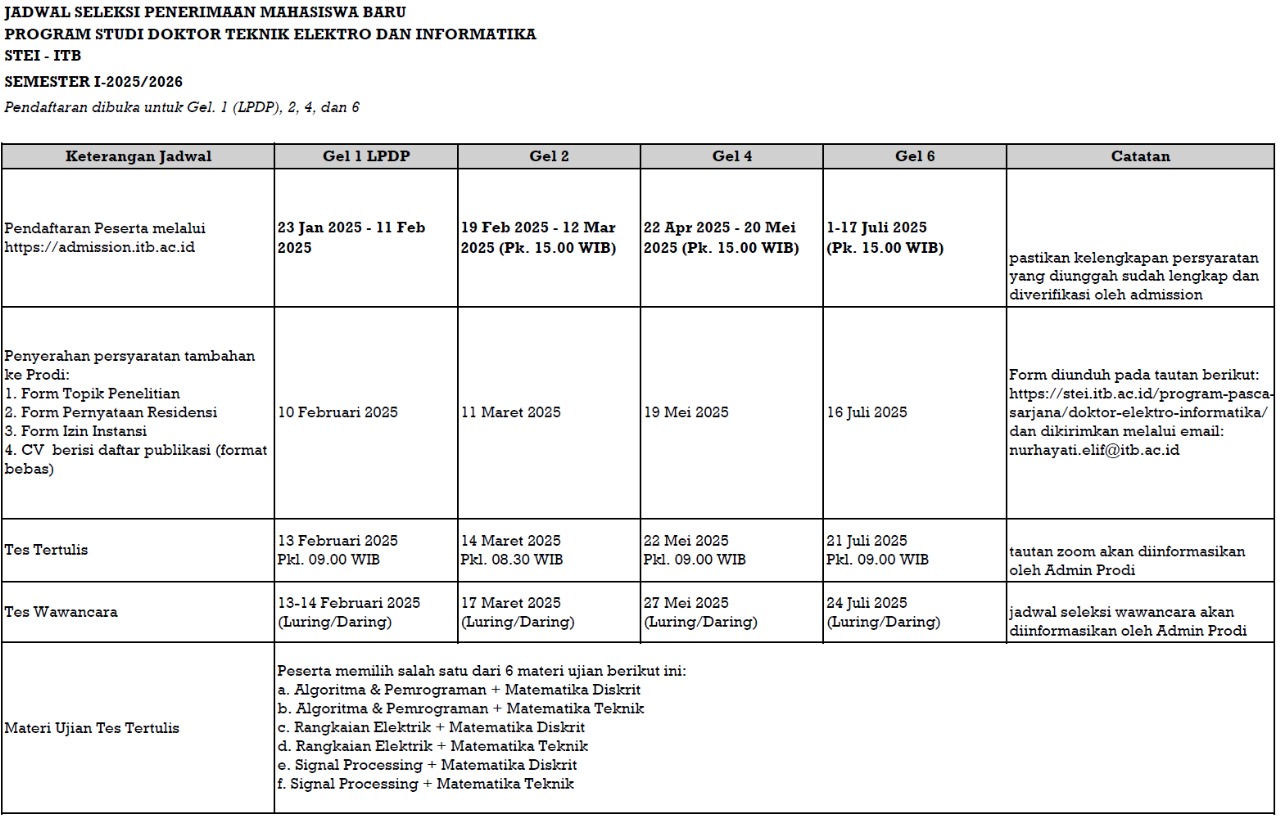 Doctoral Program Selection Schedule Semester I – 2025/2026
General Requirements:
The general requirements can be accessed via the following link: http://www.admission.itb.ac.id/
Additional requirements from STEI:
- TOEFL >=500 or ELPT ITB >= 90
- TPA ≥ 500 (Academic Potential Test score of at least 500)
Selection Schedule:
- List of Promoters
- Doctoral Selection Guidelines / Exam Scope:
- Form Kesediaan Calon Promotor S3 (untuk Seleksi S3)
Sample Questions for the Written Entrance Exam:
Doctoral Program Accreditation Decree of STEI
Document
- Guidelines for Writing the Preparation (Qualification) Exam
- Proposal Examination Writing Guidelines
- Progress Report Systematics for Doctoral Program
- Technical Guidelines for Dissertation Writing
- Dissertation Template
- Dissertation Proposal Template
- Cover and Approval Sheet Template for Qualification Examination Document
Form
- Research Topic Form (for Doctoral Program Selection)
- Institutional Permission Form (for Doctoral Program Selection)
- Residency Statement Form (for Doctoral Program Selection)
- Qualification Exam Proposal Form
- Revision Template after Qualification Exam
- Proposal Exam Proposal Form
- Revision Template after Proposal Exam
- Doctoral Defense Proposal Form
- Doctoral Progress Seminar Proposal Form
- Correction Form after Progress Seminar
- Template of Dissertation Review Revisions
- Student Guidance Form for Doctoral Students (to be submitted to the Doctoral Administration Office at the end of each semester)
- Dissertation Draft Review Proposal Form
- Form for Corrections After the Qualification Exam
- Form for Corrections After the Proposal Examination
Decrees and Academic Regulations
- Example of Author Name and ITB Affiliation Formatting in an International Journal
- ITB Rector’s Decree No. 241A of 2017 on the Publication Requirements in International Journals for Doctoral Graduation
- ITB Rector’s Decree No. 287 of 2011 on International Journal Requirements for Doctoral Program Graduation
- ITB Academic Senate Decree No. 08 of 2007 on Criteria for International Journals and Seminars
- Circular Letter on Code 5 Courses for Doctoral Program Students
- Information on Student Achievement Assessment, Study Duration, and Graduation Honors for Doctoral Program
Graduate Profile
Doctoral Graduates of Electrical Engineering and Informatics Program, April 2020
| Student Identification Number (NIM) | Name | Dissertation Poster |
|---|---|---|
| 33213023 | Fetty Fitriyanti Lubis | Metode Course Recommendation Berdasarkan User Interest Learning Pada Massive Open Online Course (MMOC) Aggregator |
| 33213024 | M Vicky Ghahi Aziz | Real-Time Simulator for Spatio-Temporal Optimal Network Traffic |
| 33214013 | Imelda Atastina | Parallel Facetnet Algorithm With Vertex Cut as A Method for Community Evolution Detection on Big Graph |
| 33215017 | Riyanto | CoM-ZMP Regulation with Gravity Compensation and Posture Control Based on Hip-Ankle Ratio Strategy in Bipedal Robots |
| 33215301 | Teguh Nurhadi Suharsono | Modeling of E-Voting Protocol to Improve Verifiability |
| 33216028 | Novianto Budi Kurniawan | Development of System Engineering Methodology for Service-Based Computing Using Service Oriented Architecture |
Doctoral Graduates of Electrical Engineering and Informatics Program, October 2019
| Student Identification Number (NIM) | Name | Dissertation Poster |
|---|---|---|
| 33213013 | Rina Mardiati | Simulation Model of Motorcycle Riders Using Markov Decision Process in Heterogeneous Traffic |
| 33214003 | Aradea | Model Requirements Engineering for Developing Self-Adaptive Systems to Handle Contextual Requirements Uncertainty |
| 33214010 | Rina Ristiana | Integrated Battery-Vehicle Modeling and Linear Quadratic Optimal PID Control Based on Partial State Feedback for Energy Saving in Electric Vehicles |
Doctoral Graduates of Electrical Engineering and Informatics Program, July 2019
Doctoral Graduates of Electrical Engineering and Informatics Program, April 2019
Webinar on Preparing PhD Research Proposals
To download the video, click here
| No | Name | Research Group / Lab | |
| 1 | Prof. Andriyan Bayu Suksmono, M.T., Ph.D. | suksmono@itb.ac.id | Telecommunication Engineering / Radio and Microwave Telecommunication Laboratory |
| 2 | Prof. Ir. Armein Z.R. Langi, M.Sc., Ph.D. | langi@itb.ac.id | Information Technology / Signal & System Laboratory |
| 3 | Prof. Dr. Ir. Bambang Riyanto Trilaksono | bambang.riyanto@itb.ac.id | Control System & Computer Research Groups |
| 4 | Prof. Ir. Emir Mauludi Husni, M.Sc., Ph.D | ehusni@itb.ac.id | Computer Engineering Research Groups |
| 5 | Prof. Dr. Ir. Jaka Sembiring | jaka@itb.ac.id | Information Technology / Signal & System Laboratory |
| 6 | Prof. Dr. Ir. Nana Rachmana Syambas, M.Eng. | nanasyambas@itb.ac.id | Telecommunication Engineering / Telematics Laboratory |
| 7 | Prof. Dr.Ing.-Ir. Suhardi, M.T. | suhardi@itb.ac.id | Information Technology / Signal & System Laboratory |
| 8 | Prof. Dr. Ir. Suhono Harso Supangkat | suhono@itb.ac.id | Information Technology / Signal & System Laboratory |
| 9 | Prof. Dr. Ir. Suwarno | suwarno@itb.ac.id | Electrical Power Engineering / High Voltage and Current Engineering Laboratory |
| 10 | Prof. Trio Adiono, S.T., M.T., Ph.D. | tadiono@itb.ac.id | Electronics Research Groups |
| 11 | Prof. Yusep Rosmansyah, S.T., M.Sc., Ph.D. | yusep@itb.ac.id | Information Technology / Signal & System Laboratory |
| 12 | Prof.Ir. Hendrawan, M.Sc., Ph.D. | hend@itb.ac.id | Telecommunication Engineering / Telematics Laboratory |
| 13 | Prof.Ir. Kridanto Surendro, M.Sc., Ph.D. | endro@itb.ac.id | Informatics / Information Systems Laboratory |
| 14 | Prof. Arif Sasongko, S.T., M.T., Ph.D. | asasongko@itb.ac.id | Electronics Research Groups |
| 15 | Prof.Dr.Ir. Y. Bandung, S.T., M.T. | yoanes.bandung@itb.ac.id | Information Technology / Signal & System Laboratory |
| 16 | Prof.Dr.Ir. Umar Khayam, S.T., M.T., IPM | umar@itb.ac.id | Power Engineering Research Groups |
| 17 | Dr. Eng. Achmad Munir | munir@itb.ac.id | Telecommunication Engineering / Radio and Microwave Telecommunication Laboratory |
| 18 | Dr. Ir. Rinaldi, M.T. | rinaldi@itb.ac.id | Informatics / Computational Science and Engineering Laboratory |
| 19 | Dr. Iskandar, S.T., M.T. | iskandar@itb.ac.id | Telecommunication Engineering / Radio and Microwave Telecommunication Laboratory |
| 20 | Dr.techn. Ary Setijadi Prihatmanto., S.T., M .T. | ary.setijadi@itb.ac.id | Computer Engineering Research Groups |
| 21 | Ir. Arief Syaichu Rohman, M.Sc., Ph.D. | arief.rohman@itb.ac.id | Control System & Computer Research Groups |
| 22 | Dr.Ir. Gusti Ayu Putri Saptawati Soekidjo, M.Comm. | putri@itb.ac.id | Knowledge & Software Engineering Research Groups |
| 23 | Dr. Tutun Juhana, S.T., M.T. | tutun@itb.ac.id | Telecommunication Engineering / Telematics Laboratory |
| 24 | Ir. Syarif Hidayat, M.T., Ph.D. | s-hidayat@itb.ac.id | Power Engineering Research Groups |
 English
  Indonesian