Irma ZakiaSTEI
STE-ITB
DwiHarinitha
STEI ITB
Abstrak
The capacity requirements of 5G systems can be met through the implementation of a user-centric cell-free massive multiple-input multiple-output (MIMO) system. This system requires the determination of access point (AP) clusters for each user. After that, pilot allocation will be performed. In the time-division duplexing (TDD) mode MIMO system, the number of pilots is much smaller than the channel coherence time. If the number of pilots does not meet the requirements, the same pilot will be used in adjacent clusters, resulting in pilot contamination. In this study, we propose a cluster formation method based on Gale Shapley and pilot allocation based on graph coloring, where each AP has a limited load. Although this method results in high overhead in terms of the number of pilots, the improvement in spatial distribution can compensate for this overhead, resulting in increased capacity in terms of spectral efficiency compared to existing schemes.
Kata kunci: pewarnaan graf, kontaminasi pilot, multiple input multiple output (MIMO), user-centric
Latar Belakang
Cell-free MIMO remains a promising technology for increasing capacity per user in 5G and beyond. This system requires the determination of access point (AP) clusters for each user. Afterward, pilot allocations will be conducted.
Pilot allocation in overlapping clusters is difficult due to the limited number of available pilots. In a massive TDD MIMO system, the number of orthogonal pilots is much smaller than the channel coherence time. For APs with a maximum load limit, a shortage of pilots will prevent the AP from being fully loaded, thus preventing pilot contamination. The impact is lower spectral efficiency due to reduced spatial diversity. Therefore, appropriate clustering and pilot allocation techniques using a flexible number of orthogonal pilots are necessary.
To the author's knowledge, no existing technique accommodates a flexible pilot count in cell-free massive MIMO systems. This demonstrates the novelty of our research. Furthermore, we demonstrate that orthogonal pilot counts from graph coloring results are an appropriate technique for improving the spectral efficiency of each user in existing schemes that are not based on graph coloring.
Metode
The system model consists of L APs, each of which has N antennas, while there are K users with single antennas distributed uniformly in an area. There are T2 orthogonal pilots with the assumption of <K. Each user will choose one of the 7 pilots, so that there will be users with the same pilot. The user will send a pilot signal to the AP. The AP will then use the pilot signal to estimate the channel for each user. The channel estimation used is the minimum mean square error (MMSE).
After the pilot signal transmission phase is complete, the user will send data symbols to the AP. Using the previous channel estimation results, the AP will calculate a combiner vector to ensure the signals arriving at each antenna are in phase. The chosen combiner vector is local partial MMSE (LP-MMSE) due to its low complexity. After this, the AP will perform symbol detection, thus calculating the spectral efficiency of each user.
To achieve high spectral efficiency, clustering and pilot allocation techniques must be appropriate. In this study, we propose clustering based on Gale-Shapley and pilot allocation based on graph coloring.
In Gale-Shapley clustering, the user measures the large-scale fading value of each AP and generates a preference list. This is what each AP does. The user will nominate the AP at the top of its preference list for connection. Meanwhile, the AP will maintain the user's connectivity request as long as it does not exceed its maximum load. If the user's request is rejected, the user will nominate the AP at number two on its preference list. This process ultimately forms an AP cluster for each UE.
After forming the clusters, the next step is to allocate pilots to each user. In a graph, each user is a node, and users whose clusters overlap with other clusters are connected with lines. Neighboring nodes are assigned different colors to prevent contamination by bad pilots.
Graph coloring will result in the lowest number of colors. The algorithm begins by calculating the degree of each vertex. Then, the vertex with the highest degree is assigned the first color. Next, the saturation degrees of neighboring vertices are recalculated, indicating the number of unique colors connected to that neighboring vertex. The next vertex assigned is determined by the highest saturation degree. The coloring process continues until all users have received pilots.
Discussion and Results

As shown in Fig. 1, as more users are on the network, increasing AP load becomes important to improve spectral efficiency. For example, when the number of users is K = 150, there is a spectral efficiency increase of more than 16% by increasing AP load from 10 to 15. However, this does not occur when AP densification is performed. When there are more APs (K = 50), because the number of orthogonal pilots available, compared to users (shown in the curve with AP load determination becomes more important for spectral efficiency. If the AP load is too low (when the load is 5), there is a decrease in spatial diversity, while if the AP load is too high (when the load is 15), there will be a high pilot overhead, both of which decrease spectral efficiency.
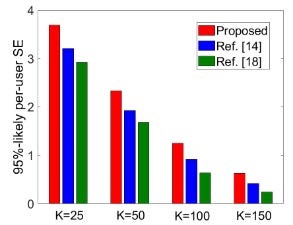
The improvement in speltral efficiency compared to existing techniques (Ref. [14] and [18] is shown in Fig. 2, which confirms the effectiveness of our proposed technique.
Kesimpulan
The output of this research promises a Q2 journal with submitted status. The author has submitted to the Q1 IEEE Access journal with the paper title "Cell-free Massive MIMO under AP Load Constraint and Flexible Pilot Resources".
Acknowledgement
This research was funded by ITB under the 2024 PPMI Program.