Dr. Fetty Fitriyanti Lubis, S.T., M.T.
STE-ITB
Abstract
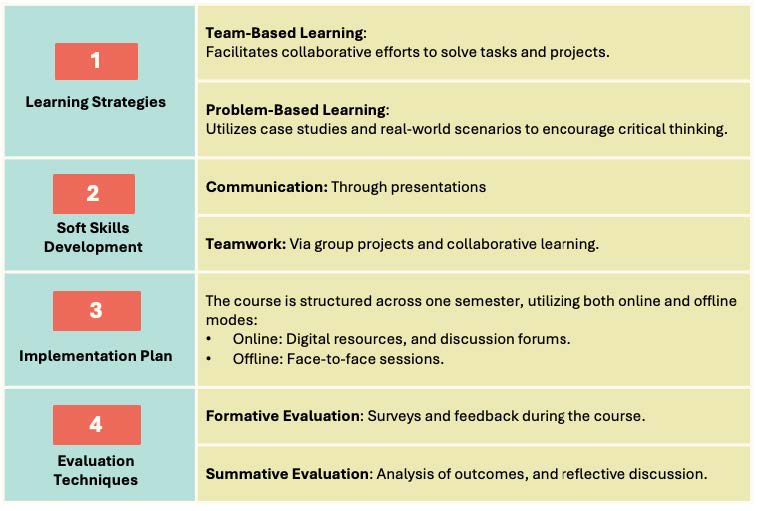
The shift from a teacher-centered approach to a student-centered learning model should be executed to improve student engagement in the Information Technology Operational Management Service course. Nevertheless, SCL alone is insufficient. Currently, students must acquire soft skills to progress in their employment. Separating soft skills training from theoretical education undermines the efficacy of the learning process; therefore, it is essential to integrate both components. The integration of Student-Centered Learning (SCL) and soft skills is essential to improve the learning experience for postgraduate students. This study proposed instructional content to develop analytical problem-solving and collaborative skills in the Information Technology Operational Management Service course. Student-Centered Learning approaches, including Team-Based Learning and Problem-Based Learning, are employed in conjunction with soft skills to establish a holistic educational framework. Evaluations, both formative and summative, demonstrate the efficacy of these strategies.
Keyword: Student-Centered Learning, Soft Skills, postgraduate student, Problem Solving.
Introduction
Enhancing Course Design is essential in today’s educational landscape. Especially for graduate education in the course of Information Technology Operational Management Service requires an engaging methodology that harmonizes theoretical understanding with actual implementation. Because many students still lack the sofskills that needed in their professional live.
SCL emphasizes the role of learners in their own education. By focusing on their needs, interests, and learning styles, educators can create a more engaging and effective learning experience that promotes critical thinking and problem-solving skills. Moreover, SCL offers a dynamic setting in which theoretical concepts are implemented in practical situations. The incorporation of soft skills, including communication, teamwork, and leadership, equips students to effectively navigate hurdles in their professional lives.
Soft skills such as communication, teamwork, and adaptability are crucial in the course of Information Technology Operational Management Service. Integrating these skills into course design prepares students for real-world challenges and enhances their employability in a competitive job market.
To effectively integrate student-centered learning and soft skills, this research employed strategies such as problem based learning, peer assessments, and team-based learning. These methods encourage active participation and practical application of skills in realistic scenarios.
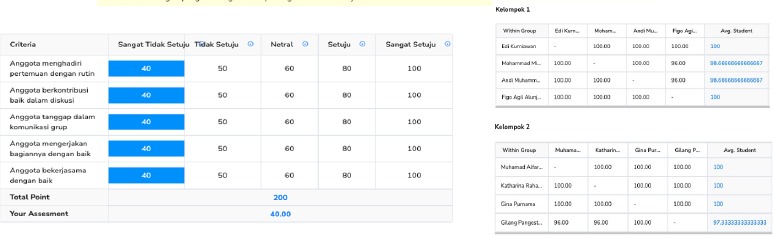
Assessing student progress in a student-centered environment requires innovative approaches. This research utilized the formative assessment, self-reflections, and peer feedback that can provide valuable insights into student learning and the development of soft skills.
Research Method
Company X’fl., an information technology company, faced challenges in improving the efficiency of its support services. To address this, the company decided to implement a more robust performance measurement system. They focused on three key metrics: Time to Resolve (TTR), First Call Resolution (FCR), and Availability.
After six months of implementing the new measurement system, the company collected the following data: Average TTR decreased from 4 hours to 3 hours. FCR percentage increased from 65% to 75%. System availability increased from 95% to 98%.
Case Study Questions:
1. Analisis Konteks:
How can performance measurement, specifically the TTR, FCR, and Availability metrics, help Company X’fZ address
tantangan efisiensi layanannya?
2. Evaluasi Pendekatan Pengukuran.:
Why the selection of TTR, FCR, and Availability metrics is relevant to the challenges faced by Company XYD
How can the implementation of this performance measurement affect operational and strategic decisions in the company?
3. lnterpretasi Data:
Based on the data provided, analyze the improvement or change in TTR, FCR, and Availability.
What are the implications of this change for ITT's service quality?
4. Conclusion and Recommendations:
Based on the results obtained, what conclusions can be drawn regarding the effectiveness of the implemented performance measurement system?
What are your recommendations for the next steps for Company ~z to continue improving the performance of its Tl services?
5. Refleksi Organisasi:
If you were the IT manager at Company X’fZ, what steps would you take to ensure that performance measurements continue to provide valuable insights for continuous improvement?
Discussion & Result
Preliminary findings indicate that the integration of SCL and soft skills fosters deeper engagement and application of knowledge. Students demonstrate improved critical thinking, and collaboration.
The approach also encourages active participation and enhances satisfaction with the learning process. Key results include:
- Increased student satisfaction (as indicated by feedback).
- Enhanced problem-solving and analytical skills (based on evaluations).
- Growth in soft skills (measured through peer and educator assessments).
Conclusion
Integrating SCL and soft skills into graduate courses significantly enhances the learning experience. By emphasizing practical applications and professional competencies, students are better prepared to tackle challenges in the course of Information Technology Operational Management Service. Future work will focus on refining these methods based on longitudinal data and extending their applicability to other courses.