Ir. Robithoh Annur, S.T., M.Eng., Ph.D.
School of Electrical Engineering and Informatics
Abstract
The Computer Networks course provides an understanding of computer network concepts with layers, topologies, protocols & standards, IPv4 / IPv6 addressing, Routing and the Latest Network Standards. In the Student Centered Learning (SCL) learning plan, students will learn through several tutorials, practicums, and independent assignments. In addition to lecture material, tutorials include material on the use of a network simulator called Packet Tracer that can be used by students to model networks and configure devices in the network.
Keyword: Jaringan Komputer, Packet Tracer , SCL
Introduction
In the Association for Computing Machinery (ACM) curriculum recommendations, Computer Networking and Communication is one of the knowledge elements required for graduates of computing-based undergraduate programs. In undergraduate Informatics programs, the available teaching materials for computer networking need to be updated in terms of content. Furthermore, modifications or updates to teaching methods and assessment methods to test student abilities are also needed.
The learning outcomes of this course are as follows:
- memahami struktur berlapis tipikal arsitektur jaringan komputer
- memahami prinsip-prinsip dasar lapisan akses menengah
- understand the principles of switched networks and reliable message delivery
- understanding the principles of routing and forwarding packets in IP networks can configure LAN and IP networks.
- can implement simple client-server networks/applications.
To achieve the established learning outcomes, the SCL format will include independent assignments and practical work that emphasizes familiarity with and mastery of the Packet Tracer tool. This is intended to enable students to perform real-world network configurations.
Research Method
For the SCL design in the Computer Networks course, the learning process will be carried out in several activities, namely:
a) Asynchronous meetings are held by providing tutorials and pre-practical materials.
b) Synchronous meetings containing explanations, discussions, interactions and discussion of material.
In asynchronous meetings, tutorial materials will be provided to students along with related assignments that must be submitted. This is then followed up with synchronous meetings in the form of practicums. During the practicum, the course assistant only provides practicum guidance, after which students are expected to complete the practicum assignments independently. In addition to practicums, synchronous meetings in the form of in-class lectures are held offline in two meetings each week. The first meeting, lasting 2 hours, will be filled with material discussion, and the second meeting, lasting 1 hour, will be filled with discussion and questions and answers related to the material or independent assignments. Assessment Plan:
a) Independent assignment and practical work scores, with a total maximum final score of 30%.
b) UTS, with a maximum final score of 35%.
c) UAS, with a maximum final score of 35%.
The materials that will be provided include: Topic 1: Introduction to Networks
Topik 2: Layered Model of Networks
Topik 3: Application Layer
Topik 4: Transport Layer
Topik 5: Network Layer
Topik 6: Data Link Layer
Topik 7: Network Security
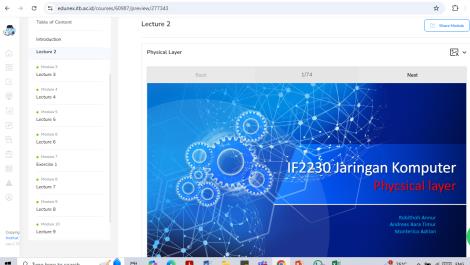
All of these topics are provided with teaching materials in the form of slides available on the Edunex platform, as seen in Figure 1.
Discussion & Result
During the implementation phase of developing these learning materials, several things changed to reflect the curriculum changes at ITB. While the main content has been successfully achieved, there has been the addition of enrichment material for the topic of Software Defined Networks. As planned and also the results of discussions with the course assistant, the implementation of this course needs to be supported by practicums. Therefore, the learning content is more focused on project-based learning. Therefore, the preparation of teaching materials is prioritized and more emphasis is placed on the creation of exercise modules and practicum modules, which are expected to develop students' strong hands-on skills. Furthermore, the teaching materials for synchronous lecture meetings have been significantly revised to reflect technological developments in networking. Examples of significant changes include the wireless network material, which was previously only included in several basic materials, now it is a separate topic, so it is expected that students will have a better understanding. For practicum materials, several new materials such as network address translation and IPv6 are introduced, enabling students to understand the addressing mechanisms on internet networks.
Outcome
The implementation of learning content development for the Computer Networks course required changes from the initial plan in terms of content to be created. However, this did not affect the objectives and targets of the activity. With more practice modules provided, students are better trained in configuring network devices. Going forward, additional practical materials for several topics are needed to more easily achieve the course's learning outcomes.